


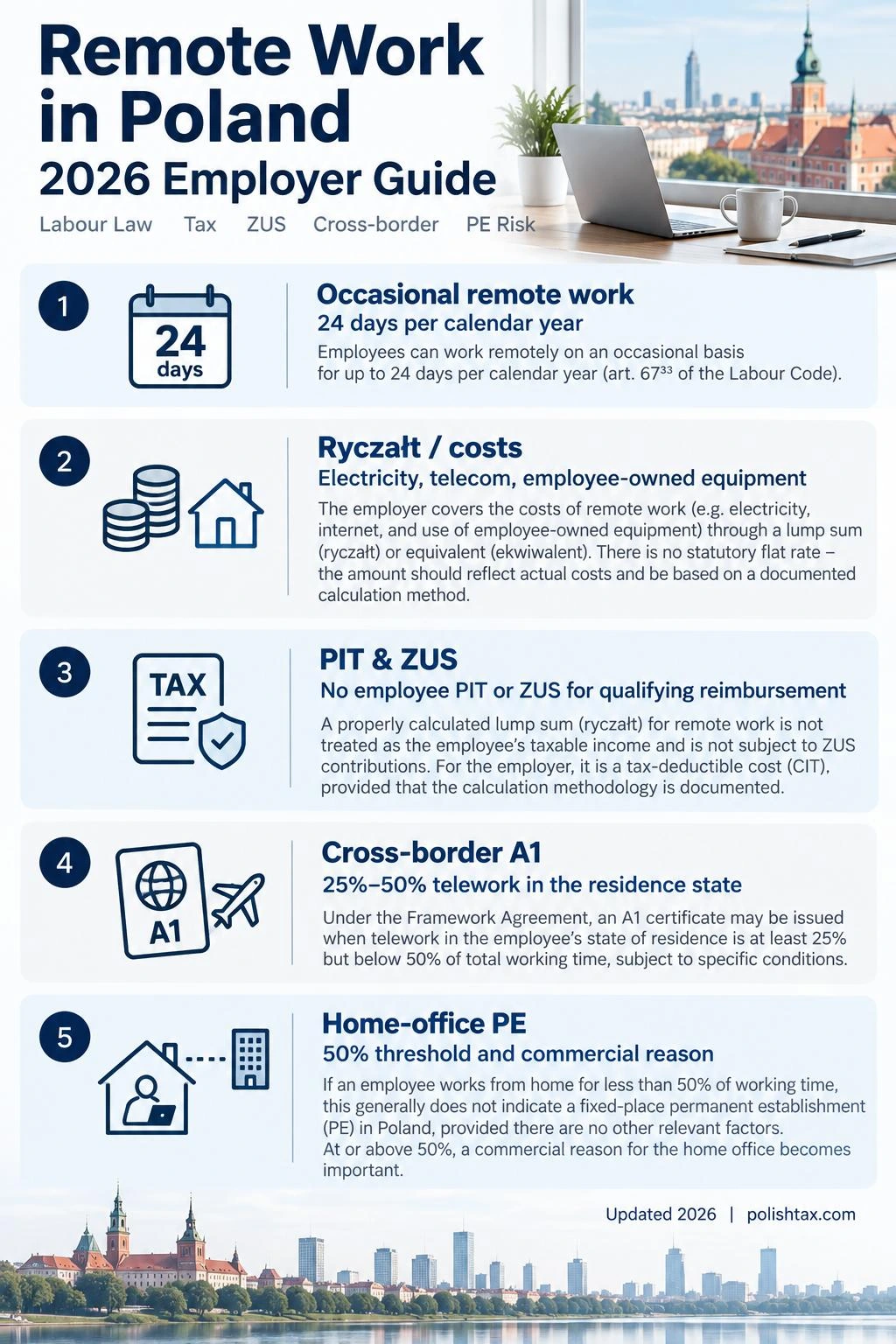
Remote work in Poland is regulated directly by the Labour Code. Employers must define the rules of regular remote work, provide equipment or reimburse qualifying costs, address health and safety and data security, and calculate any lump sum (ryczałt) using a reasonable cost methodology. Occasional remote work is available at the employee’s request for up to 24 days per calendar year and does not trigger the same cost-reimbursement duties. Cross-border remote work additionally requires a separate review of payroll, tax residence, social security/A1 and permanent-establishment exposure.
Key takeaways
-
Polish Labour Code remote-work rules have applied since 7 April 2023 and remain the core framework in 2026.
-
Regular remote work can be full-time or hybrid. It should be based on a collective agreement, remote-work regulations, an employer instruction in statutory cases, or an individual arrangement.
-
Employers generally bear specified remote-work costs. A lump sum may replace direct reimbursement if it reasonably corresponds to expected employee costs.
-
Remote-work cost reimbursement, an equivalent and a properly calculated lump sum do not constitute employee PIT income under Article 67(25) of the Labour Code; social-security treatment should follow the same employment-law qualification, provided the payment is genuinely compensatory.
-
Cross-border work can change the social-security system, payroll obligations and PE risk. Since the OECD 2025 update, the 50% working-time threshold is an important factual marker in home-office PE analysis, but it is not a standalone safe harbour.
Remote Work in Poland at a Glance (2026)
|
Topic |
Rule |
Legal / practical basis |
|
Definition |
Work performed wholly or partly at a place indicated by the employee and agreed with the employer. |
Labour Code Art. 67(18) |
|
Main forms |
Regular full remote work, hybrid work, employer-ordered remote work in statutory situations, plus occasional remote work. |
Labour Code Arts. 67(19)-67(33) |
|
Occasional remote work |
Up to 24 days per calendar year, at the employee’s request. |
Labour Code Art. 67(33) |
|
Cost duties |
Equipment, installation/service where applicable, electricity and telecommunication costs; own equipment may be compensated by an equivalent. |
Labour Code Art. 67(24) |
|
PIT treatment |
Qualifying reimbursement, equivalent or lump sum is not employee income. |
Labour Code Art. 67(25) |
|
Cross-border A1 |
Framework Agreement may keep social security in the employer state where telework in the residence state is at least 25% but below 50%, if all conditions are met. |
EU coordination + Framework Agreement |
|
Home-office PE |
Below 50% home working normally points away from a fixed-place PE absent other facts; at or above 50%, commercial reason becomes central. |
OECD 2025 Commentary update |
|
PIP reform |
Since 8 July 2026 PIP has stronger tools to challenge civil/B2B arrangements that in substance meet employment criteria. |
PIP reform 2026 |
Legal Framework: What the Polish Labour Code Says
The Polish rules on remote work are contained in Articles 67(18)-67(34) of the Labour Code. They replaced the former telework regime. Remote work may be performed wholly or partly away from the employer’s premises at a location indicated by the employee and agreed with the employer, including the employee’s home. The agreement on location matters: an employee does not have a general right to work from any country or any address without the employer’s approval.
The agreed remote-work location should also be reflected consistently in the employment documentation; see our guide to an employment contract in Poland.
Three Forms of Remote Work
|
Form |
How it starts |
Typical use |
Cost rules |
|
Regular remote / hybrid work |
Agreed at hiring or during employment; rules usually set in collective agreement or regulations. |
Ongoing home office or hybrid model. |
Full statutory cost/equipment rules apply. |
|
Employer-ordered remote work |
Employer instruction in statutory emergency/force-majeure circumstances, subject to employee declaration that conditions allow remote work. |
Temporary disruption, emergency or inability to ensure safe workplace conditions. |
Statutory duties generally continue. |
|
Occasional remote work |
Employee request. |
Short, ad hoc home-office days. |
Special simplified regime; employer has no statutory duty to reimburse remote-work costs. |
How to Introduce Remote Work in a Polish Company
The implementation route depends on the employer’s workforce structure and whether remote work is regular or exceptional. In practice, employers should treat remote work as a documented compliance process rather than a purely informal benefit.
-
If trade unions operate at the employer, conclude a remote-work agreement with the company trade union organisation(s), subject to the statutory consultation route.
-
If there are no trade unions, adopt remote-work regulations after consultation with employee representatives selected under the employer’s accepted procedure.
-
If no collective agreement or regulations are in place, remote work can still be arranged through an individual agreement or, in the statutory cases, an employer instruction.
-
Obtain the employee’s statement that the agreed workplace provides safe and hygienic conditions.
-
Keep the remote-work rules, risk assessment, data-security procedures and cost methodology consistent with payroll practice.
These arrangements should fit the company’s wider approach to payroll and employment in Poland, so that remote-work policies and payroll records remain consistent.
What should remote-work regulations cover?
-
Eligible employee groups
-
Cost reimbursement and lump-sum methodology
-
Communication and attendance confirmation
-
Work-performance controls
-
Health and safety controls
-
Data-protection and information-security controls
-
Installation, maintenance and servicing of equipment
-
Procedure for changing or withdrawing remote-work arrangements
Where remote work was agreed during employment, either party may generally request a return to the previous working conditions. The Labour Code provides a procedure for agreeing the date of return, with a statutory fallback period if the parties do not agree. Special protection applies to categories of employees whose remote-work request benefits from enhanced statutory protection.
Who Has the Right to Request Remote Work?
Any employee may request remote work, but certain protected groups receive stronger statutory treatment. These include, among others, pregnant employees, employees raising a child below the statutory age threshold and employees caring for certain persons with disabilities or special care needs. For protected requests, the employer should accept remote work unless it is impossible because of the organisation of work or the type of work performed. A refusal must be communicated with reasons within the statutory deadline.
The right is not absolute. Remote work cannot be used for work that, by law or by its nature, requires special exposure controls, creates excessive contamination, involves dangerous chemical or biological agents, or otherwise cannot safely be performed at home.
Employer Obligations: Equipment, Costs, Health & Safety, Data
-
Provide the materials and work tools, including technical equipment, necessary for remote work unless the parties agree that the employee will use their own compliant tools.
-
Cover installation, servicing, operation and maintenance costs of employer-provided tools where required by the Labour Code arrangement.
-
Cover electricity and telecommunication costs directly connected with remote work, or replace this reimbursement with a properly calculated lump sum.
-
Pay an equivalent where the employee uses their own materials or tools under an agreed arrangement.
-
Prepare an occupational risk assessment and remote-work health and safety information, taking into account ergonomic and psychosocial factors.
-
Define data-protection procedures and provide any necessary training or instructions.
-
Define proportionate rules for employer controls at the remote-work location while respecting privacy and household members.
When budgeting for a remote employee, include equipment and recurring remote-work costs in the total cost of hiring an employee in Poland.
These Labour Code duties apply to employees. A contractor operating under a civil contract or B2B agreement is not automatically covered by the remote-work chapter of the Labour Code. However, after the 2026 PIP reform, businesses should be particularly careful where a purported contractor works under conditions typical of employment.
Remote Work Allowance: Lump Sum (Ryczałt) vs Equivalent (Ekwiwalent)
For many employers, the remote-work allowance is the most practical part of the 2026 compliance framework. Polish law does not set a statutory monthly minimum or a universal market rate. Instead, the amount must be linked to the expected or actual costs connected with remote work. A flat amount that bears no reasonable relationship to costs increases payroll and tax risk.
Equivalent vs lump sum – what is the difference?
|
Criterion |
Equivalent (ekwiwalent) |
Lump sum (ryczałt) |
|
Purpose |
Compensates use of employee-owned materials/tools or other agreed qualifying items. |
Replaces reimbursement of expected recurring remote-work costs. |
|
Calculation |
Usually linked more directly to the actual value/use of employee assets. |
Based on a documented estimate of expected costs. |
|
Administration |
Can require more individual calculations. |
Simpler for recurring payroll if methodology is sound. |
|
Tax treatment |
Qualifying payment does not constitute employee PIT income. |
Qualifying payment does not constitute employee PIT income. |
|
Key risk |
Amount does not reflect actual use/value. |
Amount is arbitrary or disguised remuneration. |
How to calculate the lump sum in 2026
Article 67(24) requires the employer to take into account, in particular, usage norms for materials and tools, documented market prices, the quantity of materials used for the employer, electricity-consumption norms and telecommunication costs. This makes the methodology more important than the headline amount.
|
Cost item |
Assumption |
Monthly calculation |
Illustrative amount |
|
Electricity |
Laptop + monitor average 0.12 kWh/hour; 8 h/day; 10 remote days; PLN 1.20/kWh |
0.12 × 8 × 10 × 1.20 |
PLN 11.52 |
|
Internet |
Monthly bill PLN 80; estimated 25% business-use allocation |
80 × 25% |
PLN 20.00 |
|
Employee-owned equipment |
Illustrative economic-use allowance based on documented purchase price/useful life |
Employer methodology |
PLN 18.00 |
|
Total illustrative lump sum |
PLN 49.52 |
Example only: This is not a statutory rate. Employers should use their own electricity prices, remote-work days, equipment profile, internet allocation and documentation. A defensible method should be written down and applied consistently.
PIT, ZUS and CIT treatment
For the employee, the Labour Code expressly states that the employer’s provision of necessary tools/materials, reimbursement of remote-work costs, an equivalent and a qualifying lump sum do not constitute income for PIT purposes. The practical payroll position should therefore follow the compensatory nature of the payment. If the payment materially exceeds a reasonable cost estimate or functions as a general salary supplement, the risk of reclassification increases.
For social-security purposes, a genuine reimbursement/equivalent/lump sum linked to statutory remote-work costs should not be treated as remuneration merely because it is paid through payroll. Employers should retain the underlying calculation and policy so that the payment can be distinguished from a cash benefit unrelated to actual remote-work costs.
For the employer, the expenditure may generally be deductible where it is incurred to earn, secure or preserve taxable revenue and is properly documented. The precise timing of the deduction depends on the nature of the payment and the applicable CIT rules. Employers should avoid automatically treating every remote-work payment as employee remuneration for timing purposes without first identifying its legal character.
For a broader discussion of employer-provided benefits and their tax treatment, see our guide to tax-deductible employee benefits in Poland.
Hybrid work and absence days
A monthly lump sum can be designed around expected remote-work days, but the policy should explain how holidays, sickness, business travel and other absences affect the amount. A proportional approach usually gives the strongest connection between the lump sum and expected cost. Employers may use a standard monthly estimate with a defined adjustment mechanism rather than recalculating every electricity unit each month.
Occasional Remote Work (24 Days per Year)
Occasional remote work (praca zdalna okazjonalna) is a separate statutory route requested by the employee. The annual limit is 24 days per calendar year. It is designed for ad hoc personal needs rather than a recurring hybrid schedule. The employer is not subject to the regular statutory duties to provide equipment or reimburse electricity and telecommunication costs for those occasional days. The annual statutory limit cannot be increased simply by internal policy and still retain the special occasional-work classification.
Cross-Border Remote Work: Tax and Social Security
Cross-border remote work should never be approved solely as an HR matter. A few days abroad can raise immigration, payroll, tax residence, employer-registration, social-security and corporate tax questions. The right analysis depends on the employee’s residence, nationality, work pattern, countries involved, employer location and duration.
A useful starting point is to establish the employee’s Polish tax residency before assessing the consequences of working across borders.
Polish employee working remotely from another EU country (workation)
For EU/EEA/Swiss social-security coordination, the general “substantial activity” rule may move coverage to the state of residence where a substantial part of employment is performed there. The Framework Agreement on habitual cross-border telework provides a special exception: where the employee performs telework in the state of residence for at least 25% but less than 50% of total working time, and the required conditions are met, the parties may request coverage in the employer’s state. An A1 certificate is the practical evidence of the applicable legislation. The arrangement is not automatic and does not cover every multi-state pattern.
For additional context on social-security documentation, see our comparison of posting workers and local hiring, including A1 certificates.
Income tax must be analysed separately. The familiar 183-day concept is relevant but is not a universal exemption by itself; the applicable double tax treaty, employer/recharge position, tax residence and place where employment is exercised all matter.
Foreign company with an employee working from home in Poland
A foreign employer with a home-based employee in Poland may face Polish payroll/PIT obligations, Polish social-security registration and corporate tax PE risk. The outcome depends on the employer’s existing Polish presence, the employee’s role, authority, customer contact, working pattern and treaty position. Our guide for a foreign employer without a permanent establishment in Poland explains the related employer-registration and payroll considerations.
The OECD 2025 update to the Commentary on Article 5 gives new practical guidance for home-office PE. Where an individual works from the home in the other state for less than 50% of working time over a relevant 12-month period, the home would generally not be treated as a place of business of the enterprise absent other facts pointing the other way. Where home working reaches at least 50%, the analysis focuses more heavily on whether there is a commercial reason for the employee’s presence in that state and on all surrounding facts. The 50% figure is therefore a factual threshold in the commentary, not a mechanical statutory safe harbour in Polish domestic law.
This home-office assessment forms part of the wider analysis of a permanent establishment in Poland. Where the employee acts on behalf of the foreign business, the distinction between a dependent and independent agent may also be relevant.
Non-EU nationals
For non-EU nationals, remote work also requires an immigration and work-authorisation check. A residence title issued by one country does not automatically permit employment activity from another country.
Employers should review the employee’s right to stay and work before approving a workation or permanent move, including the requirements governing the legal stay and employment of foreigners in Poland.
Remote Employees vs B2B Contractors After the 2026 PIP Reform
From 8 July 2026, the State Labour Inspectorate (PIP) has stronger tools to challenge civil-law and B2B arrangements that in substance meet the characteristics of an employment relationship. The reform does not make B2B contracting unlawful. It increases the importance of how the relationship actually operates in practice.
-
fixed working hours and employer-controlled availability
-
work performed personally without genuine substitution
-
detailed managerial direction and ongoing subordination
-
work carried out at a place or in a manner determined by the company
-
lack of genuine entrepreneurial risk
-
integration into the employer’s organisation similar to employees
Remote work can make the distinction harder, not easier. A contractor may work from home and still be genuinely independent, but a “remote B2B” arrangement with employee-like subordination can now attract stronger PIP scrutiny. Since 8 July 2026 PIP may use a two-stage procedure, including an instruction and, where the statutory conditions are met, an administrative decision determining an employment relationship. The reform also increased certain Labour Code fine ranges.
Businesses using independent contractors should also review the tax and administrative aspects of B2B contracts in Poland alongside the employment-status assessment.
What Changed in 2026 for Remote Work?
-
The core Labour Code rules on remote work did not receive a fundamental redesign; the 2023 framework remains the baseline.
-
From 8 July 2026, PIP gained stronger enforcement tools in relation to civil-law/B2B arrangements used where employment conditions actually exist.
-
The 2025 OECD Model Commentary update is now highly relevant to 2026 cross-border home-office PE reviews, especially the new practical guidance around the 50% threshold and commercial reason.
-
Electronic HR documentation and remote processes continue to expand, making consistency between policy, payroll records and actual practice increasingly important.
Remote Work Compliance Checklist for Employers
-
Identify whether the arrangement is regular remote work, hybrid work, employer-ordered remote work or occasional remote work.
-
Adopt the correct agreement/regulations and employee communications.
-
Complete the remote-work risk assessment and H&S information.
-
Obtain required employee statements on safe working conditions.
-
Document equipment rules, service responsibilities and data-security procedures.
-
Create a written lump-sum/equivalent methodology using electricity, telecom and equipment assumptions that can be evidenced.
-
Define how absence days affect the lump sum and align this with payroll.
-
For work abroad, check immigration, A1/social security, payroll and tax residence before approval.
-
For a foreign employer with a Polish home worker, complete a PE and Polish employer-registration review.
-
Review remote B2B arrangements under the post-8 July 2026 PIP enforcement framework.
FAQ
Is remote work legal in Poland and what law regulates it?
Yes. Remote work is expressly regulated by Articles 67(18)-67(34) of the Polish Labour Code. The rules have applied since 7 April 2023 and cover regular full remote work, hybrid work, employer-ordered remote work in specified situations and occasional remote work.
Do employers in Poland have to pay a remote work allowance?
For regular remote work, employers generally must cover specified work-related costs, including electricity and telecommunication costs. They may reimburse actual costs or use a lump sum corresponding to expected costs. Occasional remote work has a simplified regime without the same statutory reimbursement duty.
How much is the remote work lump sum (ryczałt) in Poland in 2026?
There is no statutory flat amount for 2026. The lump sum should reasonably reflect expected costs. A defensible calculation can include electricity consumption, an allocated part of internet costs and, where relevant, the economic use of employee-owned equipment.
Is the remote work allowance taxable or subject to ZUS?
A qualifying reimbursement, equivalent or lump sum under the Labour Code does not constitute employee PIT income. For ZUS, employers should ensure the payment remains genuinely compensatory and is supported by a reasonable methodology rather than operating as disguised remuneration.
Can an employer refuse a remote work request in Poland?
Yes, depending on the type of request. Certain protected employees benefit from stronger statutory rights, but an employer may still refuse where remote work is impossible because of the organisation or type of work. The refusal should be reasoned and communicated within the statutory deadline.
How many days of occasional remote work are allowed in Poland?
Up to 24 days per calendar year. Occasional remote work is requested by the employee and is intended for ad hoc situations. It is separate from a recurring hybrid arrangement and carries a simplified set of employer obligations.
Can I work remotely from Poland for a foreign company?
Yes, but the foreign employer and employee should review Polish payroll, PIT, ZUS, registration and permanent-establishment issues. The tax and social-security result depends on residence, work pattern, treaty rules, the employer’s presence in Poland and the employee’s business role.
Can a Polish employee work remotely from another EU country?
Potentially yes, with employer approval. The employer should first review local labour/immigration rules, tax residence and social security. For habitual cross-border telework within the EU framework, an A1 may preserve coverage in the employer state in specified 25% to below-50% situations.
Does an employee working from home in Poland create a permanent establishment?
Not automatically. Under the OECD 2025 Commentary update, home working below 50% of working time generally points away from a home-office fixed-place PE absent other facts. At or above 50%, the commercial reason for the employee’s presence and the overall facts become particularly important.
How Intertax Can Help
Remote work combines employment law, payroll, social security and tax. Intertax’s Payroll Services can support remote-work payroll implementation and lump-sum calculations, while its Human Resources services support employment documentation and HR processes. Intertax also assists with cross-border A1 and payroll reviews, and permanent-establishment risk analysis for foreign employers with employees working from Poland.