


Executive Summary
Hiring employees in Poland requires compliant contracts, proper onboarding and ongoing payroll, tax and social security administration. This guide outlines contract types, employer obligations and costs, highlighting key risks for foreign businesses, including worker misclassification and hiring without a Polish entity.
What Is an Employment Contract in Poland?
An employment contract in Poland, known as umowa o prace, creates an employment relationship governed by the Polish Labour Code. The employee performs work for the employer, under the employer’s direction, at the place and time indicated by the employer, in exchange for remuneration. This is different from civil-law contracts and B2B cooperation because it gives the worker statutory employee rights, including paid leave, notice protection and mandatory social insurance.
For employers, the key point is practical rather than linguistic: the name of the agreement is not decisive. If the real working arrangement has the features of employment, a civil-law contract or B2B agreement may be challenged and reclassified by the State Labour Inspection or a court. The Labour Code also requires written employment terms no later than the employee’s admission to work.
Types of Employment Contracts in Poland
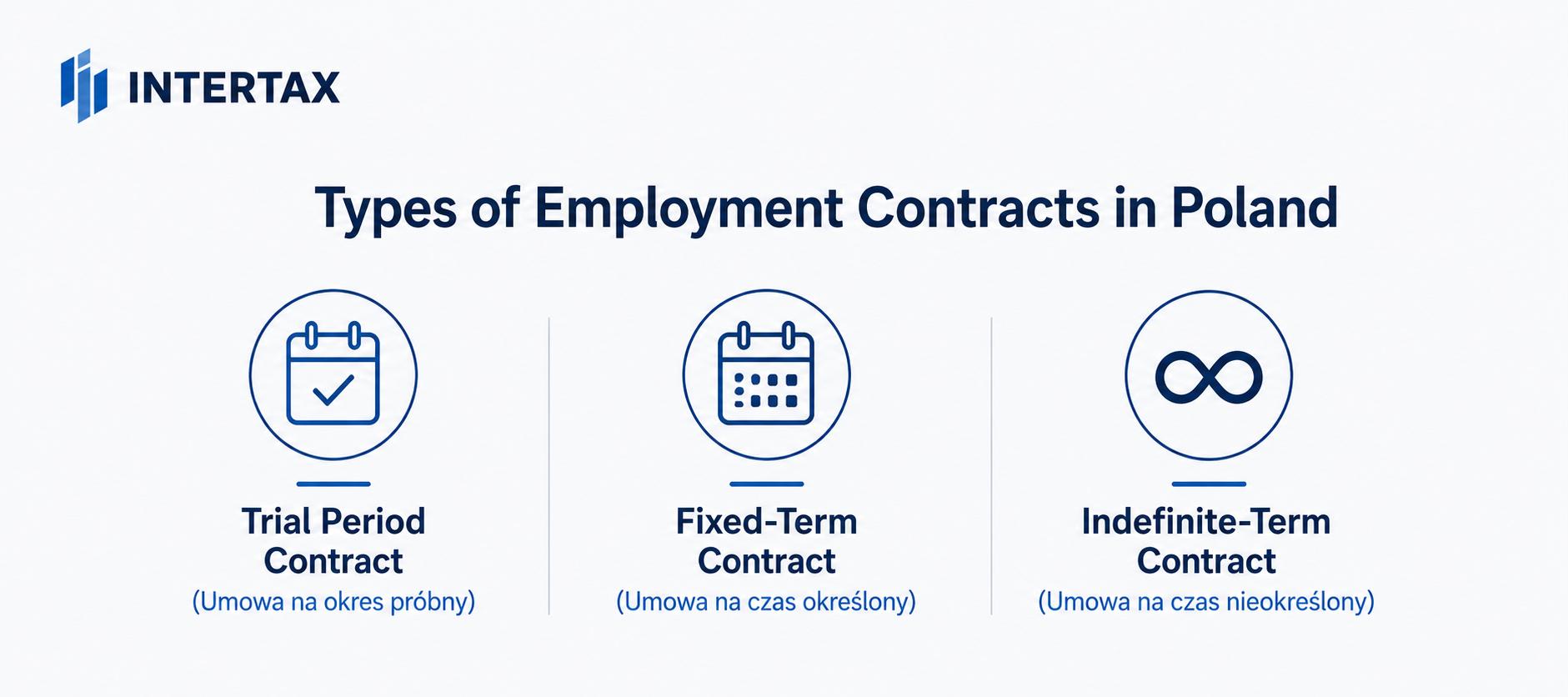
The Labour Code recognizes three main types of employment contracts: a trial period contract, a fixed-term contract and an indefinite-term contract. Choosing the right form matters because each type has its own limits, termination rules and compliance risks.
Trial Period Contract (Umowa na okres probny)
A trial period contract is used to check the employee’s qualifications and suitability for a specific type of work. Since the 2023 Labour Code changes, the maximum trial period depends on the intended length of later employment:
-
up to 1 month if the employer intends to offer a fixed-term contract shorter than 6 months;
-
up to 2 months if the employer intends to offer a fixed-term contract of at least 6 months but shorter than 12 months;
-
up to 3 months if the intended later contract is at least 12 months or indefinite.
The parties may agree in the trial period contract that it will be extended by holiday leave or another justified absence, if such absence occurs. The one-off extension by no more than one month applies only to the 1-month and 2-month trial periods used before intended fixed-term employment shorter than 6 months or from 6 to under 12 months, and only where justified by the type of work. A new trial period contract with the same employee is allowed only if the employee is to perform a different type of work.
Fixed-Term Contract (Umowa na czas okreslony)
A fixed-term contract is common where the employer has a time-limited business need. The standard Labour Code limit is 33 months and no more than three fixed-term contracts between the same employer and employee. If the limit is exceeded, the employment relationship converts into an indefinite-term contract by operation of law.
The statutory limits do not apply in four main cases: replacement of an absent employee, casual or seasonal work, work for a term of office, or objective reasons on the employer’s side. The last exception requires particular care: the employer must be able to show a real objective reason and notify the competent district labour inspector.
Indefinite-Term Contract (Umowa na czas nieokreslony)
An indefinite-term contract is the default long-term employment model and gives the highest level of employment protection. It is usually the right structure where the role is permanent and the employer expects ongoing cooperation. Employers sometimes prefer fixed-term or B2B structures for flexibility, but overusing them can increase reclassification, termination and payroll compliance risks.
Civil-law contracts such as umowa zlecenia or umowa o dzielo are not employment contracts. They may be appropriate for genuine service arrangements, but they should not be used to disguise employment. This topic deserves a separate cluster article on B2B vs employment contract Poland.
Mandatory Elements of an Employment Contract in Poland
Under Article 29 of the Labour Code, an employment contract should define the parties, the type of contract, the date of conclusion and the key working and pay conditions.
|
Mandatory element |
What it should cover |
|
Parties to the contract |
Employer and employee identification details. |
|
Type of contract |
Trial period, fixed-term or indefinite-term. |
|
Date of conclusion |
The date the contract is signed or concluded. |
|
Type of work |
Role, position or type of duties. |
|
Place of work |
Workplace or workplaces, including remote/hybrid wording if applicable. |
|
Remuneration |
Pay amount and pay components corresponding to the type of work. |
|
Working time |
Full-time or part-time fraction. |
|
Start date |
The date the employee begins work. |
The employer must also provide written information on employment conditions, generally within 7 days from the employee’s admission to work. After implementation of Directive (EU) 2019/1152, this information package is broader than many foreign employers expect and covers issues such as working time rules, breaks, leave, termination notice periods, collective agreements and other predictable working-condition information.
For assistance with employment documentation and employee records, explore our HR support in Poland.
Notice Periods for Employment Contracts in Poland
Notice periods depend on the type of contract and, for fixed-term and indefinite-term contracts, the employee’s length of service with the employer.
|
Contract / service length |
Minimum notice period |
|
Trial period not exceeding 2 weeks |
3 working days |
|
Trial period longer than 2 weeks |
1 week |
|
Trial period of 3 months |
2 weeks |
|
Fixed-term or indefinite-term: employed less than 6 months |
2 weeks |
|
Fixed-term or indefinite-term: employed at least 6 months |
1 month |
|
Fixed-term or indefinite-term: employed at least 3 years |
3 months |
The parties may agree on terms that are more favorable to the employee, but the employer should not go below Labour Code minimums. During notice, an employer may release the employee from the obligation to perform work while preserving remuneration. Special termination protections may apply, including pregnancy, maternity-related leave, union protection and pre-retirement protection.
Before allowing an employee to work, the employer must also ensure required initial occupational medicine checks are completed. This should be built into onboarding timelines, especially for foreign companies hiring their first employee in Poland.
Employer Obligations: ZUS Registration and Tax Withholding
This is where a Polish employment contract becomes a monthly compliance process. The employer generally registers the employee with ZUS on form ZUS ZUA within 7 days from the date the insurance obligation arises, typically the employment start date. The employer must also calculate and withhold PIT advances, calculate employee and employer-side social insurance contributions, maintain payroll records and submit declarations.
For assistance with payroll processing, tax withholdings and social security contributions, explore our payroll services in Poland. To learn more about personal income tax, read our guide to Personal Income Tax (PIT) in Poland.
|
Contribution |
Employee financed |
Employer financed |
Notes |
|
Old-age pension |
9.76% |
9.76% |
Mandatory. |
|
Disability pension |
1.50% |
6.50% |
Mandatory. |
|
Sickness |
2.45% |
– |
Mandatory employee-side contribution. |
|
Accident |
– |
Variable; 1.67% for certain small/other payers |
Mandatory employer-side contribution; rate varies by payer. |
|
Labour Fund / Solidarity Fund |
– |
2.45% where applicable |
Conditional employer-side fund. |
|
FGSP |
– |
0.10% where applicable |
Conditional employer-side fund. |
|
PPK* |
2.00% if participating |
1.50% if participating |
Covered employer: mandatory PPK agreement/operation and employee information. Employee decides independently and may opt out. |
|
Approximate total excluding PPK |
approx. 13.71% |
approx. 20.48% using 1.67% accident rate |
Estimate; check exemptions and accident rate. |
|
Approximate total with basic PPK participation |
approx. 15.71% |
approx. 21.98% using 1.67% accident rate |
Applies if employee participates in PPK. |
* PPK basic contributions may be increased by voluntary additional contributions: the employee may add up to 2 percentage points, for a total employee contribution of up to 4%, and the employer may add up to 2.5 percentage points, for a total employer contribution of up to 4%.
The employer’s real employment cost is therefore not just the gross salary. In many standard cases it is gross salary plus roughly 20-21% employer-side ZUS and payroll funds, before considering PPK participation, benefits, medical care, equipment, HR administration and any sector-specific requirements. Depending on the individual arrangements adopted, benefits assigned to the employee, such as a sports card, private medical insurance or other benefits, may also be subject to ZUS contributions and PIT. The accident insurance rate is variable, so the cost estimate should be refreshed for each employer.
Employment Contract vs Civil-Law Contracts and B2B
|
Feature |
Employment contract |
Civil-law / B2B |
|
Protection against dismissal |
Yes, Labour Code rules apply |
No Labour Code dismissal protection, unless reclassified |
|
Paid annual leave |
20 or 26 days depending on service |
Not a statutory employee leave entitlement |
|
ZUS / Social security |
Mandatory employee-employer payroll model |
Depends on contract and individual status |
|
Sickness benefits |
Employee sickness insurance is mandatory |
May depend on contract and voluntary coverage |
|
Reclassification risk |
Not applicable |
Yes, if the real relationship has employment features |
For foreign employers, misclassification is often the largest hidden HR risk. If a contractor works personally, under management, at times and places set by the company, for recurring remuneration, the arrangement may look like employment regardless of the label used in the contract. Reclassification can create payroll, tax, social security and employment-law consequences.
Can a Foreign Company Employ Someone in Poland Without a Local Entity?

Yes, in many cases a foreign company can employ a person who works in Poland without first incorporating a Polish company. This is common where a foreign group wants to test the Polish market or hire several Polish-based sales representatives. The contract should still be structured to comply with Polish labour law, and the employer must assess Polish payroll, ZUS, PIT, occupational medicine, documentation and permanent-establishment risks.
The usual hiring models are:
-
Direct employment by the foreign company. The foreign employer signs an employment contract compliant with Polish Labour Code rules, while a local provider such as Intertax supports payroll calculation, ZUS registration and reporting, PIT settlements, HR documentation and ongoing compliance. This is often the practical model for a small Polish sales or market-entry team.
-
Set up a Polish legal presence, typically a limited liability company (sp. z o.o.) or a branch (oddzial). A representative office (przedstawicielstwo) has a narrower permitted scope and should be assessed before it is treated as a hiring platform. A Polish entity gives more control but involves incorporation, tax, accounting, payroll and HR administration.
-
Use an Employer of Record, temporary agency or employee-leasing structure only after legal review. Polish law does not provide a simple standalone EOR regime. If a third party formally employs the worker but the foreign company recruits, directs and controls the worker on an ongoing basis, the arrangement may be challenged. Depending on the facts, it may resemble temporary agency work or raise questions about who the real employer and contribution payer is.
For a broader overview of doing business in Poland, explore our Polish market guide. If your Polish entity deducts employment-related costs for corporate income tax purposes, see our guide to Corporate Income Tax (CIT) in Poland.
Frequently Asked Questions
Does an employment contract in Poland need to be in writing?
Yes. Employment terms should be confirmed in writing no later than the employee’s admission to work. An oral employment agreement may still be valid, but failing to provide written confirmation creates employer compliance risk and may trigger liability.
How many fixed-term contracts can you have in Poland?
As a rule, the same employer and employee may have up to three fixed-term contracts and no more than 33 months of fixed-term employment. A fourth fixed-term contract or exceeding the 33-month limit normally converts the relationship into indefinite-term employment.
What is the minimum wage in Poland in 2026?
From 1 January 2026, the minimum remuneration for employees is PLN 4,806 per month. The minimum hourly rate for certain civil-law contracts is PLN 31.40, but that hourly rate is not the same thing as the monthly employee minimum wage.
Can an employer extend a probation period in Poland?
Yes, but only within the Labour Code limits. The contract may provide for extension by holiday leave or another justified absence if it occurs. A one-off extension by up to one month applies only to 1-month and 2-month trial periods and only where justified by the type of work.
What happens if an employer does not register an employee with ZUS?
Failure to register an employee with ZUS can expose the employer to arrears, interest and penalties. ZUS and the State Labour Inspection may review employment and payroll compliance, and the employer remains responsible for correct reporting and contributions.
Need help drafting or managing employment contracts in Poland?
Intertax supports foreign employers with employment documentation, payroll calculations, ZUS registration, PIT withholding, employee files and ongoing HR administration in Poland. If you are hiring your first employee in Poland or need to clean up an existing employment model, our payroll and HR team can manage the process end to end.
Sources
-
Ustawa z dnia 26 czerwca 1974 r. – Kodeks pracy, consolidated text Dz.U. 2025 poz. 277, as amended, including art. 22, art. 25, art. 25(1), art. 29, art. 34, art. 36, art. 36(2), art. 229 and art. 281.
-
State Labour Inspection, Forms of employment, essential rights and duties: https://www.pip.gov.pl/en/for-employees/forms-of-employment
-
Ministry of Family, Labour and Social Policy, Minimum wage, including 2026 minimum remuneration and legal basis: https://www.gov.pl/web/family/minimum-wage
-
Ministry of Family, Labour and Social Policy, Minimum hourly rate, including 2026 rate for selected civil-law contracts: https://www.gov.pl/web/rodzina/minimum-hourly-rate
-
ZUS, How to register an insured person / Zgloszenie ubezpieczonego, including 7-day registration timing: https://www.zus.pl/-/jak-dokonac-zgloszenia-ubezpieczonego
-
ZUS, Contributions, including employee and payer financing split: https://lang.zus.pl/finances/contributions
-
ZUS, ZUS IWA / accident insurance contribution rate notice for the contribution year 1 April 2026 – 31 March 2027: https://www.zus.pl/-/zloz-informacje-zus-iwa-o-danych-do-ustalenia-stopy-procentowej-skladki-na-ubezpieczenie-wypadkowe
-
ZUS, FP, FS and FGSP contribution information: https://www.zus.pl/firmy/rozliczenia-z-zus/skladki-na-ubezpieczenia/fp-fs-i-fgsp
-
ZUS, FGSP contribution information: https://www.zus.pl/pracujacy/fundusze-pozaubezpieczeniowe/fgsp
-
Gov.pl, PPK (Pracownicze Plany Kapitalowe): https://www.gov.pl/web/finanse/ppk-pracownicze-plany-kapitalowe
-
MojePPK official portal, Employee Capital Plans information for employees and employers: https://www.mojeppk.pl/
-
Ustawa z dnia 4 pazdziernika 2018 r. o pracowniczych planach kapitalowych, including art. 26 and art. 27 on employer and participant contributions.
-
Ministry of Finance / podatki.gov.pl, Personal income tax rates: https://www.podatki.gov.pl/en/residents/personal-income-tax-rates/
-
Ustawa z dnia 9 lipca 2003 r. o zatrudnianiu pracownikow tymczasowych, consolidated text Dz.U. 2025 poz. 236, including art. 1, art. 2 and art. 20.
-
Supreme Court judgment of 23 June 2022, I USKP 113/21, concerning temporary agency work and identification of the employer / social-security contribution payer.
-
Directive (EU) 2019/1152 of the European Parliament and of the Council of 20 June 2019 on transparent and predictable working conditions in the European Union, CELEX: 32019L1152.