


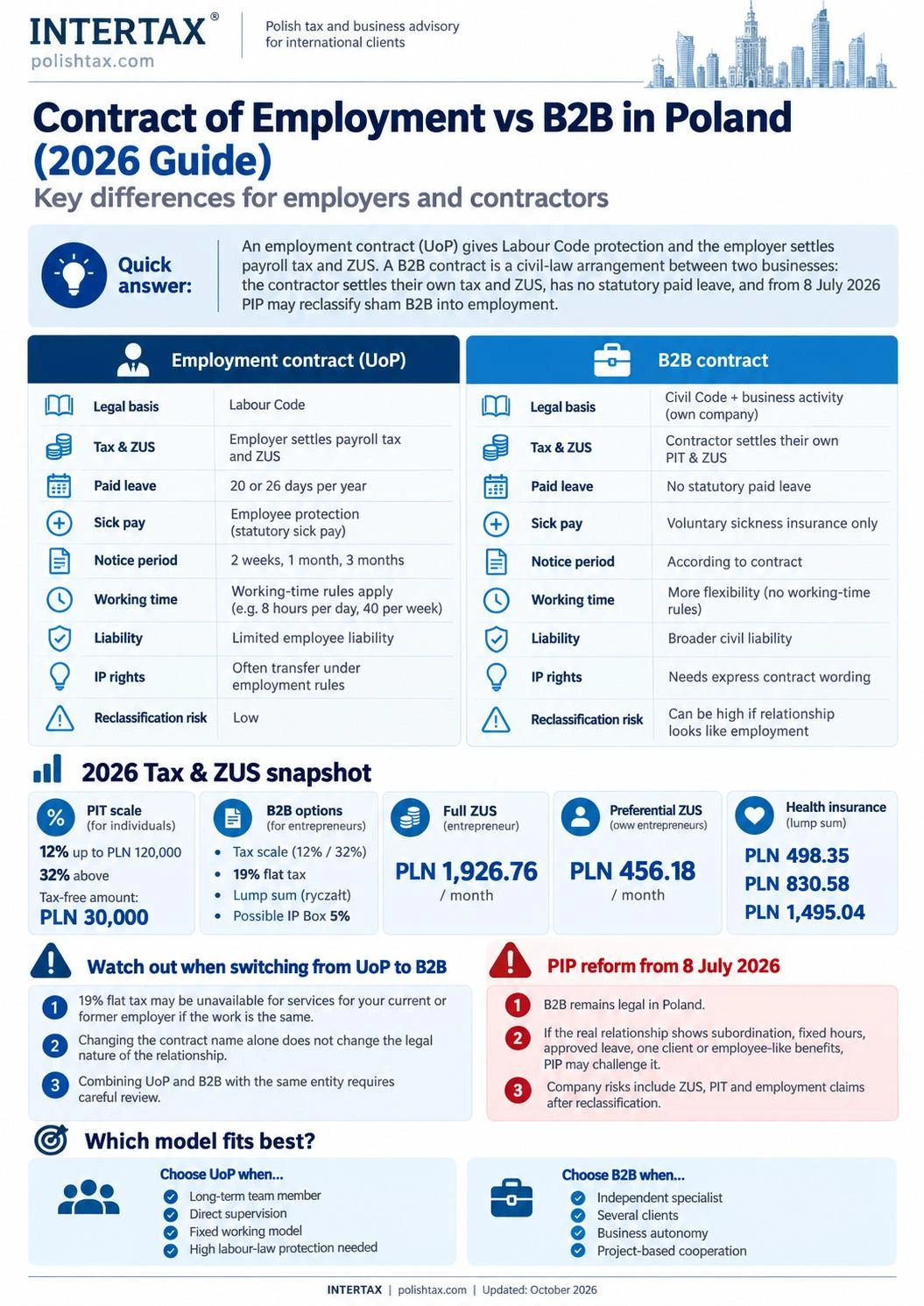
Contract of employment vs B2B Poland is one of the most important structuring decisions for companies hiring specialists in Poland. An employment contract (umowa o pracę, UoP) gives the individual statutory Labour Code protection and puts payroll, PIT and ZUS compliance on the employer. A genuine B2B contract is a civil-law relationship between independent businesses: the contractor invoices the client, settles their own taxes and social insurance, and does not automatically receive employee rights such as paid annual leave.
|
Quick answer |
Contract of Employment vs B2B in Poland – Quick Comparison
|
Aspect |
Employment contract (UoP) |
B2B contract |
|
Legal basis |
Labour Code |
Civil Code / commercial contract |
|
Subordination |
Employee works under employer direction and organisation |
Independent contractor should retain genuine business autonomy |
|
Who settles PIT/ZUS? |
Employer/payroll payer calculates and remits |
Contractor settles own PIT, ZUS and usually invoices the client |
|
Income-tax options |
Employment income: progressive PIT scale |
Depending on eligibility: scale, 19% flat tax, lump-sum tax; IP Box may apply to qualifying IP income |
|
Paid leave |
20 or 26 statutory days, subject to seniority |
No statutory paid annual leave; only if contractually agreed |
|
Sick pay / benefits |
Employee regime and statutory sickness benefits |
Depends on voluntary sickness insurance and statutory eligibility |
|
Notice period |
Statutory rules, typically 2 weeks / 1 month / 3 months |
Contractual termination rules |
|
Working time |
Labour Code limits, overtime and rest rules |
No Labour Code working-time regime if relationship is genuinely B2B |
|
Liability |
Employee liability is restricted in many cases |
Broader contractual/business liability, often supported by professional liability insurance |
|
IP ownership |
Special statutory employee-IP rules may apply |
Transfer/licence must be drafted expressly |
|
Employer/client cost |
Payroll taxes, employer ZUS, possible PPK and employee entitlements |
Invoice amount plus any agreed commercial costs; no employee benefits unless agreed |
|
Reclassification risk |
Not applicable |
Material if actual conditions resemble employment |
What Is a Contract of Employment (Umowa o Pracę)?
Under Article 22 of the Polish Labour Code, an employment relationship exists where a person undertakes to perform work of a specified type for an employer, under the employer’s direction and at the place and time designated by the employer, while the employer undertakes to employ that person for remuneration. The actual way the work is organised matters more than the title of the document.
The Labour Code recognises three main forms used in ordinary hiring: a probationary contract, a fixed-term contract and an indefinite-term contract. A probationary period is generally capped at three months. Fixed-term employment is subject to the statutory “33 months / 3 contracts” rule, subject to specific exceptions. For foreign employers, the practical consequence is that UoP is not just a payment arrangement: it brings mandatory rules on working time, leave, dismissal, health and safety, documentation, payroll and social insurance.
Internal link: Polish Labour Code – https://polishtax.com/information/polish-labor-code/
What Is a B2B Contract in Poland?
A B2B contract is a civil-law agreement between two businesses. In the common contractor model, the individual registers a sole proprietorship (jednoosobowa działalność gospodarcza, JDG) in CEIDG, performs services as an independent entrepreneur and issues invoices to the client. The contractor is responsible for choosing and applying the correct PIT regime, paying ZUS contributions and handling VAT where required.
B2B is lawful and widely used in Poland, particularly in IT, consulting and specialised professional services. Its legality depends on substance. A contractor should have meaningful business independence: the ability to organise work, bear commercial risk, negotiate fees, use substitutes where appropriate, serve more than one client and avoid day-to-day subordination characteristic of employment. KSeF and VAT compliance should also be considered where applicable.
9 Key Differences Between Employment and B2B Contracts
1. Legal basis and subordination
The strongest dividing line is subordination. An employee is integrated into the employer’s organisation and performs work under its direction. A contractor should instead perform a service as an independent business. Contractual wording helps, but it cannot override reality. What it means in practice: if the person works fixed hours, reports to a manager, needs approval for absences and has little commercial autonomy, B2B risk rises.
2. Income tax (PIT)
Employment income is taxed under the progressive PIT scale. In 2026 the core rates remain 12% and 32%, with a PLN 30,000 tax-free amount under the general rules. A sole proprietor may, depending on conditions, use the scale, 19% flat tax or lump-sum tax on recorded revenue. Qualifying creators or software businesses may also analyse the 5% IP Box regime. What it means in practice: B2B can provide more tax-choice flexibility, but only if the conditions for the chosen regime are met.
3. Social security (ZUS) and health insurance
For UoP, the employee and employer share statutory contributions and payroll handles the settlements. For a full-rate entrepreneur in 2026, the minimum social-security package is PLN 1,926.76 monthly including voluntary sickness insurance and the Labour Fund; the preferential package is PLN 456.18. Health contribution depends on the tax regime. What it means in practice: a B2B contractor controls and funds their own contribution profile, while the employer’s UoP burden is broader and recurring.
4. Paid leave, sick leave and parental rights
Employees are entitled to statutory annual leave – generally 20 or 26 days depending on seniority – plus statutory sickness and parental protections. A genuine B2B contractor has no Labour Code right to paid holiday. Time off can be negotiated commercially, but drafting “annual leave entitlement” identical to employees may become one of several facts suggesting employment. What it means in practice: contractors should negotiate service downtime rather than copy employee leave mechanics without analysis.
5. Working time and flexibility
Employees are covered by Labour Code working-time limits, rest periods, overtime rules and recordkeeping. A genuine B2B contractor organises performance independently and is paid for agreed services or outcomes rather than simply being present for employee-style working hours. What it means in practice: the more the client controls daily hours and attendance, the stronger the reclassification concern.
6. Termination and notice periods
For employment, statutory notice periods for fixed-term and indefinite contracts are generally 2 weeks, 1 month or 3 months depending on service with the employer. B2B termination is primarily contractual, subject to mandatory civil-law limits and the wording of the agreement. What it means in practice: B2B can be more flexible, but poorly drafted termination provisions create commercial uncertainty.
7. Liability and business risk
An employee’s liability to the employer is restricted by Labour Code rules in many situations; for non-intentional damage, limits may apply. A contractor normally bears broader civil and contractual liability and should consider liability caps and professional indemnity insurance. What it means in practice: genuine business risk is one of the commercial features that helps distinguish B2B from employment.
8. Intellectual property
Employee copyright and inventions are governed by statutory rules that may transfer or allocate rights to the employer under specified conditions. Under B2B, IP clauses should expressly define fields of exploitation, transfer or licence, timing and remuneration. What it means in practice: do not assume that paying a B2B invoice automatically gives the client all IP rights.
9. Seniority (staż pracy) – the 2026 change
From 2026, selected periods of sole proprietorship and civil-law work can count towards employment seniority once properly documented. The rules apply from 1 January 2026 in the public sector and from 1 May 2026 for private employers. This can affect rights linked to seniority, including annual leave and, in appropriate cases, notice-related calculations. What it means in practice: HR should recalculate employee seniority when qualifying evidence is submitted.
B2B Income-Tax Options – Simplified 2026 View
|
Regime |
Headline rate |
Typical comment |
|
Scale |
12% / 32% |
Allows tax-free amount; health contribution generally 9% of income, subject to minimum rules |
|
Flat tax |
19% |
No progressive rate; restrictions apply for same services provided to current/former employer |
|
Lump-sum tax |
Rate depends on service |
Tax on revenue, not income; limited cost deductions |
|
IP Box |
5% |
Only qualifying IP income with nexus and separate records |
Net Income and Employer Cost: A 2026 Worked Example
The table below is an illustrative comparison, not a payroll quotation. It assumes one person, no special allowances, standard employee tax costs, no children or other reliefs, and a full-rate B2B entrepreneur. VAT is ignored because it is normally neutral for a VAT-deducting business. The B2B example assumes PLN 15,000 net on the invoice, while UoP assumes PLN 15,000 gross salary.
|
Item |
UoP: PLN 15,000 gross |
B2B: PLN 15,000 invoice, 19% flat tax |
B2B: PLN 15,000 invoice, 12% lump-sum |
|
Employer/client cash cost |
Approx. PLN 18,300 incl. typical employer contributions and basic PPK assumption |
PLN 15,000 + VAT if applicable |
PLN 15,000 + VAT if applicable |
|
Social contributions borne by individual |
Employee ZUS approx. PLN 2,056.50 |
Full entrepreneur social package PLN 1,926.76 |
Full entrepreneur social package PLN 1,926.76 |
|
Health contribution |
Approx. PLN 1,164.92 |
Approx. PLN 640.59 on simplified monthly income basis |
PLN 830.58 at annual revenue of PLN 180,000 |
|
PIT – simplified monthly equivalent |
Approx. PLN 1,760 after annualising the scale and tax-free amount |
Approx. PLN 2,360 after simplified deductions |
Approx. PLN 1,519 after simplified social/health deduction assumptions |
|
Approx. cash retained |
Approx. PLN 10,020 |
Approx. PLN 10,070 |
Approx. PLN 10,724 |
|
Important |
Internal link: employer cost of hiring in Poland – https://polishtax.com/the-true-cost-of-hiring-an-employee-in-poland-guide/
Switching From Employment to B2B – Tax Traps
Changing the contract label does not automatically change the legal nature of the relationship. Article 22 §1¹ of the Labour Code prevents parties from replacing employment with a civil-law contract where the factual conditions of employment remain present.
There is also a specific PIT trap for the 19% flat tax. A taxpayer who provides services to a current or former employer that correspond to activities performed under employment in the same tax year loses the right to flat taxation and must recalculate advances under the progressive scale, with interest. This restriction is narrower than the labour-law reclassification test, but the two issues often arise together in employment-to-B2B conversions.
Running a business while also having an employment contract is possible, including in some cases with the same business group, but the scope, remuneration and actual conditions should be separated carefully. If the “business” part merely duplicates employee duties, the arrangement can create PIT, ZUS and labour-law exposure.
Reclassification Risk After the July 2026 PIP Reform
The reform effective from 8 July 2026 did not redefine employment and did not ban B2B. It gave PIP stronger tools to enforce the existing Article 22 test. During an inspection, the inspector may assess whether the factual relationship shows employment characteristics. If a written instruction to correct an irregular arrangement is not followed, the Regional Labour Inspector (Okręgowy Inspektor Pracy) may issue an administrative decision establishing the existence of an employment relationship, subject to court review.
When does B2B look like employment? Red flags
-
Fixed hours imposed by the client rather than agreed service availability.
-
Mandatory approval of “leave” or absences.
-
Direct day-to-day supervision and employee-style reporting lines.
-
No realistic possibility of using substitutes or subcontractors.
-
Economic dependence on one client combined with deep organisational integration.
-
Client equipment, benefits, internal titles and HR processes identical to employees.
-
No meaningful entrepreneurial risk or ability to negotiate how the service is delivered.
What changed on 8 July 2026?
-
PIP received stronger access to data and broader analytical tools, including cooperation with ZUS and KAS.
-
Inspectors may issue a written instruction to remedy an irregular civil-law arrangement.
-
If the instruction is not followed, the Regional Labour Inspector may issue an administrative decision establishing employment.
-
The parties can challenge the decision before the labour court.
-
A company unsure about a planned or existing model may apply to the Chief Labour Inspector for an individual interpretation on whether the described relationship constitutes employment.
The practical exposure can extend beyond employment status itself. Reclassification may trigger payroll corrections, ZUS arrears, employee claims and tax-payer obligations. The exact historical consequences depend on the legal route used and the periods covered, so a five-year ZUS exposure should be treated as a risk horizon to investigate, not as an automatic outcome in every case.
Which Contract Should You Choose?
|
Employment contract makes sense when… |
B2B makes sense when… |
|
The person is a long-term member of the organisation with a manager, fixed role and internal processes. |
The provider genuinely runs an independent business and determines how services are delivered. |
|
The company wants employee availability, working-time control and exclusivity. |
The contractor has several clients or a credible ability to serve others. |
|
The role requires employee benefits, paid leave and standard HR protections. |
The engagement is project-, deliverable- or expertise-based rather than employee-style attendance. |
|
The risk of reclassification would be commercially unacceptable. |
The contract allocates commercial risk, IP, confidentiality and liability appropriately. |
|
For foreign companies without a Polish entity |
Employer Checklist Before Choosing B2B
-
Map the actual day-to-day working model, not just the draft contract.
-
Identify who sets hours, place, method and priorities of work.
-
Check whether the contractor can use substitutes and work for other clients.
-
Compare remuneration with real business risk and responsibility.
-
Review IP transfer, confidentiality, data protection and liability clauses.
-
Confirm the contractor’s PIT, ZUS and VAT/KSeF setup is plausible for the activity.
-
Assess reclassification risk under Article 22 and the 2026 PIP enforcement rules.
-
Consider requesting a PIP individual interpretation for borderline models.
-
Re-review the model periodically: a genuine B2B relationship can drift into employee-style practice over time.
FAQ – Contract of Employment vs B2B in Poland
Is B2B still legal in Poland after the 2026 PIP reform?
Yes. B2B remains a lawful form of commercial cooperation. The July 2026 reform did not ban self-employment; it strengthened PIP enforcement where a civil-law contract is used even though the factual working conditions meet the Labour Code definition of employment.
Do B2B contractors get paid holidays in Poland?
Not automatically. Statutory annual leave belongs to employees under the Labour Code. A B2B contractor can negotiate paid or unpaid downtime contractually, but copying employee leave procedures too closely may be one of several facts relevant to reclassification risk.
How much ZUS does a B2B contractor pay in 2026?
For a full-rate entrepreneur, the minimum 2026 social-security package is PLN 1,926.76 per month including voluntary sickness insurance and the Labour Fund. Preferential social contributions are PLN 456.18. Health insurance is calculated separately and depends on the chosen tax regime.
Can I switch from an employment contract to B2B with the same company?
Yes, but the legal and tax conditions matter. If the actual work remains employee-like, changing the document title does not remove labour-law risk. The 19% flat tax can also be lost where the B2B services correspond to employment activities performed for the current or former employer in the same tax year.
Can I have an employment contract and run a B2B business at the same time?
Yes. Many people combine employment with a sole proprietorship. The tax and ZUS consequences depend on remuneration and other insurance titles. If both arrangements involve the same company, the scopes should be genuinely separate and the B2B part should retain real commercial independence.
Can a foreigner work on a B2B contract in Poland?
Potentially yes, but tax registration is not the only issue. The foreign national must also have a lawful immigration and work basis that permits the planned form of activity. Residence, social security and VAT obligations should be checked separately.
Can PIP impose ZUS contributions retroactively?
PIP can establish or seek to establish that a relationship is employment, while ZUS applies its own social-security competence. Historical contributions are therefore a material reclassification risk, but the exact period and procedure are case-specific and should not be treated as automatic without reviewing the decision and limitation rules.
Does B2B time count towards seniority in Poland?
From 2026, qualifying periods of sole proprietorship and certain civil-law work can count towards employment seniority when properly documented. The new rules apply from 1 January 2026 in the public sector and from 1 May 2026 for private employers, with transitional rules for documentation.
|
Not sure which model fits your Polish team? |
Legal and official sources
-
Polish Labour Code, in particular Article 22 and rules on fixed-term contracts, leave and notice periods.
-
State Labour Inspectorate (PIP): official 2026 materials on the reform effective 8 July 2026 and individual interpretations concerning employment classification.
-
ZUS: official 2026 contribution amounts for entrepreneurs and health-insurance parameters.
-
Ministry of Family, Labour and Social Policy / PIP: official guidance on the 2026 seniority reform.
-
Ministry of Finance (podatki.gov.pl): PIT scale and 19% flat-tax restrictions for services to a current or former employer.