


Executive Summary
To employ someone in Poland, a company must identify the correct employing model, conclude or confirm a written employment contract before work starts, complete medical and health-and-safety onboarding, register the employee with ZUS within seven days, and operate monthly payroll in accordance with Polish labour, tax and social-security rules. For most commercial employers, ZUS declarations and contributions are due by the 15th day of the following month, while PIT advances are generally due by the 20th. Employment records, working-time data, leave balances and payroll evidence must be maintained in Polish-compliant form. Foreign employers must also assess permanent establishment, immigration and social-security coordination risks before the first hire. The most frequent failures are late ZUS registration, missing written terms, incorrect contractor classification, unpaid overtime and incomplete personnel files. In 2026, employers must additionally address new pay-transparency recruitment rules and revised seniority calculations that include certain non-employment periods.
Can a Foreign Company Employ Staff in Poland Without a Local Entity?
Yes. A foreign company can hire employees who work in Poland without first incorporating a Polish subsidiary, but the legal and tax consequences depend on how the arrangement is structured. The company must not treat “no Polish company” as meaning “no Polish compliance”.
Three practical routes
-
Polish subsidiary or registered branch. The Polish entity or branch acts as employer, payroll withholding agent and ZUS payer. This is usually the clearest operational model when the business has a lasting local presence.
-
Foreign employer registered for Polish payroll and social security. A foreign company may become a Polish ZUS payer and Polish PIT withholding agent even without a local legal entity. In EU/EEA coordination cases, the employer and employee may in some circumstances agree that the employee performs the employer’s contribution-payment duties, but the employer remains responsible for compliance. The correct route depends on the employer’s state, the employee’s insurance legislation and any applicable bilateral agreement.
-
Posting or Employer of Record (EOR). A genuine temporary posting may preserve home-country social security if the relevant coordination conditions and A1 documentation are met. An EOR may handle local employment administration, but it does not automatically eliminate permanent establishment, labour-law or immigration risk for the foreign business.
Before hiring, assess whether the employee will habitually negotiate contracts, manage sales, maintain a fixed place of business or otherwise perform core revenue-generating functions in Poland. Those facts may create a Polish permanent establishment even where the employer has no subsidiary or branch. See our guides on employing without a permanent establishment and posting workers vs local hiring.
Employment Contracts in Poland: Types, Form and Mandatory Content
The Polish Labour Code recognises three main types of employment contract: a probationary contract, a fixed-term contract and an indefinite-term contract. A probationary period is generally limited to three months, with shorter statutory limits where the intended subsequent fixed term is shorter. Fixed-term employment is normally limited to three contracts and a total of 33 months between the same parties. Statutory exceptions apply, including replacement, seasonal or casual work, a term of office and objectively justified temporary needs.
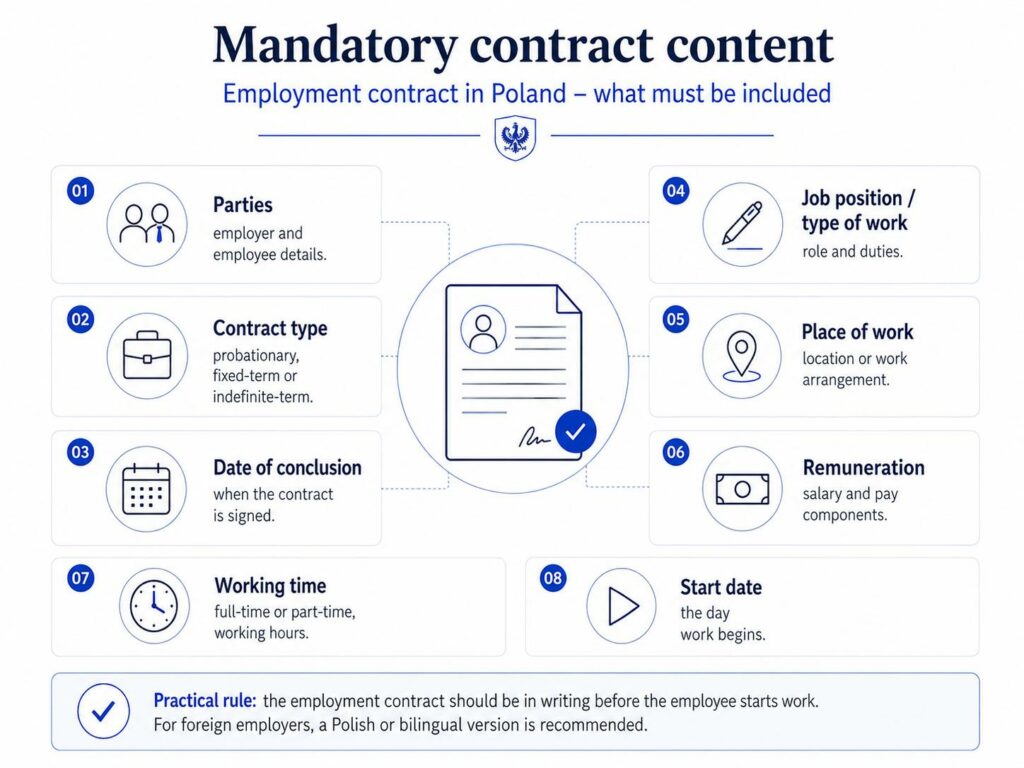
An employment contract must be in writing. If it has not been signed in advance, the employer must at least confirm in writing the parties, contract type and terms before admitting the employee to work. In practice, foreign employers should sign the complete contract before the first working day. A Polish version should be prepared; a bilingual version is often preferable for international groups, provided the governing-language clause is carefully drafted.
Mandatory contract content
-
parties to the contract and the employer’s registered address;
-
contract type and date of conclusion;
-
job title or type of work;
-
place or places of work;
-
remuneration and its components;
-
working-time fraction and employment start date;
-
for fixed-term contracts, the duration or end date and, where relevant, the statutory reason for an exception from the 3-contract/33-month limits.
Separate written information on employment conditions must normally be delivered within seven days of admission to work. It covers, among other matters, daily and weekly working-time norms, breaks, rest periods, overtime rules, paid leave, termination procedures, training rights and the applicable collective arrangements.
Civil-law and B2B contracts
A mandate contract (umowa zlecenie), specific-work contract (umowa o dzieło) or B2B arrangement is not an employment contract. However, the label does not control classification. Where work is performed personally, under the company’s direction, at a designated place and time, for remuneration, authorities and courts may reclassify the relationship as employment. This can trigger retroactive ZUS, payroll tax, leave, overtime and employment-protection claims. See our guide to tax services in Poland for B2B contracts.
Registering an Employee: What Must Happen and by When
Onboarding is not a single registration. It is a sequence of labour-law, occupational-health, personnel-file, social-security and PPK steps. A foreign employer should assign a named owner for each item and retain evidence of completion.
|
Obligation |
Deadline |
Consequence of failure |
|
Pre-employment medical examination |
Before admission to work |
Employee must not be admitted to work; potential PIP fine and liability |
|
Written contract or written confirmation of terms |
Before admission to work |
PIP fine; evidentiary and employment-status risk |
|
Initial OHS/BHP training |
Before duties start |
PIP fine; enhanced accident and management liability |
|
ZUS registration: ZUS ZUA or ZUS ZZA |
Within 7 days from the insurance obligation arising |
Contribution arrears, interest, corrections and possible sanctions |
|
Written information on employment conditions |
Within 7 days after admission to work |
Labour-law infringement and PIP exposure |
|
Personnel file (akta osobowe) |
From day one |
PIP exposure; retention and evidence problems |
|
PPK enrolment |
Normally by the 10th day of the month after the month in which 3 months of employment elapsed |
PPK fine and requirement to correct enrolment/contributions |
The employee’s personnel documentation includes the recruitment documents, employment relationship records, working-time and leave records, payroll-related evidence, disciplinary documents and termination records. Standard retention is generally 10 years for employment commencing from 2019, subject to transitional rules for older records. Electronic personnel files are permitted if statutory integrity, accessibility and security standards are met.
For a broader onboarding explanation, see hiring employees by foreign companies in Poland.
The Monthly Payroll Cycle: Deadlines You Cannot Miss
Payroll in Poland is deadline-driven. The date of payment affects the PIT period, while the insurance period follows the month for which remuneration is due. Variable remuneration, absences, benefits, PPK and cross-border data must be closed before payroll is finalised.
|
Compliance item |
Standard deadline |
Operational note |
|
Payroll calculation and payslip data |
Before contractual pay date |
Check working time, absences, overtime, benefits, garnishments and PPK |
|
ZUS DRA and individual reports; contribution payment |
By the 15th of the following month for most companies and other legal persons |
Different deadlines can apply to public-sector units and natural-person payers |
|
PIT advance payment |
By the 20th of the following month |
Apply employee declarations, tax reliefs, deductible costs and the correct tax office account |
|
PPK contributions |
By the 15th of the month following the month in which contributions were calculated and collected |
Coordinate payroll deduction and employer contribution |
|
PIT-11 to tax office |
By end of January following the tax year; electronically |
For 2025 data, 31 January 2026 fell on Saturday, so the deadline moved to 2 February 2026 |
|
PIT-11 to employee |
By end of February following the tax year |
Electronic delivery is possible if effective and documented |
|
PIT-4R to tax office |
By end of January following the tax year |
Electronic filing |
|
ZUS IWA, if applicable |
By 31 January following the reporting year |
Applies to payers meeting statutory conditions |
ZUS documents are generally filed electronically through eZUS/PUE, ePłatnik or the Płatnik program. Small payers may retain limited paper-filing options, but foreign-owned businesses should build an electronic workflow from the outset. Tax declarations such as PIT-11 and PIT-4R are filed electronically.
For broader annual deadlines, use the 2026 tax and reporting calendar. For payroll tax mechanics, see our guide to Polish PIT rules.
Employment Costs in Brief (and Where to Find the Full Breakdown)
Gross salary is not the employer’s total cost. In a standard employment scenario, employer-funded social contributions add approximately 20.5% to gross salary before PPK and certain role- or company-specific items. The exact percentage depends mainly on the accident-insurance rate and whether Labour Fund and Guaranteed Employee Benefits Fund contributions apply. Employer PPK contributions normally add at least 1.5% for participating employees.
From 1 January 2026, the national minimum monthly salary is PLN 4,806 gross for full-time employment, and the minimum hourly rate for covered civil-law contracts is PLN 31.40. The 2026 annual cap for pension and disability contribution assessment is PLN 282,600. These figures affect payroll controls, contribution calculations and salary reviews, but do not replace a person-specific gross-to-net calculation.
For a full gross-to-net and employer-cost breakdown with 2026 examples, see our dedicated guide to the full cost of hiring in Poland.
Working Time, Rest Periods and Overtime
The basic working-time norm is eight hours per day and an average of 40 hours per week in an average five-day working week over the adopted reference period. Including overtime, average weekly working time must generally not exceed 48 hours. Employees are normally entitled to at least 11 consecutive hours of daily rest and 35 consecutive hours of weekly rest.
The Labour Code sets a default annual overtime limit of 150 hours for overtime caused by the employer’s special needs. A collective agreement, work regulations or employment contract may establish another limit, but the 48-hour average weekly ceiling and rest rules continue to apply.
Overtime compensation
-
100% supplement for overtime at night, on Sundays and public holidays that are not scheduled working days, on a day granted in exchange for Sunday/holiday work, and generally for exceeding the average weekly norm;
-
50% supplement for overtime on other days;
-
paid time off instead of the supplement, either at the employee’s request on a one-for-one basis or, if granted unilaterally by the employer, generally at 1.5 hours off for each overtime hour.
Pregnant employees and juvenile workers may not work overtime. An employee caring for a child under eight years of age may not be assigned overtime, night work, interrupted working time or work away from the permanent workplace without consent. Restrictions also apply where occupational exposure limits would be exceeded.
Remote work
Regular remote work should be governed by an agreement with trade unions or internal remote-work rules, or by an individual arrangement where the statutory conditions are met. The employer must provide tools and materials or pay an agreed equivalent, cover necessary installation, service and electricity costs, and normally pay a lump sum or equivalent for electricity and telecommunications. The amount should reflect foreseeable actual costs and must be documented through a defensible methodology.
Leave, Sick Pay and Parental Entitlements
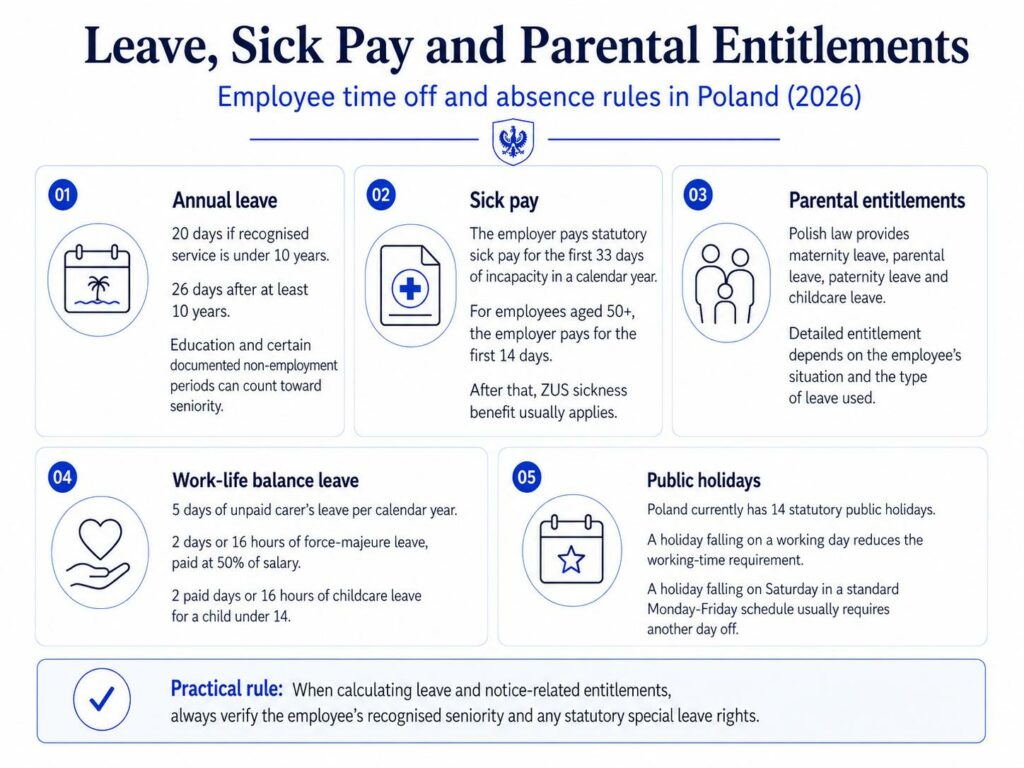
Annual leave is 20 days for employees with less than 10 years of recognised service and 26 days after at least 10 years. Education periods count under statutory rules. From 2026, recognised seniority also includes certain documented periods of business activity, mandate/service contracts, agency work and other qualifying non-employment activity: from 1 January 2026 in the public sector and from 1 May 2026 for private employers. This may move an employee from 20 to 26 days during 2026 and may require supplementary leave.
For ordinary sickness, the employer finances statutory sick pay for the first 33 days of incapacity in a calendar year, or the first 14 days for an employee who has reached age 50, subject to the detailed statutory age rule. ZUS sickness benefit generally applies thereafter. Payroll must coordinate medical certificates, waiting periods, benefit bases and any accident-at-work classification.
Polish law also provides maternity leave, parental leave, paternity leave and childcare leave, with detailed allocation and benefit rules. Work-life balance rights include five days of unpaid carer’s leave per calendar year and two days or 16 hours of force-majeure leave for urgent family matters, paid at 50% of salary. Employees raising a child under 14 also have two paid days or 16 hours of childcare leave.
Poland currently has 14 statutory public holidays, including Christmas Eve from 2025. Holidays falling on a working day reduce the working-time requirement. A holiday falling on Saturday in a standard Monday-Friday schedule normally requires another day off within the reference period.
Employee Benefits: What Is Taxed and What Is Exempt
An employee benefit may be tax-deductible for the employer while simultaneously constituting taxable and contributory income for the employee. Exemptions must be matched to a specific PIT and ZUS provision and its documentation requirements. Benefits financed from the Company Social Benefits Fund (ZFŚS) are subject to separate social criteria and tax rules. Employer-financed meals may benefit from a social-security exemption up to the statutory monthly limit of PLN 450 where all conditions are met; the PIT treatment must be analysed separately.
See our dedicated guide to the tax treatment of employee benefits.
Terminating Employment in Poland
Termination in Poland is formal and evidence-sensitive. A notice or termination without notice must be in writing and should be delivered in a way that proves when the employee could read it. For fixed-term and indefinite-term contracts, the standard notice period depends on total service with the employer: two weeks for less than six months, one month for at least six months, and three months for at least three years. Probationary contracts have shorter notice periods.
An employer terminating an indefinite-term or fixed-term contract must state a real, specific and defensible reason. Where the employee is represented by a trade union, consultation requirements may apply. Particular protection covers, among others, pregnancy and maternity-related periods, specified leave periods and employees approaching retirement age, subject to statutory exceptions.
Where an employer with at least 20 employees terminates for reasons unrelated to the employee, statutory severance may apply under the collective-redundancy legislation. Depending on service, severance equals one, two or three months’ remuneration, subject to a statutory cap. Collective redundancy procedures add consultation and notification duties.
A work certificate (świadectwo pracy) must generally be issued on the day employment ends unless another employment relationship with the same employer will begin within seven days and the employee does not request the certificate. An employee may challenge dismissal before the labour court and seek reinstatement or compensation. For protected employees, reinstatement risk is particularly significant.
Employing Foreign Nationals in Poland
EU, EEA and Swiss citizens generally have unrestricted access to the Polish labour market, although residence registration may be required for stays exceeding three months. Third-country nationals normally need both a legal stay title that permits work and a valid basis for employment, such as a work permit, a registered declaration where available, a seasonal permit, or a temporary residence and work permit. Statutory exemptions apply to defined categories.
Before work starts, the employer must verify the document legalising the foreign national’s stay and retain a copy for the required period. The employment conditions must match the permit or declaration. The agreement must be in writing before work begins, and if the worker does not understand Polish, the employer must provide a written version in a language the worker understands before signature.
Since the 2025 reform of the rules on entrusting work to foreigners, illegal employment can expose the employer to a fine from PLN 3,000 to PLN 50,000, with higher minimum fines for exploitative or fraudulent conduct. A permit or declaration is not a substitute for a lawful residence basis. Employers should also monitor reporting duties when work starts, does not start, is interrupted or ends.
A PESEL number is frequently needed for payroll, tax and administrative processes. See our service page on granting a PESEL number.
Inspections and Penalties: PIP, ZUS and the Tax Office
Three authorities commonly intersect in payroll compliance. The State Labour Inspectorate (PIP) examines employment legality, written contracts, working time, leave, minimum pay, OHS and personnel documentation. ZUS audits insurance coverage, contribution bases, benefits and contractor classification. The National Revenue Administration (KAS) verifies PIT withholding, declarations, benefits and tax residence.
Many Labour Code infringements are punishable by fines of PLN 1,000 to PLN 30,000. Illegal employment of foreign nationals may carry fines up to PLN 50,000 under the dedicated legislation. ZUS can assess contribution arrears with interest and require extensive corrections. In practice, management-board members, directors or other persons responsible for employment matters may face personal offence liability even when payroll has been outsourced.
|
Common mistake |
Why it matters |
Control to implement |
|
Employee starts without written terms, medical clearance or BHP training |
Direct PIP exposure and accident liability |
No system access or first shift until onboarding checklist is signed off |
|
ZUS ZUA/ZZA filed after 7 days |
Arrears, corrections and audit risk |
Automated alert from signed contract/start date |
|
Incomplete personnel and working-time records |
Employer may be unable to prove compliance |
Monthly HR file audit and retention matrix |
|
Overtime not recorded or compensated |
Wage claims, interest and PIP fine |
Manager approval plus payroll reconciliation to time system |
|
B2B or civil contract functions like employment |
Retroactive ZUS, PIT and employee-rights exposure |
Pre-engagement classification review and periodic reality test |
2026 Changes Every Employer Should Track
1. Recruitment pay transparency
From 24 December 2025, candidates must receive information on the initial salary or salary range, based on objective and gender-neutral criteria. The information must be provided in the job advertisement where possible, otherwise before the interview, or at the latest before the employment relationship is established. Employers may not ask candidates about remuneration received in current or previous employment. Job advertisements and position names must be gender-neutral, and recruitment must be non-discriminatory.
2. Broader EU pay-transparency implementation
The wider EU Pay Transparency Directive must be implemented by 7 June 2026. Employers should prepare job architecture, objective pay criteria, gender-pay data and a process for employee information requests. The exact Polish reporting thresholds and procedures depend on implementing legislation, so compliance teams should verify the final Polish rules before publication or reporting.
3. New seniority calculation
From 1 May 2026, private employers must include qualifying and documented non-employment periods in seniority calculations. Employees already employed on that date generally have 24 months to submit evidence. This can affect annual leave, notice periods, seniority-based benefits and eligibility criteria. Overlapping periods are not counted twice.
4. 2026 payroll parameters and digital administration
The 2026 minimum salary is PLN 4,806 and the covered civil-contract hourly minimum is PLN 31.40. The pension/disability annual contribution cap is PLN 282,600. Employers should also maintain reliable e-personnel files, electronic ZUS processes and e-sick-leave workflows. KSeF affects supplier invoices and payroll-adjacent accounting, but it does not replace payroll records or PIT/ZUS reporting.
FAQ
Can a foreign company employ someone in Poland without opening a company?
Yes. A foreign company may employ a person working in Poland without incorporating a Polish subsidiary, but it may still need to register as a Polish ZUS payer and PIT withholding agent. It must also assess permanent establishment, labour-law, immigration and social-security coordination issues before employment begins.
How long does an employer have to register an employee with ZUS?
The employer normally has seven days from the date the insurance obligation arises. For an employee, this is generally the employment start date. Registration is made on ZUS ZUA or, where only health insurance applies, ZUS ZZA. Late filing may require corrections and payment of arrears with interest.
What are the notice periods in Poland?
For fixed-term and indefinite employment, notice is two weeks if service with the employer is under six months, one month after at least six months, and three months after at least three years. Probationary contracts have shorter periods. Protected status and special termination rules must also be checked.
How many days of annual leave is an employee entitled to in Poland?
The entitlement is generally 20 days where recognised service is below 10 years and 26 days after at least 10 years. Education and, from 2026, certain documented periods of business activity and civil-law work can count toward seniority. Part-time leave is calculated proportionally.
Who pays sick leave in Poland — the employer or ZUS?
Both may pay, depending on duration. The employer generally finances sick pay for the first 33 days of incapacity in a calendar year, reduced to 14 days for qualifying employees aged over 50. ZUS sickness benefit normally applies after that employer-financed period.
Do I need a work permit to hire a non-EU citizen in Poland?
Usually, but not always. A third-country national needs a legal stay basis that permits work and generally a work permit, registered declaration or combined residence-and-work permit, unless a statutory exemption applies. The employer must verify documents before work starts and ensure actual conditions match the authorisation.
What can the Labour Inspectorate (PIP) fine an employer for?
PIP can sanction failures involving written contracts, minimum pay, working time, overtime, leave, OHS, personnel files and employment legality. Many Labour Code offences carry fines from PLN 1,000 to PLN 30,000. Illegal employment of foreign nationals is governed by separate rules and can trigger higher fines.
Does an employment contract in Poland have to be in Polish?
A Polish-language version should be prepared for employment performed in Poland. A bilingual contract is common and can be fully effective, but the employee must understand the terms and the governing-language clause should be clear. For foreign nationals who do not speak Polish, a written understandable version must be provided before signature.
How Intertax Supports Foreign Employers in Poland
Intertax supports foreign-owned businesses from the first Polish hire through ongoing payroll and HR compliance. Our work can cover employer and ZUS registration, payroll calculations, PIT and ZUS filings, PPK administration, employment-document templates, personnel-file processes, benefits and cross-border payroll coordination. We also identify permanent establishment and contractor-classification risks that are often missed when payroll is treated as a purely administrative function.
Learn more about our payroll services in Poland and human resources support, or request a fixed-scope proposal for your first Polish employee or an existing payroll migration.