


Employment termination in Poland is not based on an ‘at-will’ model. An employer must use a legally permitted termination route, comply with formal requirements and, for most employer-initiated terminations of fixed-term and indefinite contracts, state a real and specific reason. The cost of dismissal can include notice-period pay, holiday equivalent, statutory or contractual severance, and payroll/tax consequences. In 2026, employers also need to account for new seniority rules that may bring certain civil-law contracts and B2B activity into the employment seniority calculation. This guide explains the main routes, notice periods, protected groups, severance, tax and ZUS treatment, and a practical termination checklist for employers operating in Poland.
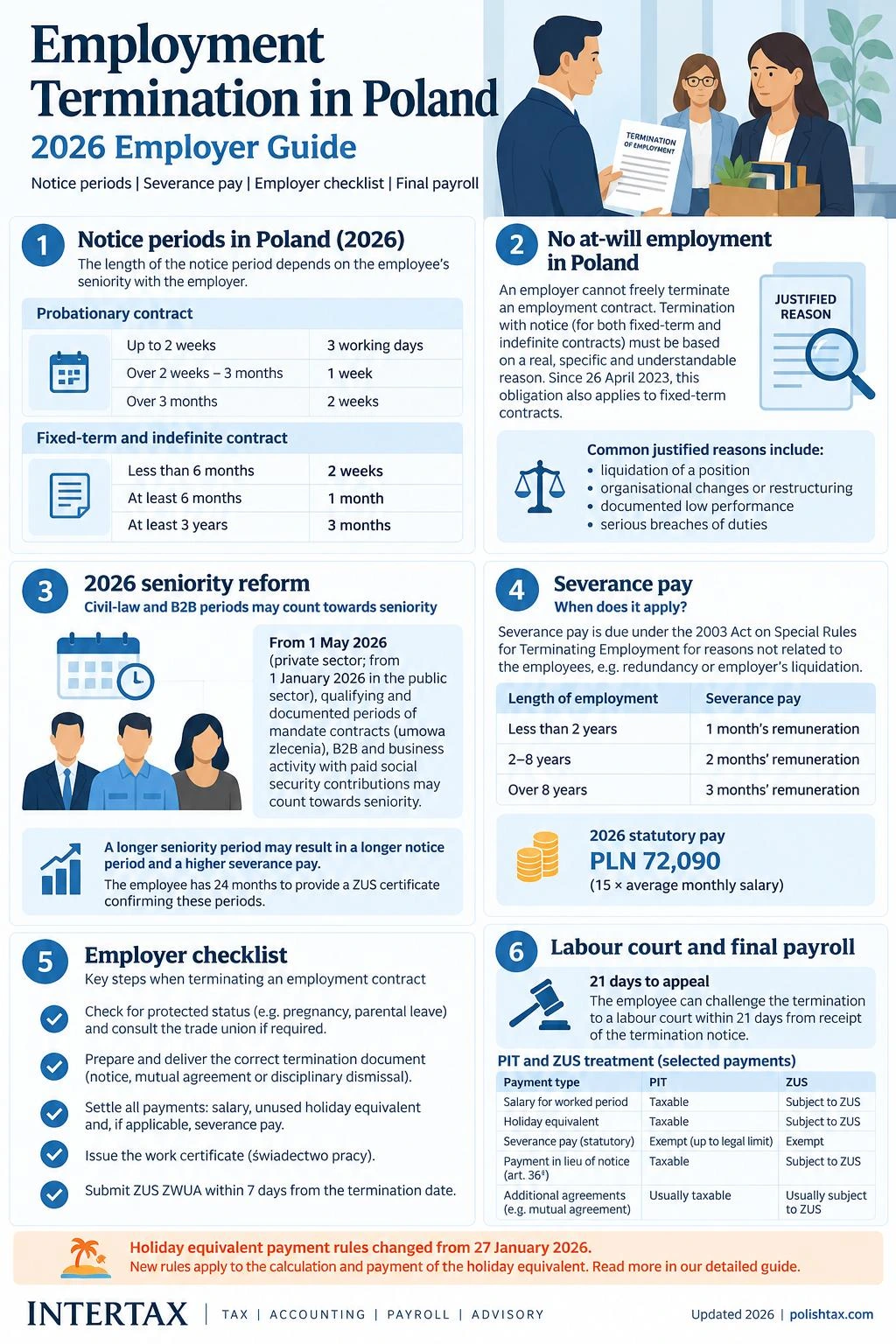
Employment Termination in Poland: Key Facts at a Glance (2026)
|
Topic |
Rule |
|
At-will employment |
No. Employer-initiated dismissal normally requires a lawful route and, for fixed-term/indefinite contracts, a stated reason. |
|
Notice periods |
Fixed/indefinite: 2 weeks (<6 months), 1 month (>=6 months), 3 months (>=3 years). Trial contracts have shorter periods. |
|
Appeal to labour court |
21 days from delivery of the termination/dismissal notice. |
|
Disciplinary dismissal |
Must be based on Art. 52 Labour Code grounds and generally made within 1 month after the employer learns of the circumstance justifying dismissal. |
|
Statutory severance |
Where the 13 March 2003 Act applies: 1, 2 or 3 months of pay depending on seniority. |
|
2026 severance cap |
15 x minimum wage = PLN 72,090 (15 x PLN 4,806). |
|
2027 severance cap |
15 x minimum wage = PLN 74,250 (15 x PLN 4,950), based on the published 2027 minimum wage. |
|
2026 seniority reform |
For private employers from 1 May 2026, documented qualifying civil-law/B2B periods may count toward employment seniority. |
|
Protected employees |
Special protection may apply to pregnancy/parental leave, pre-retirement employees, certain union representatives, leave and justified absence. |
How Can an Employment Contract Be Terminated in Poland?
Polish law provides several distinct termination routes. Choosing the correct route matters because the formalities, notice period, consultation duties, severance and litigation exposure differ.
Termination by Mutual Agreement (Porozumienie Stron)
The employer and employee may agree on any termination date. No statutory notice period is required and the parties do not need to state a dismissal reason in the agreement. This route can also be used with an employee who would otherwise enjoy dismissal protection, provided the employee’s consent is genuine. A mutual agreement does not automatically eliminate severance exposure: if the initiative came from the employer and the termination is for reasons not attributable to the employee, statutory severance may still be due where the 2003 collective-redundancy act applies.
Termination with Notice
An employment contract for a trial period, fixed term or indefinite term may generally be terminated with notice. Since 26 April 2023, an employer terminating a fixed-term contract with notice must, like with an indefinite contract, state the reason and follow the relevant union-consultation rules if the employee is represented.
Termination Without Notice: Art. 52 and Art. 53
Article 52 of the Labour Code allows immediate dismissal for serious employee fault, including a serious breach of basic employee duties, a crime that makes further employment impossible in the statutory circumstances, or culpable loss of qualifications necessary for the job. The employer must act within one month from learning of the circumstance justifying dismissal. If the employee is represented by a trade union, the employer must consult the organisation; the union has a short statutory period to present its position.
Article 53 is different: it permits termination without notice in certain cases of prolonged, justified absence, especially long-term incapacity for work after the applicable protection periods expire. It is not a disciplinary dismissal and should be analysed separately.
Expiry of a Fixed-Term or Trial Contract
A fixed-term contract normally ends automatically on the agreed end date, without a separate notice. A trial-period contract ends on expiry of the agreed trial period unless terminated earlier. Employers should still complete final payroll, holiday settlement, work certificate and deregistration duties.
Resignation by the Employee
An employee may terminate the contract with notice without giving a reason. In limited cases, Article 55 allows the employee to terminate without notice, for example where the employer commits a serious breach of basic obligations toward the employee. Such a termination can carry compensation consequences for the employer.
Notice Periods in Poland (2026)
|
Contract / seniority |
Notice period |
|
Trial period up to 2 weeks |
3 working days |
|
Trial period over 2 weeks |
1 week |
|
Trial period of 3 months |
2 weeks |
|
Fixed-term or indefinite: less than 6 months with employer |
2 weeks |
|
Fixed-term or indefinite: at least 6 months |
1 month |
|
Fixed-term or indefinite: at least 3 years |
3 months |
How to Count the Notice Period
A notice period expressed in weeks ends on a Saturday. A notice period expressed in months ends on the last day of a calendar month. The period of notice itself is included when determining seniority for the notice-period threshold.
|
Example – one-month notice |
|
Example – threshold reached during notice |
New in 2026: Civil-Law and B2B Periods Count Towards Seniority
The 2026 seniority reform is a major compliance change. From 1 January 2026 in the public sector and from 1 May 2026 for private employers, documented qualifying periods such as certain mandate/service contracts and periods of business activity can be included in employment seniority. This may affect notice periods, holiday entitlement and severance calculations. Employees who were already employed on the relevant effective date generally have 24 months to provide documents for earlier periods. The transitional rules also state that the reform does not retroactively change a notice period already running on the effective date.
Garden Leave, Job-Search Leave and Holiday During Notice
-
Garden leave: the employer may release the employee from the obligation to work during the notice period while preserving pay (Art. 36² Labour Code).
-
Job-search leave: where the employer gives at least two weeks’ notice, the employee may be entitled to 2 or 3 paid working days for job search (Art. 37).
-
Holiday during notice: the employer may require the employee to use accrued holiday during the notice period (Art. 167¹).
-
“Payment in lieu of notice” is not a general Polish-law substitute for notice. However, a three-month notice period may be shortened to one month in the statutory cases of bankruptcy, liquidation or other reasons not attributable to employees, with compensation for the remaining portion (Art. 36¹).
Valid Reasons for Dismissal: No At-Will Employment in Poland
For employer-initiated notice of a fixed-term or indefinite contract, the reason should be real, specific and understandable to the employee. A vague formulation such as ‘loss of trust’ without concrete supporting facts may be difficult to defend. Typical potentially legitimate reasons include genuine elimination of a position, restructuring, documented performance problems, repeated failure to follow lawful instructions, or other objectively demonstrable breaches of duties.
The reason written in the notice is strategically important because the employer’s defence in litigation is generally tied to that stated reason. Internal evidence should therefore be reviewed before the notice is delivered, not reconstructed after a claim is filed.
|
Practical drafting rule |
Termination Procedure: Step-by-Step Checklist for Employers
-
Check the employee’s protection status and seniority: Recalculate seniority under the 2026 rules where applicable, including qualifying documented civil-law/B2B periods.
-
Check trade-union consultation: For an employee represented by a union, determine whether Art. 38 consultation or another consultation/consent rule applies before dismissal.
-
Choose the correct legal route: Notice, mutual agreement, Art. 52, Art. 53, expiry, or another statutory route.
-
Prepare the termination document: For employer notice of a fixed-term or indefinite contract, state the reason and include information on the right to appeal to the labour court.
-
Use the correct form and signature: A paper document remains the safest operational standard. Electronic form can be used with a qualified electronic signature where legal form requirements are met.
-
Plan delivery: Personal delivery with acknowledgment is usually easiest to evidence. Registered post can be used, but the employer should manage risks around the date the employee could access the declaration.
-
Manage notice-period obligations: Decide on garden leave, job-search leave, holiday use, handover, access rights and return of company property.
-
Complete final payroll: Settle salary, holiday equivalent, severance/compensation where due, PPK and other benefits.
-
Issue the work certificate: As a rule, issue the świadectwo pracy on the day employment ends, subject to statutory exceptions.
-
Deregister from ZUS: Submit ZUS ZWUA within 7 days from the end of the insurance title; handle family-member deregistration where relevant.
-
Check foreign-worker notifications: If the employee’s right to work is based on a permit/notification regime, verify the current electronic notification duty and deadline. Since 1 June 2026, relevant notifications are handled electronically via praca.gov.pl.
-
Close annual tax reporting: Include final employment income in PIT-11 and file by the statutory deadline in the following year.
Need support with termination documentation, payroll settlement or HR compliance? See Intertax Human Resources services and Payroll Services.
Protected Employees: When You Cannot Terminate
|
Group |
Protection |
Typical exceptions / notes |
|
Pregnancy and maternity/parental/paternity leave |
Strong statutory protection, including periods linked to qualifying leave applications. |
Exceptions are narrow; bankruptcy/liquidation and certain disciplinary situations require separate analysis. |
|
Pre-retirement employees |
Generally protected during the 4 years before reaching statutory retirement age if employment would allow reaching that age. |
Specific statutory exceptions may apply. |
|
Protected trade-union representatives |
Special consent/protection rules may apply. |
Protection depends on statutory designation and union status. |
|
Leave / justified absence including sickness |
Art. 41 limits ordinary notice during leave or other justified absence while protection continues. |
Art. 53 may permit termination after statutory protection periods expire; disciplinary dismissal is a separate route. |
|
Works council / other specially protected roles |
Additional protection may apply under specific legislation. |
Check the statute governing the role before any action. |
Severance Pay in Poland (Odprawa)
Statutory severance under the Act of 13 March 2003 generally applies where an employer with at least 20 employees terminates employment for reasons not attributable to the employee, including certain individual dismissals. The amount depends on employment seniority with the employer. The 2026 seniority reform can therefore influence the applicable severance band where qualifying prior periods must be counted.
|
Seniority |
Statutory severance |
|
Less than 2 years |
1 month of remuneration |
|
2 to 8 years |
2 months of remuneration |
|
More than 8 years |
3 months of remuneration |
|
Maximum statutory severance |
Statutory severance is generally not due for a disciplinary dismissal based on employee fault. Separate contractual severance may arise from an employment contract, collective agreement, remuneration regulations, management package or negotiated separation agreement.
Collective Redundancies in Poland
The collective-redundancy procedure may apply to employers with at least 20 employees where, within 30 days, dismissals for reasons not attributable to employees reach the statutory thresholds: 10 employees for employers with fewer than 100 employees; at least 10% of employees for employers with 100–299 employees; or 30 employees for employers with at least 300 employees. The process requires employee-side consultation and notification to the competent labour office, and may involve an agreement or redundancy regulations.
Final Settlement: How Termination Payments Are Taxed (PIT & ZUS)
Final payroll should separate each payment by legal basis. The tax and social-security result does not depend only on the label used in the settlement agreement. In particular, ZUS exclusions for severance, compensation and other termination-related payments generally require a direct link with the expiry or termination of employment.
|
Payment |
Employee PIT |
ZUS |
Employer CIT / KUP |
|
Salary during notice / garden leave |
Yes |
Yes |
Generally deductible under normal payroll rules |
|
Holiday equivalent |
Yes |
Yes |
Generally deductible under normal payroll rules |
|
Statutory severance under the 2003 Act |
Yes |
Generally excluded from contribution base when directly linked to termination |
Generally deductible if business-purpose and timing rules are met |
|
Compensation for shortened notice (Art. 36¹) |
Generally taxable unless a specific exemption applies |
Generally excluded from contribution base |
Generally deductible subject to general rules |
|
Court-awarded / court-settlement compensation for unlawful dismissal |
Depends on the exact legal basis and wording; exemptions may apply |
Often excluded where it qualifies as termination-related compensation |
Case-specific |
|
Post-employment non-compete compensation |
Generally taxable |
Generally excluded from contribution base |
Generally deductible subject to general rules |
|
Voluntary severance under mutual agreement |
Usually taxable |
Depends on whether it is directly and genuinely linked to termination; wording and legal basis matter |
Generally case-specific but may be deductible |
|
Tax caution |
Worked Example: Employee on PLN 10,000 Gross with 5 Years’ Seniority
Assume a private employer with at least 20 employees eliminates the employee’s position for economic reasons. The employee earns PLN 10,000 gross per month, has 5 years of seniority for severance purposes, and has 5 days of unused annual leave. Assume no variable remuneration and a full-time schedule.
|
Component |
Illustrative gross amount / treatment |
|
Statutory severance |
PLN 20,000 gross (2 months x PLN 10,000). PIT: yes. ZUS: generally no, where the statutory termination conditions are met. |
|
Holiday equivalent |
Using the 2026 full-time holiday-equivalent coefficient of 20.92, daily equivalent is approx. PLN 478.01; for 5 days approx. PLN 2,390.06 gross. PIT and ZUS apply. |
|
Notice-period salary |
Payable according to the applicable notice period and subject to normal PIT/ZUS. |
|
Total immediate termination-specific items illustrated here |
PLN 22,390.06 gross, excluding ordinary notice-period salary and any other benefits. |
The example is intentionally simplified. Actual holiday-equivalent calculations can be affected by variable pay components, working-time arrangement and the employee’s actual entitlement. The final payroll should be calculated from payroll records, not from this illustration.
New in 2026: Timing of Holiday-Equivalent Payment
From 27 January 2026, the Labour Code expressly links payment of unused-holiday equivalent to the employer’s normal salary payment date. If that salary payment date falls before the employment-end date, the holiday equivalent must be paid no later than 10 days after termination (or earlier where the statutory rule on a non-working final day applies). This change is operationally important for final payroll checklists.
Challenging a Dismissal: Labour Court Risks for Employers
An employee generally has 21 days to challenge a termination or dismissal before the labour court. In an employer-initiated dismissal dispute, the employer must be able to substantiate the stated reason and prove compliance with formal requirements. Depending on the claim and contract type, remedies can include reinstatement, compensation and, in reinstatement cases, pay for the period of remaining out of work within statutory rules.
The strongest risk reduction comes before delivery: verify the legal route, protection status, evidence, union obligations, seniority, signature/form and delivery method. A negotiated separation agreement can reduce litigation risk when appropriately structured, but it should not be used to bypass statutory rights or misstate the real economic reason for termination.
Dismissing a Management Board Member Employed Under a Contract
Foreign shareholders often assume that removal from the management board automatically ends the individual’s employment. It does not. Corporate removal under the Commercial Companies Code and termination of the employment relationship are separate legal acts. If the board member also has an employment contract, the company must separately terminate or amend that contract using the Labour Code rules and the correct corporate representation.
Common Mistakes Foreign Employers Make
-
Using an overly generic dismissal reason such as “loss of trust” without concrete facts.
-
Sending an ordinary unsigned email when statutory written/electronic form requirements are relevant.
-
Skipping trade-union consultation or consent rules.
-
Calculating seniority under pre-2026 rules after 1 May 2026 for a private employer.
-
Assuming every mutual agreement eliminates severance exposure.
-
Treating “payment in lieu of notice” as a freely available Polish-law option.
-
Failing to issue the work certificate or complete ZUS deregistration on time.
-
Applying one tax/ZUS treatment to all final-settlement payments without analysing their legal basis.
Related Intertax Guides
FAQ
What is the notice period in Poland?
For fixed-term and indefinite employment contracts, the statutory notice period is 2 weeks if employment with the employer is under 6 months, 1 month from 6 months, and 3 months from 3 years. Trial contracts have shorter notice periods. In 2026, qualifying documented civil-law/B2B periods can affect seniority under the new rules.
Can you fire an employee without a reason in Poland?
Poland has no general at-will employment rule. An employer terminating a fixed-term or indefinite contract with notice must normally state the reason. The reason should be real, specific and understandable. Different rules apply to expiry of a fixed term, employee resignation and some other termination routes.
How much severance pay is required in Poland in 2026?
Where the 2003 severance act applies, statutory severance is generally 1, 2 or 3 months of remuneration depending on employment seniority. The statutory cap is 15 times the minimum wage. With the 2026 minimum wage of PLN 4,806, the cap is PLN 72,090.
Is severance pay taxed in Poland?
Statutory termination severance is generally subject to PIT. For ZUS, qualifying severance, compensation and similar payments directly connected with expiry or termination of employment can be excluded from the contribution base. The exact legal basis and wording of negotiated payments should be reviewed before payroll processing.
Can an employer terminate an employee on sick leave in Poland?
Ordinary notice is restricted during justified absence while statutory protection applies. However, after the relevant protection period expires, Article 53 may allow termination without notice in specified cases. Disciplinary dismissal under Article 52 is a separate mechanism and requires its own statutory grounds.
Can you pay in lieu of notice in Poland?
Not as a general substitute for the statutory notice period. After notice is given, the parties can agree an earlier termination date. The employer can also shorten a three-month notice period to one month in specific statutory cases such as liquidation or reasons not attributable to the employee, with compensation for the balance.
How do you terminate a fixed-term contract in Poland?
A fixed-term contract can end automatically on its agreed end date or may be terminated earlier with notice where permitted. If the employer gives notice, the employer normally must state the reason and comply with the relevant consultation rules. The same statutory notice periods as for indefinite contracts apply.
How long does an employee have to appeal a dismissal in Poland?
The standard deadline is 21 days from delivery of the employer’s termination or dismissal declaration. Because the deadline runs from delivery, employers should retain evidence showing when and how the document was delivered or became accessible to the employee.
|
Need help with employment termination in Poland? |
Human Resources services | Payroll Services
Legal Basis and Official Sources
-
State Labour Inspectorate (PIP) – employment relationship guidance
-
Ministry of Family, Labour and Social Policy – 2026 seniority reform Q&A
-
PIP – holiday equivalent payment timing from 27 January 2026
-
ZUS – contribution-base rules and termination-related exclusions
-
Biznes.gov.pl – foreign-worker employment changes / notifications