


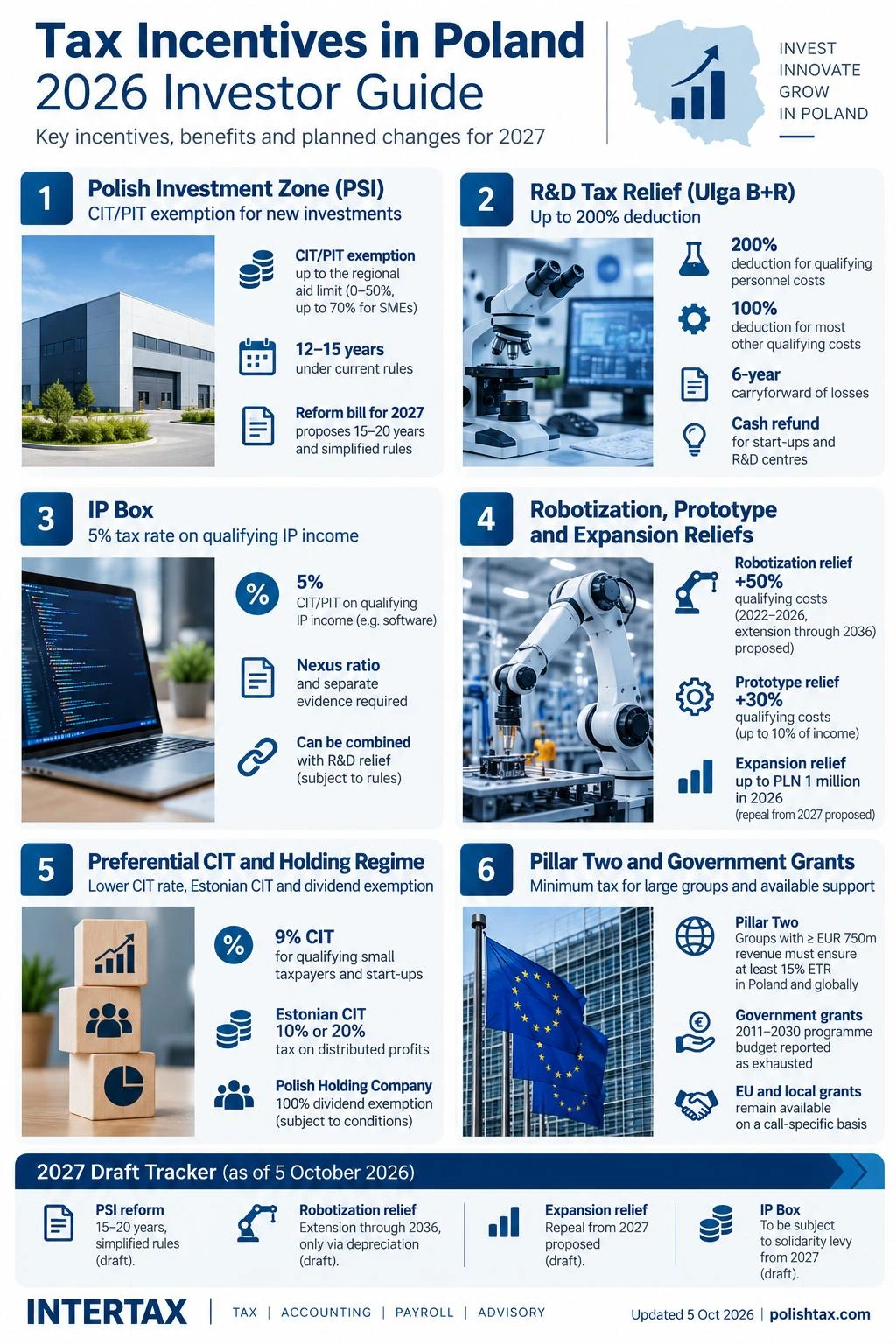
Tax incentives in Poland can materially reduce the cost of entering or expanding in the Polish market, but the available instruments work in very different ways. Some reduce taxable income, some apply a preferential tax rate, and others provide a regional income-tax exemption or public funding. For foreign investors, the key question is not simply which incentive has the highest headline percentage, but which one fits the project, legal structure, location, payroll profile and expected exit strategy. This guide compares the most relevant incentives available in 2026 and flags the legislative changes currently proposed for 2027. Draft measures are clearly marked as such, with status checked as of 5 October 2026.
Key takeaways
-
The Polish Investment Zone (PSI) can provide a CIT/PIT exemption linked to a new investment and regional-aid limits; current decisions generally run for 12–15 years.
-
R&D relief can allow a 200% deduction for qualifying personnel costs and 100% for most other qualifying R&D costs; unused relief can generally be carried forward for six years.
-
IP Box applies a 5% rate to qualifying IP income if the nexus and record-keeping conditions are met and can, in appropriate cases, be combined with R&D relief.
-
Robotization relief still applies to qualifying costs in tax years beginning in 2022–2026; a government bill would extend it through 2036, but the extension is not yet enacted.
-
Large groups within Pillar Two must model incentives together with the 15% global minimum tax; a tax benefit can be partly neutralised by top-up tax.
Tax Incentives in Poland at a Glance (2026 Comparison Table)
|
Incentive |
Best for |
Benefit |
Key condition |
Can be combined with |
Status 2027 |
|
Polish Investment Zone (PSI) |
New manufacturing / service investments |
CIT/PIT exemption up to regional-aid limit |
Decision on support; qualifying investment; quantitative + qualitative criteria |
Grants, some tax reliefs subject to no-double-financing rules |
Government reform bill for 2027 |
|
R&D relief |
R&D centres, software, engineering, product/process development |
200% personnel costs; usually 100% other qualifying costs |
Qualifying R&D activity and separate cost records |
IP Box, innovative employees relief |
No major enacted redesign as of 5 Oct 2026 |
|
IP Box |
Software / technology / protected IP |
5% tax on qualifying IP income |
Qualifying IP, R&D link, nexus, dedicated records |
R&D relief |
2027 tax package proposes solidarity-levy inclusion for PIT IP Box |
|
Robotization relief |
Industrial automation |
Extra 50% deduction of qualifying costs |
Qualifying industrial robots and related costs |
Ordinary depreciation / costs under detailed rules |
Bill proposes extension through 2036 |
|
Prototype relief |
Product industrialisation |
30% extra deduction, capped at 10% of relevant income |
Trial production / market launch of a new product |
R&D relief where costs are not duplicated |
In force in 2026 |
|
Expansion relief |
Manufacturers expanding sales |
Extra deduction up to PLN 1m per year |
Own manufactured products + statutory sales-growth test |
Selected incentives if no same-cost duplication |
Government bill proposes repeal from 2027 |
|
9% CIT |
Small/start-up corporate taxpayers |
9% CIT on non-capital-gains income |
Revenue limits + small taxpayer/start-up status + exclusions |
Many standard reliefs |
In force in 2026 |
|
Estonian CIT |
Companies reinvesting profits |
Tax generally deferred until distribution; 10%/20% company rate |
Eligible legal form, ownership, revenue/activity and employment conditions |
Not with classic R&D/IP Box while in regime |
Separate 2027 technical changes proposed |
|
Polish Holding Company (PSH) |
Holding / M&A structures |
100% dividend exemption and qualifying share-sale exemption |
Holding/subsidiary tests, 2-year holding and other conditions |
EU/treaty relief analysis |
Current 2026 rules already provide full dividend exemption |
|
WHT / participation exemptions |
Cross-border dividends, interest, royalties |
Possible exemption / treaty reduction |
Shareholding, holding period, beneficial-owner/due-diligence and procedural conditions |
PSH depending on payment/structure |
Procedure remains high-risk area |
|
Public grants / EU funds |
Large capex, R&D, green/digital projects |
Cash support |
Programme/call eligibility; state-aid rules |
PSI subject to cumulation ceilings |
National 2011–2030 grant programme budget reported exhausted |
Polish Investment Zone (PSI): Up to 15 Years of Income Tax Exemption
The Polish Investment Zone (Polska Strefa Inwestycji, PSI) is one of the most important investment incentives in Poland for projects involving new production capacity, expansion, diversification or certain service activities. It operates through a decision on support (decyzja o wsparciu). The benefit is an exemption from CIT or PIT on income attributable to the activity covered by the decision, up to the available public-aid ceiling. It is therefore a capped state-aid instrument, not a permanent tax holiday.
Legal basis: Act of 10 May 2018 on supporting new investments; CIT Act art. 17(1)(34a).
How Much Can You Save? Regional Aid Map 2022–2027
For large enterprises, the standard regional aid intensity is generally between 15% and 50% of eligible costs, depending on location. Small enterprises may normally receive a 20 percentage-point uplift and medium-sized enterprises a 10-point uplift, which can bring the maximum to 70% in the highest-support regions. Warsaw city is excluded from regional investment aid under the current map, while many eastern regions benefit from the highest base intensity.
Example: if a medium-sized company invests PLN 40 million in a region with a 50% base aid intensity, the SME uplift may increase the applicable ceiling to 60%. The theoretical maximum aid could therefore reach PLN 24 million, subject to the precise project, eligible cost base, cumulation rules and the terms of the decision on support.
Quantitative and Qualitative Criteria
The minimum investment threshold is not a single national amount. It depends on factors including the unemployment level in the relevant district, the size of the enterprise and the character/location of the project. A project must also meet qualitative criteria. Investors should establish the threshold for the exact site before signing binding investment commitments, because starting the project too early may jeopardise state-aid eligibility.
SEZ Permits Expire on 31 December 2026 – What Existing Investors Should Do
The old Special Economic Zone (SSE) permit system reaches the end of its statutory life on 31 December 2026. Existing permit holders should review the remaining aid pool, income allocation, eligible activity, fixed-asset and employment commitments and the practical transition to PSI or ordinary taxation. The expiry of the old SSE framework does not mean that investment incentives disappear: PSI is the successor mechanism for new investments.
PSI Reform from 2027 – Government Bill
On 29 September 2026 the Council of Ministers adopted a bill reforming PSI. As of 5 October 2026 this is still draft legislation, not enacted law. The bill would generally extend decisions on support to 15–20 years, simplify the link between exempt income and the new investment, require an opinion from the Head of the National Revenue Administration for decisions where the maximum public aid is at least PLN 40 million, and introduce an electronic PSI platform. The core changes are intended to apply from 1 January 2027. The final Act should be checked before any 2027 application is filed.
R&D Tax Relief (Ulga B+R): Up to 200% Deduction
The R&D relief is designed for taxpayers carrying out creative, systematic work aimed at increasing knowledge or using knowledge to create new applications. It is broader than laboratory science: software development, engineering, testing, product redesign and process improvement can qualify when the statutory R&D definition is met.
For ordinary CIT taxpayers, qualifying remuneration of employees and qualifying civil-law contractors, together with related social-security contributions, can generally be deducted at 200% of the qualifying amount. Most other qualifying costs are deductible at 100%. R&D centres may have broader or higher deductions under dedicated rules. The relief is claimed in addition to the ordinary tax deduction of the underlying cost, subject to the statutory conditions.
Unused R&D relief can generally be carried forward for six tax years. Start-ups in defined situations may receive a cash refund of unused relief. Proper cost allocation and a defensible description of the R&D project are essential; routine changes and ordinary implementation work are not enough.
Critical trap: the same expenditure cannot be relieved twice where the law excludes reimbursed costs. Grant-funded expenditure therefore needs a careful net-cost analysis. External services also require special attention because the eligible counterparty can matter for certain R&D cost categories.
Innovative Employees Relief – Benefit Even Without Profit
If a taxpayer has unused R&D relief because of a loss or insufficient taxable income, the innovative employees mechanism may allow the taxpayer to offset part of that unused R&D amount against PIT advances withheld from qualifying R&D staff. It can be particularly relevant for high-growth technology companies that employ R&D teams before they become profitable.
IP Box: 5% Tax Rate on Qualifying IP Income
Polish IP Box allows a 5% tax rate on qualifying income from specified intellectual-property rights developed, improved or enhanced through the taxpayer’s own R&D activity. Copyright in a computer program is expressly included, making the regime particularly relevant to software businesses. The amount benefiting from the 5% rate is determined using the nexus formula, which links the benefit to qualifying R&D expenditure.
A taxpayer must keep records enabling revenue, costs and income to be allocated to each qualifying IP right. Weak or retrospective documentation is one of the main practical risks. R&D relief and IP Box may be combined: qualifying R&D costs can first generate an R&D deduction and, subject to the statutory mechanism, the resulting qualifying IP income can be taxed at 5%.
What Is Proposed for 2027?
An earlier legislative concept discussed an employment condition for IP Box, but this condition is not confirmed in the current official government summary available as of 5 October 2026. The current 2027 tax package does, however, propose bringing PIT income taxed under IP Box into the solidarity levy calculation. Investors should therefore treat the employment-condition proposal as unconfirmed unless it reappears in the final parliamentary text.
Robotization, Prototype and Expansion Reliefs
Robotization relief
For tax years beginning in 2022–2026, taxpayers can deduct an additional 50% of qualifying tax-deductible costs relating to industrial robots, related machinery, software, training and certain leasing costs. The government bill sent to parliament on 29 September 2026 would extend the relief for another 10 years, through 2036, while clarifying that qualifying acquisition expenditure is recognised through depreciation in the relevant cases. As of 5 October 2026, the extension remains draft legislation.
Prototype relief
The prototype relief allows an additional deduction equal to 30% of qualifying costs of trial production of a new product and placing that product on the market. The deduction is capped at 10% of income from non-capital-gains sources. The relief is primarily relevant after R&D is complete and the business moves into industrialisation and market launch.
Expansion relief
The expansion relief allows manufacturers to deduct qualifying market-expansion costs twice: once as an ordinary tax-deductible expense and again as a special deduction, up to PLN 1 million per year. It applies only to products manufactured by the taxpayer and requires the statutory sales-growth result within the prescribed period. A government bill adopted in September 2026 proposes repealing the relief from 2027, so 2026 expenditure and timing should be reviewed carefully.
Other targeted incentives include consolidation relief, IPO-related reliefs and certain CSR deductions. Their usefulness is usually transaction-specific and should be assessed after the main investment structure is chosen.
Preferential CIT Regimes: 9% CIT and Estonian CIT
9% CIT
The 9% CIT rate applies to qualifying income other than capital gains where the current-year revenue ceiling is met and the taxpayer is a small taxpayer or a qualifying start-up. The statutory threshold is EUR 2 million, converted under the applicable rules. For small-taxpayer status in 2026, the official PLN threshold based on 2025 sales is PLN 8,517,000. Special exclusions apply to entities created through certain restructurings, contributions and other transactions.
Read more: 9% CIT and Estonian CIT guide
Estonian CIT
Estonian CIT (ryczałt od dochodów spółek) changes the timing of taxation: retained profits are generally not taxed in the same way as under classic CIT until a taxable distribution or another statutory taxable event occurs. The company-level rates are 10% for small/start-up taxpayers and 20% for others. The regime is powerful for reinvestment but comes with ownership, activity and employment conditions and a separate catalogue of taxable events, including hidden profits and non-business expenses.
A company under Estonian CIT does not simultaneously use the classic CIT R&D deduction or IP Box on the same basis as a taxpayer under standard CIT. For groups deciding between R&D/IP incentives and profit-retention efficiency, this trade-off should be modelled rather than decided solely by headline rates.
Holding and Cross-Border Structures: PSH, Participation Exemption and WHT Relief
The Polish Holding Company (Polska Spółka Holdingowa, PSH) regime can provide a 100% exemption for qualifying dividends received from Polish or foreign subsidiaries and an exemption for qualifying gains on the sale of subsidiary shares to an unrelated buyer. The holding company must meet the statutory conditions, including the relevant legal form, Polish tax residence and a direct holding of at least 10% in the subsidiary; the holding conditions must generally be met continuously for at least two years.
For EU/EEA structures, domestic implementation of the Parent-Subsidiary Directive can also exempt qualifying dividends, generally with at least a 10% holding for the required two-year period. Interest and royalty exemptions under EU rules use a different threshold, generally 25%, together with additional related-company and beneficial-owner conditions. Poland’s tax treaties may provide lower WHT rates where domestic/EU exemptions are unavailable.
WHT relief is documentation-heavy. Certificate of residence, beneficial-owner analysis, due diligence, the PLN 2 million pay-and-refund mechanism for specified related-party payments and the possibility of obtaining an opinion on the application of preferences should be reviewed before payment, not after.
Related guides: withholding tax in Poland | WHT opinion on preferences | dividend tax in Poland
Incentives for Individual Investors and Key Staff
|
Incentive |
Who may benefit |
Main benefit |
Key risk |
|
Lump-sum tax on foreign income |
Eligible new Polish tax residents |
PLN 200,000 annual lump sum on qualifying foreign income |
Strict residence/eligibility conditions; Polish-source income taxed separately |
|
Return relief (ulga na powrót) |
Individuals moving tax residence to Poland |
Temporary PIT exemption up to statutory annual cap |
Prior residence history and transfer conditions |
|
Youth relief |
Employees/contractors under 26 |
PIT exemption up to PLN 85,528 for qualifying income |
Age and income-source restrictions |
|
50% copyright costs |
Creators / software / R&D staff |
50% tax-deductible costs on qualifying copyright remuneration |
Proper IP creation, transfer and remuneration allocation; annual cap |
Beyond Tax: Government Grants, EU Funds and Property Tax Exemptions
Tax relief is only part of the investment-incentive landscape. Investors should also consider EU programmes, local property-tax exemptions and public grants. However, availability must be checked in real time: PAIH states that the budget of the Programme for Supporting Investments of Major Importance to the Polish Economy 2011–2030 was exhausted as of 3 December 2025, so new applications exceeding the budget cannot receive funding under that programme unless additional funding is provided or the programme is modified.
EU funding under the 2021–2027 perspective, including FENG and regional programmes, remains call-specific. Municipalities may adopt property-tax exemption schemes for new investments and jobs. De minimis aid is generally subject to a EUR 300,000 ceiling over a rolling three-year period under the current EU de minimis regulation.
Read more: property taxes in Poland
Can You Combine Tax Incentives in Poland? (Stacking Rules)
Combining incentives can create substantial value, but the same cost cannot simply be subsidised or deducted twice where the relevant law excludes double financing. Public-aid cumulation can also cap the aggregate benefit. The matrix below is a practical starting point, not a substitute for a project-specific calculation.
|
Combination |
Result |
Practical note |
|
R&D relief + IP Box |
YES |
Statutory mechanism allows combination, subject to qualifying-cost and nexus rules. |
|
Estonian CIT + classic R&D/IP Box |
NO / not concurrently in the classic regime |
Choice of Estonian CIT changes the tax base and removes classic-CIT deductions during the regime. |
|
PSH + PSI |
GENERALLY INCOMPATIBLE for the PSH company |
The PSH definition and exemptions must be tested against use of PSI/SSE exemptions; structure at group level instead. |
|
R&D relief + grant-funded same cost |
NO for reimbursed portion |
Qualifying R&D costs must be reduced by costs reimbursed/returned. |
|
R&D relief + PSI exempt-income cost |
NO for costs allocated to exempt income |
Separate taxable and exempt activity; avoid double benefit. |
|
PSI + cash grant |
POSSIBLE |
Subject to public-aid cumulation ceiling and eligible-cost allocation. |
|
Prototype + R&D relief |
POSSIBLE |
Often sequential stages; no duplication of the same special deduction. |
|
9% CIT + R&D relief |
POSSIBLE |
If the taxpayer qualifies for both regimes and the cost rules are met. |
Global Minimum Tax (Pillar Two): Do Incentives Still Work for Large Groups?
Poland’s Pillar Two rules have applied since 1 January 2025 to multinational and domestic groups meeting the EUR 750 million consolidated-revenue threshold. The system is designed to ensure an effective tax rate of at least 15% in a jurisdiction. For an in-scope group, a local exemption or deduction can reduce Polish covered taxes and potentially generate top-up tax.
This does not make incentives irrelevant. Cash grants, refundable credits, timing benefits and substance-based exclusions may have different GloBE outcomes. But the value of PSI, R&D, IP Box or other incentives must be modelled at both Polish CIT level and Pillar Two level before the group commits to a location or incentive package.
See: global minimum tax in Poland
What Changes in 2027? Draft Legislation Tracker
|
Change |
Status as of 5 Oct 2026 |
Expected date |
Investor impact |
|
End of old SSE permits |
Enacted framework / expiry |
31 Dec 2026 |
Legacy SSE investors move out of permit-based exemption; PSI continues for new investment. |
|
PSI reform |
Government bill adopted 29 Sep 2026 |
Mainly 1 Jan 2027 |
15–20 year decisions; simpler income link; KAS opinion from PLN 40m maximum aid; e-platform. |
|
Robotization relief |
Government bill in parliament (print 3149) |
1 Jan 2027 proposed |
Extension through 2036; 50% deduction retained; depreciation approach clarified. |
|
Expansion relief |
Government bill |
1 Jan 2027 proposed |
Repeal of art. 18eb CIT / corresponding PIT relief. |
|
IP Box solidarity levy (PIT) |
Government tax package |
1 Jan 2027 proposed |
Qualifying IP income would enter solidarity levy calculation. |
|
IP Box employment condition |
Not confirmed in current official 2026 package |
Uncertain |
Earlier concept should not be presented as enacted or current without final-text confirmation. |
|
Estonian CIT changes |
Government tax package |
1 Jan 2027 proposed |
Technical changes to hidden profits, formal entry and employment condition. |
|
R&D / QRTC reform |
No enacted QRTC redesign identified in current official materials checked |
Uncertain |
Large Pillar Two groups should monitor any future refundable-credit redesign. |
How to Choose the Right Incentive: Investor Checklist
-
Define the investment profile: manufacturing, software/R&D, shared services, holding/M&A or reinvestment of profits.
-
Map the legal entity and tax regime before comparing headline percentages.
-
For capex projects, check the exact location and regional-aid intensity before committing to the investment.
-
Identify which expenditure is R&D, industrialisation, robotization or market expansion and keep the cost pools separate.
-
Model classic CIT versus Estonian CIT over the expected reinvestment and dividend period.
-
For holding structures, compare PSH, EU participation exemptions and treaty relief, including WHT procedure and beneficial-owner evidence.
-
If group revenue is at least EUR 750 million, calculate the Pillar Two impact before assigning value to a local tax incentive.
-
Review cumulation and no-double-financing rules where grants, PSI and tax reliefs overlap.
-
Protect the position with contemporaneous documentation and, where appropriate, an individual tax ruling or WHT preference opinion.
-
Re-check 2027 legislation immediately before implementation because several key reforms are still draft as of 5 October 2026.
|
Which incentive fits your investment? Before choosing PSI, R&D relief, IP Box, Estonian CIT or a holding structure, compare the tax benefit with eligibility, documentation, public-aid limits, cash-flow timing and Pillar Two impact. Intertax can prepare a project-specific incentive map and implementation checklist. |
FAQ – Tax Incentives in Poland
Do Special Economic Zones still exist in Poland after 2026?
The legacy Special Economic Zone permit system ends on 31 December 2026. This does not end investment tax incentives. New projects can use the Polish Investment Zone, which replaced the old geographic SSE model and allows qualifying investments across Poland, subject to location, sector, project and state-aid conditions.
Is there a minimum investment to get a tax exemption in Poland?
Yes, under the Polish Investment Zone there is a minimum eligible-investment threshold, but it is not one fixed amount for the whole country. The threshold depends on the location, local unemployment, enterprise size and other statutory factors. It should be checked for the exact project site before investment starts.
Can a foreign-owned company use R&D relief in Poland?
Yes. Foreign ownership does not by itself prevent a Polish company from using R&D relief. The Polish taxpayer must carry out qualifying R&D activity, incur qualifying costs and keep the required records. The analysis focuses on the Polish taxpayer and the nature of the work and expenditure, not shareholder nationality.
Can I combine IP Box and R&D relief?
Yes, Polish rules allow the two incentives to work together where their separate conditions are met. R&D relief concerns qualifying R&D costs, while IP Box applies a 5% rate to qualifying IP income calculated under the nexus rules. Detailed records are essential to support both calculations.
Can a company on Estonian CIT use R&D relief or IP Box?
Not in the same way as a company taxed under classic CIT. Estonian CIT uses a different tax-base model and the classic R&D deduction and IP Box are not applied concurrently during the regime. Companies with significant R&D or IP income should model both alternatives before electing Estonian CIT.
Can a loss-making company benefit from tax incentives in Poland?
Yes. Some incentives remain useful even without current taxable profit. Unused R&D deductions may generally be carried forward for six years, innovative-employees relief can monetise part of unused R&D relief through payroll PIT, and certain start-ups may qualify for a direct refund under the statutory rules.
Does the global minimum tax affect Polish tax incentives?
Yes, potentially. Groups with consolidated revenue of at least EUR 750 million are within the Pillar Two framework, which targets a 15% effective tax rate by jurisdiction. A Polish tax exemption or deduction may therefore reduce local tax but also increase top-up tax, so the net group benefit should be modelled.
Legal Basis and Official Sources
-
Corporate Income Tax Act of 15 February 1992: in particular arts. 17, 18d, 18db, 18ea, 18eb, 24d, 24m–24o, 28c et seq., 38eb.
-
Act of 10 May 2018 on Supporting New Investments (Polish Investment Zone).
-
Act of 6 November 2024 on Top-up Taxation of Constituent Entities of Multinational and Domestic Groups (Pillar Two).
-
Regional Aid Map for Poland 2022–2027 and state-aid rules.
-
Official portals checked: podatki.gov.pl, gov.pl, PAIH, UOKiK and Sejm legislative pages; legal status checked on 5 October 2026.
