


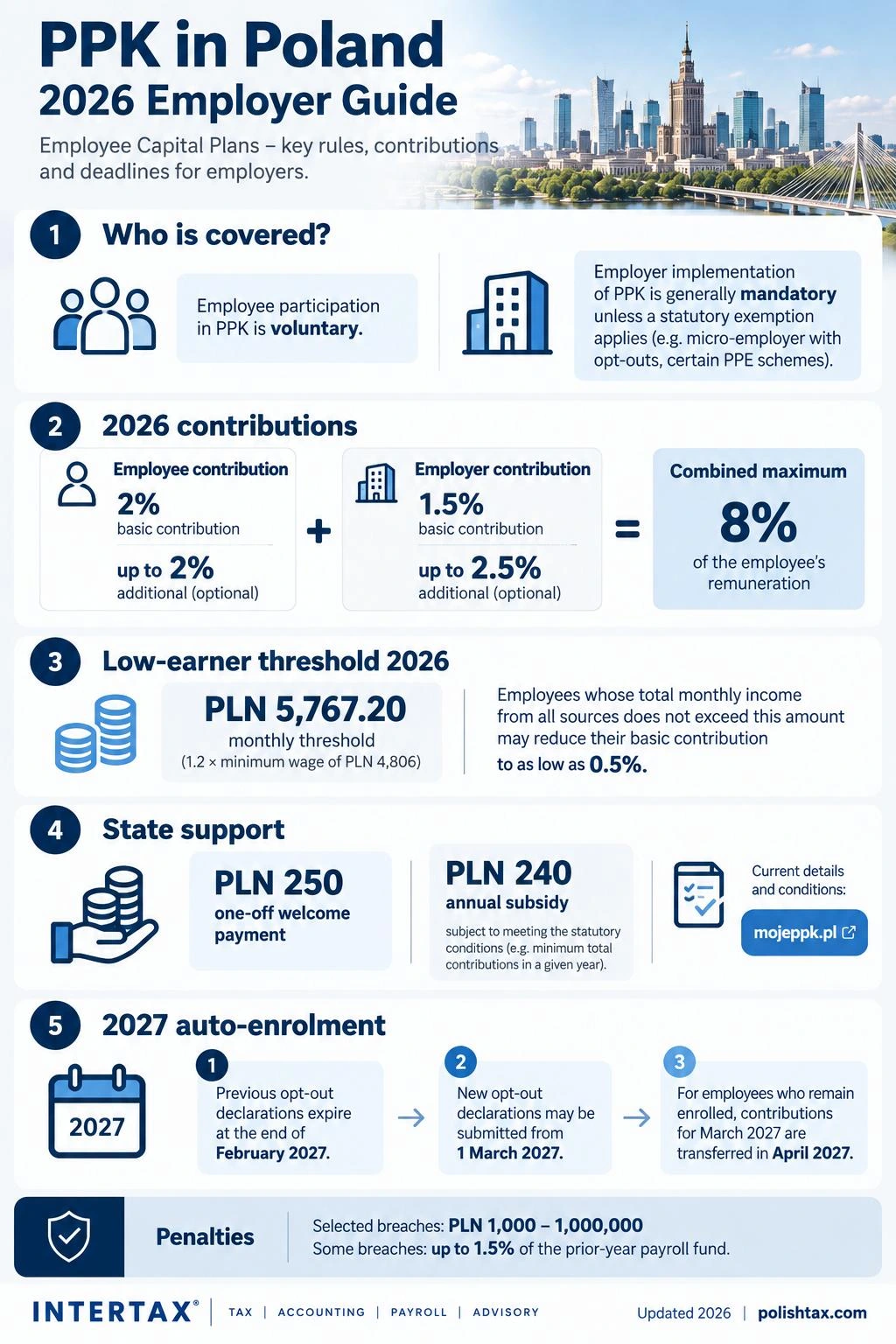
PPK in Poland (Pracownicze Plany Kapitałowe, Employee Capital Plans) is a workplace long-term savings system financed jointly by the employee, the employer and the state. The key compliance point for foreign-owned Polish companies is simple: participation is voluntary for the employee, but implementation is generally mandatory for the employer. In 2026, payroll teams should also prepare for the next recurring auto-enrolment cycle in 2027 and apply the current rules on lower employee contributions, tax treatment and electronic PFR compliance notices.
PPK at a glance
|
Topic |
2026 rule |
|
Who is covered? |
Employers with at least one “employed person” subject to mandatory Polish pension and disability insurance, unless a statutory exemption applies. |
|
Employee participation |
Voluntary: employees can opt out and later return. |
|
Employer participation |
Generally mandatory: the employer must implement PPK and finance at least a 1.5% contribution. |
|
Basic contributions |
Employee 2% (reducible to 0.5% for qualifying low earners); employer 1.5%. |
|
Optional contributions |
Employee up to +2%; employer up to +2.5%; combined maximum 8%. |
|
State support |
PLN 250 welcome payment and PLN 240 annual subsidy, subject to statutory conditions. |
|
Next auto-enrolment |
2027: previous opt-out declarations cease to protect employees from the recurring auto-enrolment cycle; new declarations may be submitted from 1 March 2027. |
|
Penalties |
Selected breaches can trigger fines from PLN 1,000 to PLN 1,000,000; failure to conclude a management agreement or encouraging opt-outs can also be penalised up to 1.5% of the prior-year payroll fund. |
What Is PPK (Employee Capital Plans) in Poland?
PPK is a private, long-term savings programme created under the Act of 4 October 2018 on Employee Capital Plans. Savings are built from three sources: employee contributions, employer contributions and state subsidies. The assets are held in the participant’s private PPK account and are managed by a selected financial institution through a target-date fund structure.
The most common misunderstanding is to describe PPK as “mandatory for everyone”. That is not accurate. For the employee, participation is voluntary: an eligible employee can opt out and can later return. For the employer, however, establishing and operating PPK is generally a statutory compliance obligation unless a specific exemption applies.
Which Employers Must Implement PPK?
As a rule, a Polish employing entity must implement PPK if it employs at least one person who meets the statutory definition of an “employed person” and is subject in Poland to mandatory pension and disability insurance. This can apply to Polish subsidiaries of foreign groups just as it applies to domestic businesses.
The three statutory exemptions
-
A micro-entrepreneur may be exempt if all employed persons submit declarations to opt out of PPK contributions.
-
A natural person who employs another natural person outside the scope of that person’s business activity is outside the PPK regime in the circumstances specified by the Act.
-
An employer operating a qualifying Employee Pension Scheme (PPE) may be exempt if the PPE contribution is at least 3.5% of remuneration and at least 25% of employed persons participate, subject to the statutory conditions.
Foreign-group point: a pension or savings plan operated abroad does not, by itself, replace Polish PPK. The statutory PPE exemption must be satisfied under Polish law.
Who Is Enrolled? Employee Eligibility
Age rules
-
18 to under 55: automatic enrolment, unless the person submits a valid opt-out declaration.
-
55 to under 70: participation only on the employee’s request.
-
70 and over: the employer does not conclude a PPK participation agreement for that person.
For a newly employed person, the employer generally concludes the PPK participation agreement after the required 3-month employment period. Periods of employment with the same employer during the previous 12 months are taken into account under the statutory rules.
Foreign employees, civil-law contracts, B2B and posted workers
Nationality is not the deciding factor. The key question is whether the person is an “employed person” under the PPK Act and is mandatorily covered by Polish pension and disability insurance from the relevant employment title.
-
Foreign employee locally insured in Poland: generally within PPK on the same basis as a Polish employee.
-
Mandatorily insured contractor under a mandate contract (umowa zlecenia): can be within PPK.
-
Student under 26 performing a mandate contract with an entity other than their own employer: generally outside PPK because that mandate is not subject to mandatory social insurance.
-
Self-employed B2B contractor: not enrolled merely because services are supplied to the company.
-
Worker posted to Poland who remains covered by another state’s social-security legislation under a valid A1 certificate: generally outside PPK because Polish mandatory pension/disability insurance does not apply.
Related: posting workers and A1 certificates
PPK Contribution Rates in 2026
|
Contributor |
Basic |
Additional (optional) |
Maximum |
|
Employee |
2% |
up to +2% |
4% |
|
Employer |
1.5% |
up to +2.5% |
4% |
|
Combined |
3.5% |
up to +4.5% |
8% |
The contribution base follows the social-insurance pension/disability contribution base, but the PPK Act expressly disapplies the annual “30-times” cap. Therefore, PPK contributions continue to be calculated even after the annual social-insurance cap has been reached.
Reduced rate for lower earners in 2026
In 2026, the minimum monthly wage is PLN 4,806. An employee whose total monthly remuneration from all sources does not exceed 120% of that amount – PLN 5,767.20 – may reduce the employee basic PPK contribution below 2%, but not below 0.5%. The employee must monitor the threshold across all relevant sources of remuneration.
State contributions
State support consists of a PLN 250 welcome payment and a PLN 240 annual subsidy, subject to statutory eligibility conditions. For the 2026 annual subsidy, the general minimum contribution threshold equals 3.5% of six times the 2026 minimum wage, i.e. PLN 1,009.26. For participants using a reduced basic employee contribution, the statutory threshold is 25% of that amount, i.e. PLN 252.32 after rounding to grosz.
Worked example – PLN 10,000 gross monthly remuneration
-
Employee basic contribution: PLN 10,000 x 2% = PLN 200.
-
Employer basic contribution: PLN 10,000 x 1.5% = PLN 150.
-
Total monthly PPK funding before state subsidies: PLN 350.
-
The employer-funded PLN 150 is generally taxable employee income for PIT purposes, but it is not included in the social-insurance contribution base. At a 12% PIT rate, the additional PIT attributable to the employer contribution is approximately PLN 18, before individual payroll variables.
Related: the true cost of hiring an employee in Poland
How PPK Is Taxed – Employer vs Employee
|
Item |
Employee PIT |
ZUS |
Employer CIT |
|
Employer-funded PPK contribution |
Generally taxable income when made available/credited under payroll rules |
Excluded from ZUS contribution base |
Generally deductible if statutory conditions are met; timing linked to payment under CIT rules |
|
Employee-funded PPK contribution |
Paid from net remuneration; does not reduce taxable income |
No separate ZUS relief effect; amount is withheld from net pay |
Not an employer cost |
|
State welcome/annual subsidies |
Exempt from PIT |
Not subject to ZUS |
Not funded by employer |
|
Qualifying withdrawal after age 60 |
Can be tax-preferred if statutory payout conditions are met |
Not relevant |
Not relevant |
A common misconception is that employer-funded PPK contributions are “tax free” because they are excluded from the ZUS base. These are separate systems: the employer contribution is generally an employee PIT benefit while remaining outside the social-insurance contribution base. State subsidies, by contrast, are tax-exempt.
Related: tax-deductible costs in Poland
Employer Obligations and Deadlines
|
Obligation |
Deadline / timing |
Practical point |
|
Select financial institution |
Before concluding the management agreement |
Selection should follow statutory consultation/coordination rules with trade unions or employee representatives. |
|
Management agreement (umowa o zarządzanie PPK) |
For a new employer: no later than 10 business days before the deadline for the first participation agreement |
This is the employer-to-financial-institution framework agreement. |
|
Participation agreement (umowa o prowadzenie PPK) |
Generally no later than the 10th day of the month following the month in which the 3-month employment period expires |
Concluded by the employer in the name and for the benefit of each eligible person. |
|
Calculate and withhold contributions |
On payroll payment date |
Employee contributions are withheld from net remuneration; employer contributions are funded separately. |
|
Transfer contributions to PPK institution |
Generally by the 15th day of the following month |
Payroll cut-offs and banking calendars should be built into internal procedures. |
|
Retain opt-out declarations and PPK records |
Ongoing |
Keep evidence of employee declarations, calculations, dates and communications. |
Management agreement vs participation agreement
The management agreement creates the employer’s PPK with the chosen financial institution. The participation agreement is then concluded by the employer on behalf of individual eligible employees. Foreign groups often confuse the two because both are signed with the same PPK institution, but they serve different legal functions and have separate timing rules.
Choosing the financial institution
The statutory selection process should involve the relevant trade union organisation or, if none operates, employee representatives. In practice, foreign employers often compare target-date fund costs and performance, digital administration, payroll integration, English-language service, employee education and support for international HR teams.
Related: payroll and employment in Poland
Opting Out and the 2027 Auto-Enrolment
An employee may opt out by submitting the statutory declaration. The employer must not encourage or pressure employees to opt out. An employee who has opted out may return to PPK at any time by submitting a request to resume contributions.
Key dates for employers in 2027
-
By the end of February 2027: inform employees who previously opted out that contributions will be resumed under the recurring auto-enrolment rules.
-
1 March 2027: earlier opt-out declarations cease to protect employees from the new cycle; a new declaration may be submitted from this date.
-
March 2027 payroll: for employees who do not submit a new opt-out declaration, contributions should be calculated and withheld under the auto-enrolment rules.
-
1-15 April 2027: transfer the March contributions to the financial institution (subject to the usual due-date mechanics).
-
Next recurring cycle: 2031.
For employees who will be aged 55 or more before 1 April 2027, the auto-enrolment rules operate differently: they are not automatically brought into PPK solely by the four-year cycle and may need to submit a statutory request, depending on their status and age.
Withdrawing PPK Savings
|
Scenario |
Conditions |
Tax / deductions |
|
After age 60 – standard tax-favoured payout |
25% as a lump sum and 75% in at least 120 monthly instalments, or another statutory tax-favoured configuration |
Designed to preserve PIT exemption on investment gains under statutory conditions. |
|
After age 60 – faster payout |
Participant may choose faster access |
Investment gains may become subject to 19% capital-gains tax if statutory tax-favoured conditions are not met. |
|
Early return before age 60 |
Available at any time |
State subsidies are returned; 30% of employer-funded contributions is transferred to ZUS; 19% tax applies to investment gains. |
|
Housing own contribution before age 45 |
Up to 100% for qualifying mortgage own-contribution purposes |
Must generally be returned to the PPK account within the statutory period, up to 15 years. |
|
Serious illness |
Up to 25% for qualifying serious illness of participant, spouse or child |
No repayment obligation, subject to statutory conditions and documentation. |
|
Death of participant |
Funds pass according to PPK succession rules |
Assets do not simply lapse; designated persons/heirs may receive them under statutory rules. |
What happens when a foreign employee leaves Poland?
There is no special “expat departure” withdrawal mode merely because the employee leaves Poland. The participant can keep the PPK assets invested, transfer them where statutory transfer-payment rules permit, or request an early return. Tax consequences in the employee’s new country of residence should be analysed separately under that country’s rules and the applicable tax treaty.
Penalties for Non-Compliance
PPK compliance is enforceable. Failure to conclude the participation agreement on time, failure to make contributions, incorrect or missing statutory data and failure to keep required calculation records can trigger a fine from PLN 1,000 to PLN 1,000,000. Failure to conclude the management agreement on time, and encouraging employed persons to opt out, can be penalised up to 1.5% of the employer’s payroll fund for the previous financial year. The State Labour Inspectorate (PIP) prosecutes these offences under the applicable procedure.
What Changed in PPK in 2026?
Two developments are especially relevant for employers in 2026. First, the low-earner threshold increased because the minimum wage rose to PLN 4,806, producing a PPK reduced-contribution threshold of PLN 5,767.20 per month. Second, the 2026 deregulation amendment changed how PFR can communicate with employers that have not concluded a PPK management agreement: official notices can be delivered through the employer’s ZUS account, with statutory electronic-delivery effects.
The deregulation measure was initially presented as a government bill in April 2026, but by October 2026 it was no longer merely a proposal. The amending Act of 29 May 2026 was published as Journal of Laws 2026, item 989 and is in force. Employers should therefore review responsibility for monitoring their ZUS account as part of PPK compliance.
2026 statutory review
The PPK Act provides for periodic system review, and policy proposals may continue to appear concerning state subsidies, participation and auto-enrolment. Employers should distinguish enacted law from consultation or policy proposals. The operational rules described in this guide are based on the law and official guidance verified as at 1 October 2026.
PPK Compliance Checklist for Employers
-
Confirm whether the company is a statutory employing entity and whether any Article 13 exemption actually applies.
-
Identify all “employed persons”, including relevant mandate contractors, and verify Polish social-insurance status.
-
Apply the correct age rules and 3-month employment rule for each new hire.
-
Ensure the management agreement is in place and the financial institution was selected under the statutory process.
-
Conclude participation agreements on time for eligible persons who have not opted out.
-
Configure payroll for employee and employer contributions, including the 2026 low-earner threshold of PLN 5,767.20.
-
Do not stop PPK contributions merely because the employee exceeds the annual 30-times social-insurance cap.
-
Apply correct PIT/ZUS treatment to the employer-funded contribution and state subsidies.
-
Transfer PPK contributions by the statutory deadline and retain calculation records.
-
Prepare the employee communication and payroll workflow for the 2027 recurring auto-enrolment.
-
Monitor the employer’s ZUS account for PFR compliance notices under the 2026 electronic-notice rules.
-
Do not encourage employees to opt out; train HR and managers on this restriction.
FAQ
Is PPK mandatory in Poland?
PPK is generally mandatory for the employer to implement, but voluntary for the employee. Eligible employees aged 18 to under 55 are normally enrolled automatically unless they submit an opt-out declaration. Statutory exemptions exist for certain micro-entrepreneurs, certain private individuals and qualifying employers operating a PPE.
Do foreign employees have to join PPK?
Nationality does not determine PPK coverage. A foreign employee or contractor may be covered if they meet the statutory definition of an employed person and are subject in Poland to mandatory pension and disability insurance. A valid A1 certificate keeping the person in another state’s social-security system may therefore change the result.
Can a foreign pension plan replace PPK?
Not automatically. A foreign group pension or savings plan does not itself satisfy the Polish statutory exemption. The relevant Polish exemption concerns a qualifying Employee Pension Scheme (PPE) meeting the statutory contribution and participation conditions. Foreign employers should therefore test their Polish entity separately rather than relying on group-wide benefits.
Are PPK employer contributions taxable?
Yes, the employer-funded PPK contribution is generally taxable income for the employee for PIT purposes, even though it is excluded from the ZUS contribution base. State subsidies such as the PLN 250 welcome payment and PLN 240 annual subsidy are tax-exempt under the PPK rules.
Can I withdraw PPK when leaving Poland?
Yes, but leaving Poland does not create a special withdrawal category. A participant can leave funds invested or request an early return. An early return before age 60 generally causes loss of state subsidies, transfer of 30% of employer-funded contributions to ZUS and capital-gains tax on investment profit.
What happens to PPK after an opt-out in 2027?
Previous opt-out declarations cease to protect employees from the recurring auto-enrolment cycle at the end of February 2027. Employees who still do not want contributions must submit a new declaration from 1 March 2027. Otherwise, the employer resumes calculating contributions from March remuneration and transfers them in April.
Need help setting up PPK or preparing for the 2027 auto-enrolment?
Intertax can support foreign-owned employers with PPK implementation, payroll configuration, employee eligibility reviews, contribution calculations and 2027 auto-enrolment procedures.
Payroll Services | Human Resources
Legal Basis and Official Sources
-
Act of 4 October 2018 on Employee Capital Plans – consolidated text, Journal of Laws 2026 item 192
-
Ministry / government information on the 2026 PPK deregulation amendment
