


A Polish limited partnership (spółka komandytowa, abbreviated as sp.k.) is a commercial partnership with at least one general partner who normally manages and represents the business and bears unlimited subsidiary liability, and at least one limited partner whose liability is limited by the partnership agreement and the statutory rules on the commendam sum. There is no statutory minimum share capital. The partnership comes into existence upon registration in the National Court Register (KRS) and, since 2021, is generally a Polish corporate income tax (CIT) taxpayer rather than a tax-transparent vehicle.
In brief
An sp.k. can be useful where one party is intended to manage the business while another provides capital with a more limited risk profile. Its key advantages are contractual flexibility and the possibility of combining an operating partnership with a corporate general partner. Its main trade-offs are full accounting, CIT at partnership level, partner-level tax on distributions, and ZUS exposure for individual partners. For foreign investors, the structure should be reviewed together with tax treaty, beneficial-owner, signing and corporate-document requirements.
What Is a Limited Partnership in Poland?
A limited partnership in Poland (spółka komandytowa or sp.k.) is a partnership regulated by the Polish Commercial Companies Code. It does not have legal personality in the same way as a limited liability company, but it has its own legal capacity: it may acquire rights and assets, incur obligations, enter into contracts, sue and be sued in its own name. The partnership is created only when it is entered in the National Court Register (KRS).
An sp.k. must have at least two partner roles: at least one general partner (komplementariusz) and at least one limited partner (komandytariusz). The partners may be individuals, companies or other entities capable of becoming partners under Polish law. A foreign investor can therefore use a foreign company as one of the partners, subject to documentary and registration requirements.
A crucial tax point is that a Polish limited partnership should not be described as a pass-through entity. Since 2021, an sp.k. with its registered office or management in Poland is itself a CIT taxpayer. Distributions to partners are then taxed under partner-level rules, although special credit or exemption mechanisms may reduce the economic double taxation in some cases.
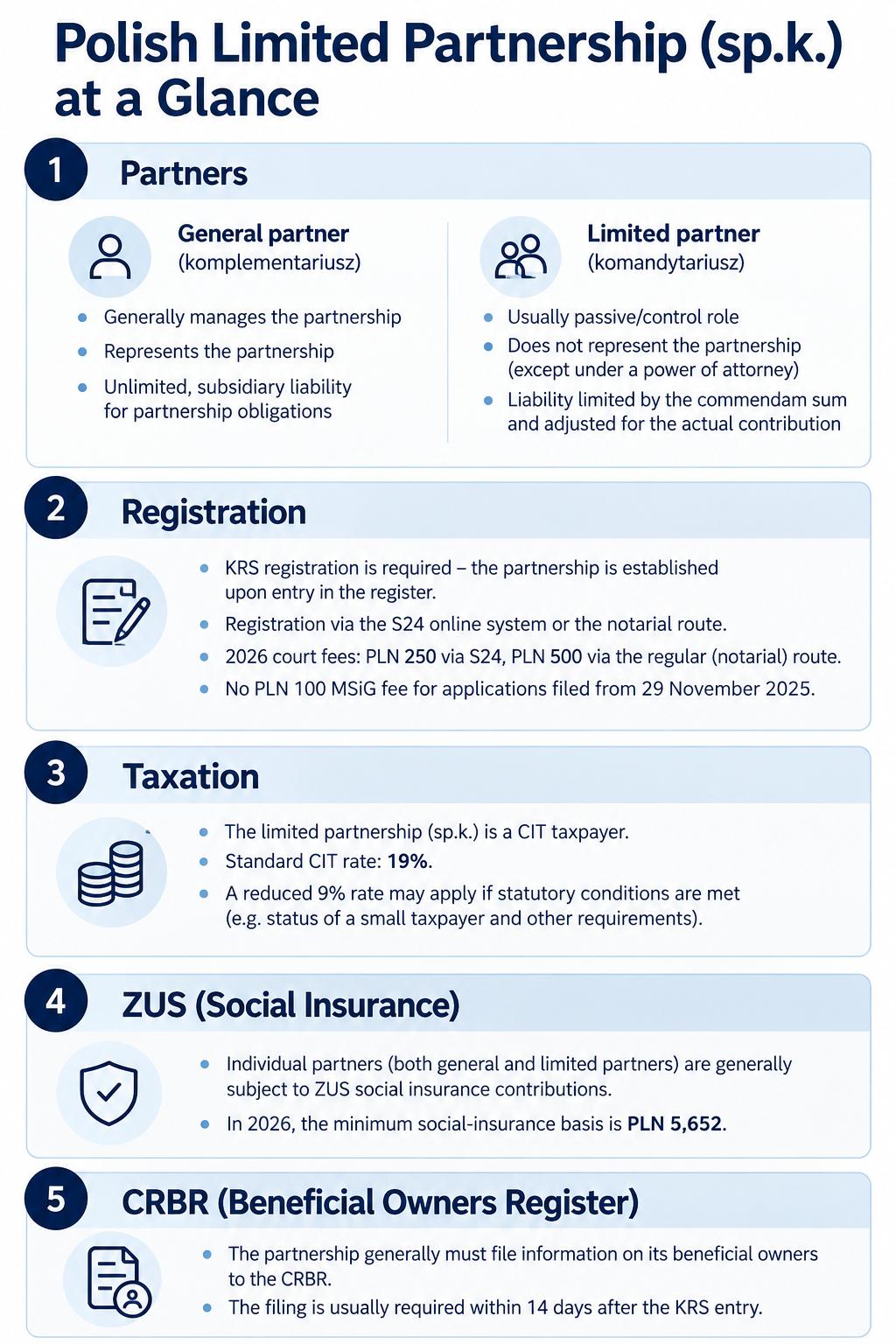
General Partner vs Limited Partner
|
Criterion |
General partner |
Limited partner |
|
Polish term |
Komplementariusz |
Komandytariusz |
|
Management |
Generally manages the partnership |
Generally passive / control role |
|
Representation |
Represents the partnership unless deprived of that right |
Only as attorney/proxy; improper representation can trigger unlimited liability |
|
Liability |
Unlimited and subsidiary for partnership debts |
Limited up to the commendam sum, reduced by the value of contribution effectively made under statutory rules |
|
Tax position |
Partner-level 19% distribution tax may be reduced by a credit for attributable CIT paid by the partnership |
50% distribution exemption up to PLN 60,000 per year per partnership may apply, subject to exclusions |
|
ZUS (individual partner) |
Generally applies |
Generally applies |
Commendam sum (suma komandytowa) vs contribution (wkład). These are not the same concept. The commendam sum is the contractual amount that defines the limited partner’s external liability ceiling toward creditors. The contribution is the value actually contributed or promised to the partnership. Under the Commercial Companies Code, the limited partner is released from liability within the value of the contribution actually made, but liability can revive if the contribution is returned.
|
Numerical example – liability Assume the partnership agreement sets a limited partner’s commendam sum at PLN 100,000 and the partner contributes PLN 70,000. In a simplified example, the remaining external liability exposure can be up to PLN 30,000. If the contribution is later returned in part, the liability can revive to the extent specified by the statutory rules. The exact result should be checked against the agreement and the facts of the payment or return. |
Who Can Establish a Polish Limited Partnership?
In principle, a Polish limited partnership is available to foreign individuals and foreign companies. A fully foreign-owned structure is possible, and a foreign company may act as a general partner or limited partner if the relevant corporate and representation requirements are met. In cross-border structures, the registration process is usually driven less by nationality and more by the ability to prove legal existence, representation and authority to enter the partnership agreement.
For a foreign corporate partner, the filing package may require an up-to-date commercial register extract, constitutional documents, corporate resolutions, powers of attorney and evidence of representation. Depending on the issuing country and the document, an apostille or legalisation and a Polish sworn translation may be necessary.
S24 can be efficient for simple structures, but it may be operationally harder for foreign investors. The system requires accepted electronic signatures, and identification or signature compatibility can become a practical bottleneck. Where governance, profit-sharing, exit rules or cross-border representation must be tailored, a notarial agreement filed through the PRS route is often more suitable.
When Is a Limited Partnership the Right Choice?
A Polish limited partnership can be commercially attractive where the ownership structure should distinguish between an active managing party and a passive or financial investor. The partnership agreement also gives considerable flexibility in allocating profits, which does not always have to mirror the nominal value of contributions.
-
Real-estate or development projects in which the operational partner and capital provider have different roles.
-
Joint ventures requiring detailed rules on management, consent rights, distributions and exit.
-
Passive-investor structures where day-to-day management should remain with the general partner.
-
Family businesses and succession arrangements where economic participation and management roles are separated.
-
A structure using a Polish sp. z o.o. as the general partner to move unlimited external liability to a limited-liability corporate vehicle.
-
Investment projects requiring tailored profit-sharing or waterfall provisions.
|
When an Sp.k. May Not Be the Best Choice An sp.k. may be less attractive when simplicity is the main objective, all founders expect full liability protection, individual partners want to avoid recurring ZUS exposure, or the project does not justify full accounting and more complex partner-level taxation. It is also less internationally familiar than a standard Polish limited liability company. |
How to Register a Limited Partnership in Poland – Step by Step
-
Choose the partners and determine who will be the general partner and who will be the limited partner.
-
Select the partnership name and registered office.
-
Choose the relevant Polish PKD activity codes.
-
Set contributions, each limited partner’s commendam sum and the profit-sharing rules.
-
Decide whether to use the S24 template or a customised notarial agreement.
-
Sign the partnership agreement in the required form.
-
Submit the electronic application for entry in the National Court Register (KRS).
-
After registration, confirm KRS, NIP and REGON data.
-
Complete post-registration formalities, including CRBR, NIP-8, VAT (if required), ZUS, bank account and accounting setup.
Partnership name. The business name must include the surname or business name of at least one general partner and the designation “spółka komandytowa” or the abbreviation “sp.k.”. A limited partner’s surname or business name should not be included in the partnership name; if it is, that limited partner may become liable toward third parties as if it were a general partner.
What Must the Partnership Agreement Contain?
The Commercial Companies Code requires the agreement to state at least:
-
the partnership name and registered office;
-
the scope of business activity;
-
the duration, if fixed;
-
the contribution of each partner and its value;
-
the commendam sum specified for each limited partner.
For a commercially robust agreement, foreign investors should normally go beyond the statutory minimum and address representation, profit and loss allocation, reserved matters, information rights, admission of new partners, transfer of rights and obligations, deadlock, exit, succession, dissolution and dispute-resolution mechanisms.
S24 or Notarial Deed?
|
Criterion |
S24 |
Notarial route |
|
Agreement |
Standard template |
Customised agreement |
|
Contributions |
More limited structuring options |
Cash and appropriate in-kind contributions can be tailored |
|
Signatures |
Electronic signatures in the S24 environment |
Before a notary or through an authorised proxy, subject to formal requirements |
|
Cost |
Lower court and documentation cost |
Higher due to notary and potentially translations / powers of attorney |
|
Speed |
Often faster for simple filings |
Usually slower because the agreement and documents are customised |
|
Best for |
Simple structures |
JV, foreign groups, bespoke governance and investor protection |
S24 should not be presented as a guaranteed “24-hour registration”. In practice, a complete simple filing can be processed quickly, but registration time depends on the registry court, the completeness of the documents and whether the court requests corrections. “Typically a few business days” is a safer operational expectation than a guaranteed 24-hour outcome.
Limited Partnership Registration Costs in 2026
For applications filed from 29 November 2025, the previous PLN 100 publication fee for an entry in the Court and Commercial Gazette (MSiG) no longer applies. The court fee for registering a limited partnership is currently PLN 250 when the agreement is concluded using the S24 template and PLN 500 for a standard registration application filed through the regular KRS/PRS route.
|
Cost item |
Typical amount / treatment |
Comment |
|
KRS registration – S24 |
PLN 250 |
For eligible S24 incorporation using the statutory template |
|
KRS registration – regular route |
PLN 500 |
For standard registration application |
|
MSiG publication fee |
PLN 0 for the KRS entry |
The former PLN 100 fee was removed for applications from 29 Nov 2025 |
|
Notary |
Variable |
Depends on the agreement and notarial tariff |
|
Sworn translations |
Variable |
Often relevant for foreign partner documents |
|
Apostille / legalisation |
Variable |
Depends on country and document |
|
Qualified electronic signature |
Variable |
May be needed in practice for foreign users |
|
PCC |
Generally 0.5% base rules apply |
Calculated under the PCC Act with statutory base and deductions |
|
Advisory and accounting setup |
Variable |
Depends on complexity and scope |
There is no reliable single “all-in incorporation price” for foreign investors because translation, notary, legalisation, signature and advisory costs vary significantly by structure and jurisdiction.
Taxation of a Polish Limited Partnership
CIT at Partnership Level
A Polish limited partnership is itself subject to corporate income tax. The standard CIT rate is 19%. A reduced 9% rate may be available for qualifying small taxpayers and certain businesses starting activity, but it applies only when the statutory conditions are met and generally concerns income other than capital gains. Restructuring exclusions and the current-year revenue limit must also be checked.
For a 2026 overview of the 19% and 9% regimes, see Corporate Tax Options for Low-turnover Companies in Poland.
Taxation of the General Partner
A distribution of profit to a general partner is generally subject to 19% tax at partner level. However, the law provides a credit mechanism under which the partner-level tax can be reduced by the general partner’s proportionate share of CIT paid by the partnership on the profit from which the distribution is made. In practice, this can significantly reduce the economic double taxation, although the exact result depends on the tax position of the partnership and the partner.
|
Numerical example – general partner tax credit Assume an sp.k. earns PLN 1,000,000 of taxable income and pays 19% CIT (PLN 190,000). A general partner is entitled to 20% of the profit distribution, i.e. PLN 162,000 after partnership-level CIT. The nominal 19% partner-level tax would be PLN 30,780. The attributable CIT credit is also 20% of PLN 190,000 = PLN 38,000, but the credit cannot exceed the partner-level tax. In this simplified example, the partner-level tax can therefore be reduced to zero. This illustration ignores other adjustments and assumes the statutory credit conditions are met. |
Taxation of the Limited Partner
A limited partner’s profit distribution is also generally taxed at 19%. A statutory exemption may cover 50% of the limited partner’s income from participation in the profit, capped at PLN 60,000 per tax year separately for each limited partnership. The exemption is not automatic: it is excluded in specified related-party and management situations, including certain links between the limited partner and a corporate general partner. The ownership and governance structure should therefore be checked before relying on the exemption.
Foreign Partners, WHT and Tax Treaties
Where a partner is a non-resident, the Polish domestic tax outcome must be read together with the relevant double tax treaty and the partner’s legal form. The analysis can depend on tax residence, classification of the income, beneficial-owner status, a valid certificate of residence and, for qualifying corporate partners, possible domestic or EU-based exemptions. Cross-border distributions should be reviewed before payment rather than after the withholding obligation has already arisen.
Estonian CIT
A limited partnership is one of the legal forms that can potentially use the Polish lump-sum corporate income tax regime commonly called Estonian CIT. Eligibility depends on the full statutory conditions, including ownership, employment and other requirements. It should therefore not be marketed simply as “0% tax”. The regime is better analysed in a separate corporate-tax comparison.
PCC and VAT
A partnership agreement and certain increases in the contribution base can be subject to Polish tax on civil law transactions (PCC), generally at 0.5% under the rules applicable to company agreements, after statutory deductions. VAT treatment depends on the actual business activity and transactions performed by the partnership, not merely on its legal form. If taxable activities are planned, VAT registration and invoicing obligations should be assessed separately.
For broader tax context, see Polish Tax Law – Complete Guide for Foreign Investors and VAT Registration in Poland.
ZUS Contributions for Partners
An individual partner in a Polish limited partnership is generally treated for social-security purposes as a person conducting non-agricultural activity. ZUS includes partners of limited partnerships in the group for which the minimum basis for social insurance contributions in 2026 is PLN 5,652, corresponding to 60% of the forecast average monthly salary of PLN 9,420.
The sickness contribution is voluntary. The final contribution position can also depend on other insurance titles, periods of coverage and health-insurance rules, so an individual calculation is recommended before choosing the partner structure. Foreign partners may additionally need a coordination analysis under EU/EEA rules or an applicable social-security agreement.
Post-Registration Obligations
Registration in KRS is only the start of the compliance process. A practical post-incorporation checklist includes:
-
NIP-8 supplementary registration data;
-
CRBR beneficial-owner filing – generally within 14 days of the KRS entry, with Saturdays and public holidays excluded from the statutory counting rules;
-
VAT-R if registration is required or commercially justified;
-
bank account and, where relevant, verification for the Polish VAT White List;
-
ZUS registration and contribution analysis for individual partners;
-
full accounting books and an accounting policy;
-
KSeF readiness and an invoicing workflow;
-
annual CIT-8 and financial statements;
-
employee registrations and payroll obligations if the partnership hires staff;
-
AML / beneficial-owner procedures and ongoing updates.
For VAT and e-invoicing support, see VAT Consulting in Poland.
Limited Partnership vs Limited Liability Company in Poland
|
Criterion |
Limited partnership (sp.k.) |
Limited liability company (sp. z o.o.) |
|
Minimum owners / partners |
At least two partner roles: general and limited partner |
One or more shareholders |
|
Minimum capital |
No statutory minimum share capital |
PLN 5,000 share capital |
|
Liability |
Depends on partner category |
Shareholders generally not liable for company debts |
|
Management |
General partners |
Management board |
|
CIT taxpayer |
Yes |
Yes |
|
Profit distribution |
Highly contractually flexible |
Generally linked to shareholding, subject to corporate-law rules |
|
ZUS |
Individual partners generally covered |
Shareholders of a multi-member LLC generally not covered solely because of ownership |
|
Typical use |
Active-passive investor structures, JV and tailored economics |
Standard operating subsidiary or foreign-owned company |
For a detailed LLC comparison, see Polish LLC (Sp. z o.o.) – How to Register, Costs & Taxes in 2026.
Common Mistakes
1. Confusing the contribution with the commendam sum.
2. Including the limited partner’s name or business name in the partnership name.
3. Assuming that every partner benefits from limited liability.
4. Treating the sp.k. as tax-transparent despite its CIT taxpayer status.
5. Ignoring ZUS exposure for individual partners.
6. Using the S24 template for a complex JV or investor-protection arrangement.
7. Missing CRBR, NIP-8, VAT or bank-account formalities after KRS registration.
8. Using “LLP” as if it were a precise legal equivalent of sp.k.
9. Comparing structures only by the nominal CIT rate and ignoring partner-level tax.
10. Assuming that a foreign electronic signature will work seamlessly in S24 without technical or identity issues.
Is a Limited Partnership in Poland Right for Your Business?
|
Often suitable when |
Often less suitable when |
|
One party manages while another contributes passive capital. |
Simplicity is the main priority. |
|
Tailored profit-sharing is important. |
All founders expect full liability protection. |
|
A corporate general partner can be used. |
Individual partners want to avoid recurring ZUS exposure. |
|
The project is a JV, real-estate, family or investment structure. |
The structure does not justify higher legal and accounting complexity. |
Before choosing between an sp.k. and a Polish LLC, compare liability, partner-level taxation, ZUS, governance and planned profit distributions. Intertax can prepare a structure-specific tax and compliance comparison for foreign investors and Polish business owners.
FAQ – Limited Partnership in Poland
What is a limited partnership in Poland?
A Polish limited partnership (spółka komandytowa, sp.k.) is a commercial partnership with at least one general partner and at least one limited partner. The general partner normally manages and represents the business and bears unlimited subsidiary liability, while the limited partner’s liability is limited under the rules on the commendam sum and contribution. The sp.k. is a CIT taxpayer in Poland.
Can a foreigner establish a limited partnership in Poland?
Yes. Foreign individuals and foreign companies can generally participate in a Polish sp.k., including in fully foreign-owned structures. The practical issues are usually documentary: proof of legal existence and representation, corporate approvals, powers of attorney, apostille or legalisation where required, sworn translations and compatible electronic signatures for online filing.
How many partners are required for a Polish limited partnership?
At least two partner roles are required: one general partner and one limited partner. The same person cannot occupy both roles in a way that eliminates the statutory distinction, but companies and individuals may be combined flexibly. In practice, a Polish or foreign company is often used as general partner and investors act as limited partners.
Does a Polish limited partnership have legal personality?
No. An sp.k. does not have legal personality in the same sense as an sp. z o.o., but it does have legal capacity. It can own assets, enter into contracts, incur liabilities and act as a party in court proceedings. It is also a separate CIT taxpayer if it has its registered office or management in Poland.
Is there a minimum capital requirement for an sp.k.?
No statutory minimum share capital applies to a Polish limited partnership. The partnership agreement must, however, specify each partner’s contribution and, for each limited partner, the commendam sum. The amount and form of contributions should be designed with liability, tax, funding and business needs in mind.
How is a limited partnership taxed in Poland?
The partnership itself generally pays CIT at 19%, or potentially 9% if the preferential-rate conditions are met. Profit distributions are then taxed at partner level. A general partner may use a credit for attributable CIT paid by the partnership, while a limited partner may qualify for a 50% exemption capped at PLN 60,000 per year per partnership, subject to statutory exclusions.
Does a limited partner pay ZUS in Poland?
An individual limited partner is generally treated as a person conducting non-agricultural activity for Polish social-security purposes. ZUS therefore usually applies, subject to insurance-title and cross-border coordination rules. In 2026 ZUS lists PLN 5,652 as the minimum basis for social-insurance contributions for this category; health-insurance treatment should be checked separately.
What is the difference between a general partner and a limited partner?
The general partner normally manages and represents the partnership and bears unlimited subsidiary liability for its debts. The limited partner is usually not responsible for day-to-day representation and benefits from limited external liability under the statutory commendam-sum mechanism. Their tax treatment also differs, particularly because the general partner may use the CIT credit mechanism.
Can an sp. z o.o. be the general partner?
Yes. A Polish limited liability company can act as the general partner of an sp.k. This is a common structure because unlimited external liability then rests with a limited-liability corporate entity rather than directly with an individual. The tax and ZUS consequences for the remaining partners still need separate analysis.
Can a limited partnership be registered online through S24?
Yes. An sp.k. can be formed through S24 using the statutory template. This can reduce cost and simplify registration, but the agreement is less flexible. Complex joint ventures, foreign-group structures or arrangements requiring bespoke profit-sharing, consent, exit or succession clauses are often better suited to a customised notarial agreement.
How much does it cost to register an sp.k. in 2026?
The KRS court fee is PLN 250 for eligible S24 registrations and PLN 500 for the regular route. Since 29 November 2025, the former PLN 100 MSiG publication fee no longer applies to the KRS entry. Additional costs may include notary fees, sworn translations, apostille/legalisation, qualified signatures, PCC, advisory work and accounting setup.
Is a Polish limited partnership the same as an LLP?
Not exactly. “LLP” is a legal label used in other jurisdictions and can imply a different liability model. A Polish sp.k. has two distinct partner categories: at least one general partner with unlimited subsidiary liability and at least one limited partner. For cross-border documents, it is safer to use “Polish limited partnership (spółka komandytowa, sp.k.)”.
What is the difference between an sp.k. and an sp. z o.o.?
An sp.k. is a partnership managed by general partners, with liability depending on partner category and flexible contractual profit allocation. An sp. z o.o. is a company managed by a management board, with shareholders generally protected from company debts and a minimum PLN 5,000 share capital. Both are CIT taxpayers, but partner/shareholder tax and ZUS consequences differ.
How Intertax Can Help
Choosing between a limited partnership and a Polish LLC should be based on the planned business model, liability allocation, partner profile, tax residence, ZUS exposure and expected profit distributions. Intertax supports foreign investors and Polish businesses with structure comparisons, tax analysis, incorporation coordination, VAT registration, accounting setup and ongoing compliance.
For incorporation support, see New Business Formation in Poland. For direct contact, use Intertax contact page or email office@intertax.pl.