
VAT Refund in Poland for Foreign Businesses: 8th & 13th Directive Guide (2026)
VAT Refund in Poland – Who Can Reclaim and Under Which Procedure?
A foreign business that incurs Polish VAT may be able to recover it, but the correct procedure depends first on whether the company is registered for VAT in Poland and where it is established. In practice, choosing the wrong route is one of the fastest ways to lose time or miss a filing deadline.
| Your status | Procedure | Where the claim is filed |
| VAT-registered in Poland | Polish VAT return / JPK_V7 | Through regular Polish VAT reporting |
| EU business, not VAT-registered in Poland | Directive 2008/9/EC (successor to the former 8th Directive) | Electronically through the VAT refund portal of the Member State of establishment |
| Non-EU business, not VAT-registered in Poland | 13th Directive 86/560/EEC + Polish domestic rules | Directly to the Head of the Second Tax Office Warszawa-Srodmiescie |
If your company is already registered for Polish VAT, see our guide to VAT refund deadlines for VAT-registered taxpayers in Poland. If the business is not registered, the Directive 2008/9/EC or 13th Directive route may apply instead.
| In practice: Before preparing a refund claim, confirm that the company does not have an establishment or fixed establishment in Poland from which relevant transactions are carried out and that it is not required to register for Polish VAT because of its Polish activities. |
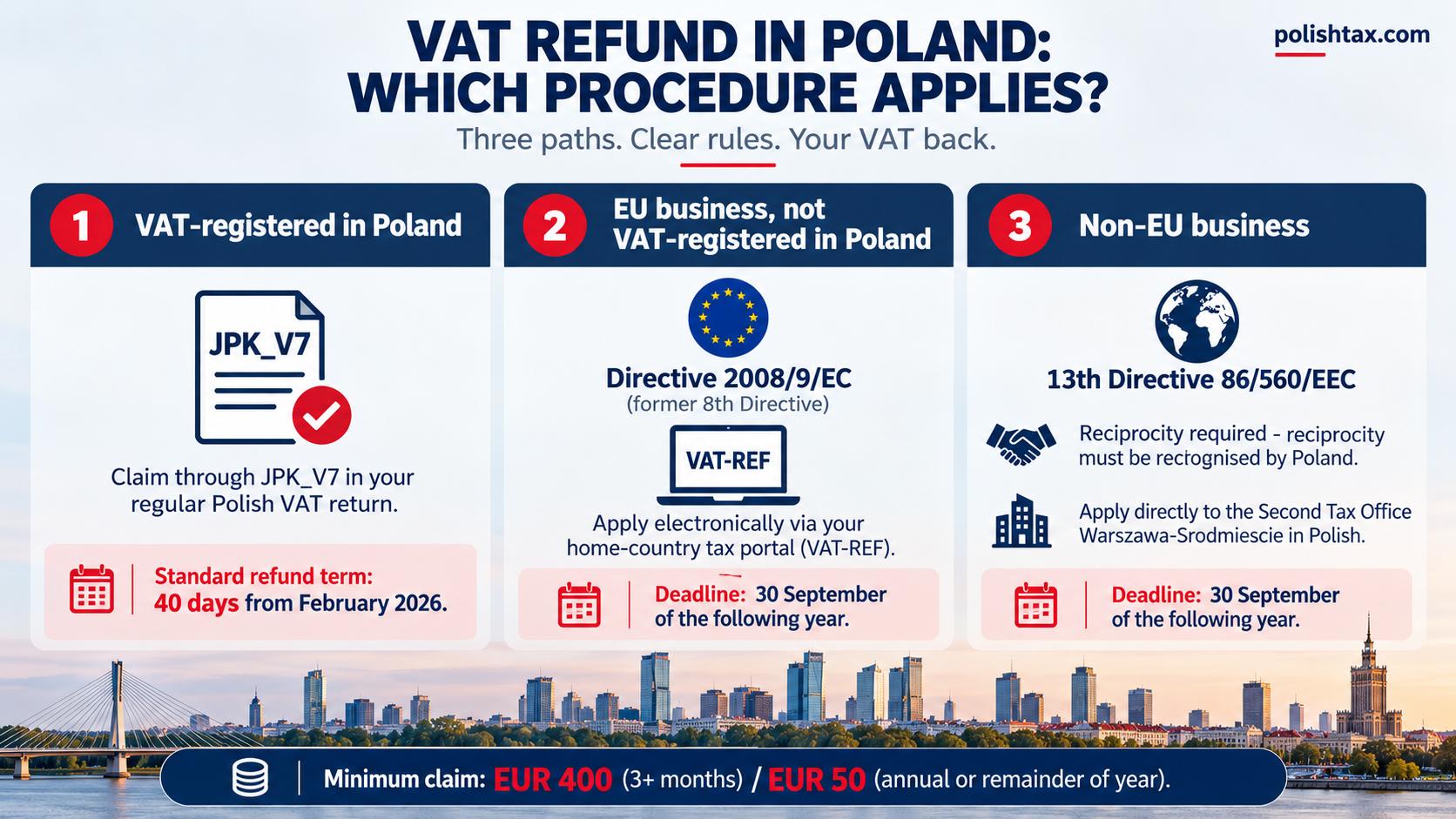 Decision guide: which Polish VAT refund route applies?
VAT Refund for EU Businesses – Council Directive 2008/9/EC
EU-established businesses that incur Polish VAT without being established or VAT-registered in Poland will normally use the electronic refund procedure under Council Directive 2008/9/EC. The Directive replaced the former Eighth Directive procedure, which is why the expression “8th Directive refund” is still widely used in practice even though Directive 2008/9/EC is the current legal framework.
Eligibility criteria
A business established in another EU Member State can generally reclaim Polish VAT if it is a VAT taxable person in its home state, has no establishment or relevant fixed establishment in Poland during the refund period, and does not carry out Polish supplies that would normally require local VAT registration, subject to limited statutory exceptions such as certain reverse-charge transactions. The underlying expenditure must also be connected with activities that give a right to deduct VAT.
| In practice: If the company has local sales, stock movements, installation supplies, a Polish fixed establishment, or other transactions that could trigger VAT registration, test the registration position first. A refund application is not a substitute for a Polish VAT return where registration is required. |
How to submit a VAT-REF application step by step
- Prepare the invoice and import-document data for the relevant refund period. The period is normally at least three calendar months and no more than one calendar year, although the remainder of a calendar year may be shorter than three months.
- Submit the electronic VAT refund application through the tax portal of the EU Member State where the business is established. The home tax administration forwards an admissible claim to Poland.
- Provide the required invoice details, expense codes, Polish supplier VAT numbers, refund amount and bank information. Copies of invoices or customs documents may be required where the taxable amount reaches the statutory thresholds.
- Monitor messages from the Polish tax authority. The Second Tax Office Warszawa-Srodmiescie may request additional information, which should generally be supplied in Polish within the deadline stated in the request.
- After the decision, the approved refund is paid to the bank account indicated in the application. A Polish bank account is not required for an EU VAT-REF claim.
Deadline: 30 September of the following year
The application must be submitted by 30 September of the calendar year following the refund period. For example, VAT incurred in 2025 must be claimed no later than 30 September 2026. Because this is a statutory filing deadline, businesses should avoid leaving invoice validation and home-state portal formalities until the final days of September.
VAT Refund for Non-EU Companies – 13th Directive (86/560/EEC)
Businesses established outside the European Union may reclaim Polish VAT under the 13th Directive framework, implemented through Polish VAT law and the Polish refund regulation. This route is materially different from the EU VAT-REF procedure: the claim is submitted directly in Poland, Polish formal requirements apply, and the reciprocity principle is central.
Reciprocity principle: which countries qualify?
Poland generally grants a refund to eligible third-country businesses only where reciprocal treatment is available to Polish businesses in the claimant’s jurisdiction. As of the current 2026 practice, the commonly recognised non-EU jurisdictions are:
- Iceland
- North Macedonia
- Norway
- Switzerland
- United Kingdom
Reciprocity should still be checked for the relevant period and the claimant’s exact status. A non-EU company from a country outside the recognised reciprocity group may be unable to use the standard 13th Directive route, subject to special rules for certain OSS/IOSS-related activities.
| In practice: For a US business, reciprocity is a critical issue. A US company should not assume that Polish VAT on fairs, logistics or professional costs is refundable merely because the invoices show Polish VAT. The country-of-establishment test must be completed before filing. |
Where to apply: Second Tax Office Warszawa-Srodmiescie
A third-country applicant files its claim directly with the Head of the Second Tax Office Warszawa-Srodmiescie. The application is made under the Polish procedure and should be prepared in Polish. Unlike the EU route, there is no home-state electronic portal that automatically forwards the application to Poland.
The claim must be supported by the documentation required under the Polish refund regulation. A key document is an original certificate issued by the tax authority in the country of establishment confirming that the applicant is registered there as a VAT taxpayer or as a taxpayer of a tax of a similar nature. The certificate is generally reusable for subsequent applications while it remains current and the relevant facts have not changed.
Required documents checklist
- Completed Polish refund application for the correct refund period.
- Invoices and customs documents supporting the claimed Polish VAT, subject to the 2026 KSeF documentation rules described below.
- Original certificate of tax status / VAT or equivalent tax registration issued by the competent authority in the country of establishment.
- KSeF identification numbers for Polish purchase invoices where such numbers have been assigned.
- Bank account details for the refund.
- Power of attorney if a Polish representative is appointed for the refund proceedings.
- Polish translations or explanations where requested by the authority.
Minimum Amounts, Deadlines and Processing Times
| Procedure | Minimum claim | Application deadline | Standard decision time | Payment after decision |
| EU – Directive 2008/9/EC | EUR 400 for 3+ months; EUR 50 for annual/remainder claim | 30 September of following year | 4 months if complete; may extend where information is requested | Normally within 10 working days after the decision |
| Non-EU – 13th Directive | EUR 400 for 3+ months; EUR 50 for annual/remainder claim | 30 September of following year | 4 months if complete; may extend to 6 or 8 months in information-request scenarios | Normally within 10 working days after the decision |
The four-month period assumes a complete claim. If the tax authority requests additional or further information, the final deadline may be extended. This is why a well-documented application can materially improve the practical processing time even though it cannot guarantee a specific refund date.
What Expenses Qualify for a Polish VAT Refund (and What Doesn’t)
A foreign business can only recover VAT to the extent the same input VAT would be deductible under Polish rules and the purchases are connected with its taxable business activity. The fact that an invoice contains Polish VAT does not itself create a right to refund.
| Category | Typical treatment | Practical comment |
| Trade fairs, exhibition costs, professional services, local logistics | Potentially refundable | Subject to business-use and documentation requirements. |
| Fuel, leasing, repairs and other passenger-car expenses | Often partially refundable | Polish rules commonly limit deduction to 50% for mixed-use passenger vehicles unless the conditions for full business-use deduction are met. |
| Hotel accommodation | Generally not refundable | Exception may apply to accommodation purchased for resale and taxed accordingly. |
| Restaurant / catering services | Generally not refundable | Limited statutory exceptions apply, e.g. certain ready meals for passengers supplied by passenger transport businesses. |
| Private, entertainment or non-business expenditure | Not refundable | No business deduction right means no refund right. |
| Incorrectly charged Polish VAT | Not refundable through the normal refund route | The supplier may need to correct the invoice instead. |
What Changed in 2026: KSeF and Corrective Invoice Handling
The rollout of the National e-Invoicing System (KSeF) changes how Polish invoice evidence should be handled. From 2026, many Polish suppliers issue structured invoices through KSeF. For third-country refund claims, where a purchase invoice has a KSeF identification number, the applicant should provide that number in the refund application. If the KSeF number is not provided, the applicant must submit or make available the underlying invoice in the form required by the regulation.
Corrective invoices also matter. If a correction reduces or increases the Polish VAT attributable to a purchase already included in a refund claim, the claimant should make sure that the refund position reflects the corrected amount and that the relevant invoice references are consistent. KSeF makes the link between a structured corrective invoice and the original invoice easier to verify, but it does not remove the claimant’s responsibility to request the correct VAT amount.
A separate 2026 change concerns businesses that are actually registered for Polish VAT: the standard refund term under JPK_V7 was shortened to 40 days for settlement periods from 1 February 2026. That 40-day rule should not be confused with the Directive 2008/9/EC or 13th Directive refund procedures, where the standard decision period remains four months.
Common Mistakes That Delay or Kill VAT Refund Claims
Documentation errors
- Claiming VAT from invoices issued to the wrong legal entity or with incomplete purchaser data.
- Missing tax-status certificate for a third-country applicant.
- Failing to provide KSeF invoice numbers or underlying invoice evidence where required.
- Using invoice amounts that do not match later corrective invoices.
Deadline and process errors
- Missing the 30 September filing deadline.
- Using the Polish VAT-return procedure when the company is not registered, or using VAT-REF when Polish registration is actually required.
- Responding late to a request for additional information from the Polish tax authority.
Eligibility errors
- Assuming a non-EU business qualifies without checking reciprocity.
- Claiming non-deductible hotel, restaurant, private or entertainment expenses.
- Claiming 100% VAT on mixed-use passenger-car costs where Polish law allows only partial deduction.
- Trying to recover VAT that was incorrectly charged and should instead be corrected by the supplier.
How Intertax Supports Your VAT Refund Claim
Intertax assists foreign businesses with the full Polish VAT refund process – from eligibility review and invoice screening to preparation of the claim, correspondence with the Polish tax authority and follow-up on additional-information requests. For non-EU applicants, we also verify reciprocity and the documentation package before the application is filed.
Our support can be combined with broader VAT consulting in Poland, fiscal representation and VAT registration in Poland where the business model requires ongoing Polish VAT compliance rather than a stand-alone refund claim.
To discuss your Polish VAT position or send us invoices for an initial eligibility review, contact Intertax.
FAQ – VAT Refund in Poland
Can a non-EU company get a VAT refund in Poland?
Yes, but the standard 13th Directive procedure is generally subject to reciprocity. The claimant must also meet the Polish eligibility and documentation conditions. For 2026, the recognised reciprocity jurisdictions commonly include Iceland, North Macedonia, Norway, Switzerland and the United Kingdom.
What is the deadline for a VAT refund application in Poland?
For both the EU VAT-REF procedure and the Polish third-country refund procedure, the application must generally be filed by 30 September of the year following the refund period. For example, VAT incurred in 2025 should be claimed by 30 September 2026.
Do I need a Polish bank account to receive the refund?
No. EU VAT-REF refunds may be paid to an account in Poland, the Member State of establishment or another Member State. A Polish bank account is not a general eligibility condition for the refund procedure.
Which countries have a reciprocity arrangement with Poland?
For practical 13th Directive purposes, Poland currently recognises reciprocity with Iceland, North Macedonia, Norway, Switzerland and the United Kingdom. Because reciprocity can change, it should be checked at the time of filing.
What is the difference between the 8th and 13th Directive procedure?
The former 8th Directive route for EU businesses was replaced by Directive 2008/9/EC and is now an electronic home-state portal procedure. The 13th Directive applies to businesses established outside the EU and, in Poland, involves a direct Polish filing plus the reciprocity and tax-status-certificate requirements.
How long does the Polish tax office take to process a refund?
The standard decision period is four months from receipt of a complete claim. If additional information is requested, the procedure may extend, in some cases up to six or eight months. The approved amount is generally paid within 10 working days after the decision.