

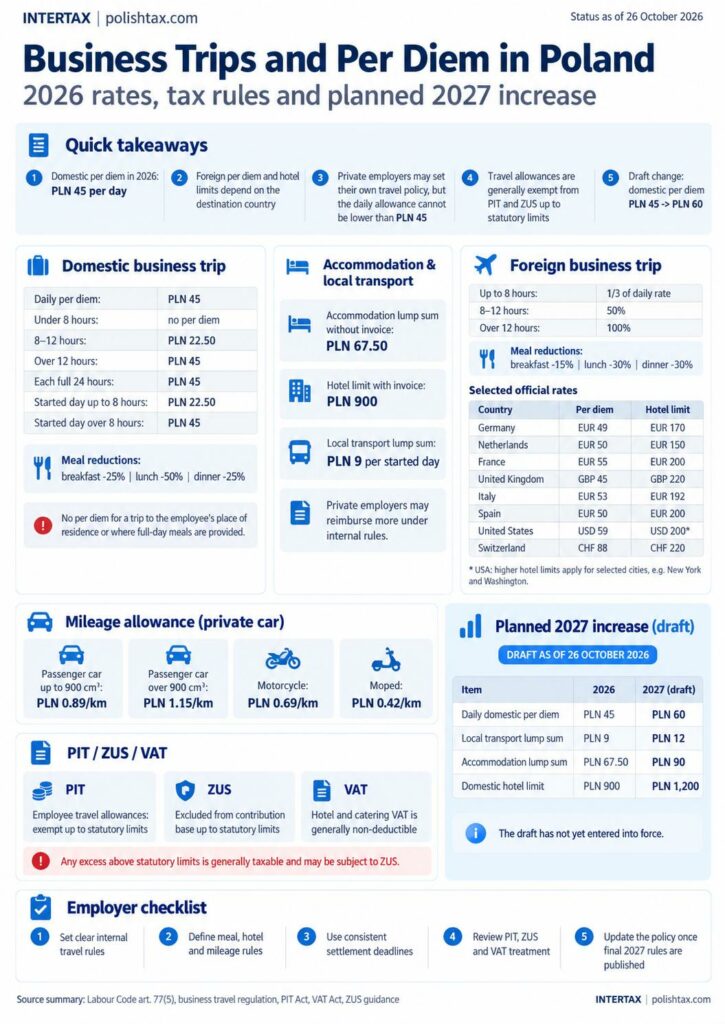
Per diem in Poland is still PLN 45 per day for a domestic business trip in 2026, while foreign per diem and hotel limits depend on the destination country. For employers, the key issues are not only how much to pay, but also when meals reduce the allowance, when lump sums apply, which amounts are exempt from PIT and ZUS, and how travel expenses should be documented. Private-sector employers may set their own business-travel rules, but the daily allowance cannot be lower than the statutory domestic rate. A draft regulation published in January 2026 would raise the domestic rate to PLN 60, but as of 26 October 2026 it has not yet entered into force.
Key Takeaways
- Domestic per diem in 2026: PLN 45 per day.
- Foreign per diem and hotel limits depend on the destination country and currency.
- Private employers may set their own travel policy, but the daily allowance cannot be lower than the statutory Polish domestic rate.
- Qualifying travel allowances are generally exempt from PIT and ZUS up to statutory limits.
- Draft change: domestic per diem PLN 45 → PLN 60; status: draft as of 26 October 2026.
Per Diem in Poland at a Glance (2026)
| Allowance | Domestic trip | Foreign trip |
|---|---|---|
| Daily per diem | PLN 45 | Country-specific rate |
| Accommodation lump sum without invoice | PLN 67.50 (150% of per diem) | 25% of the country hotel limit |
| Hotel limit with invoice | PLN 900 (20 × per diem) | Country-specific hotel limit |
| Local transport lump sum | PLN 9 per started day (20% of per diem) | 10% of foreign per diem per started day |
| Station / airport transfer | Not a separate statutory lump sum | 1 per diem; 50% if only one direction |
| Meal reduction | Breakfast 25%; lunch 50%; dinner 25% | Breakfast 15%; lunch 30%; dinner 30% |
The amounts above are statutory public-sector benchmarks. In the private sector, internal rules may be more generous or structured differently, subject to the minimum daily allowance rule explained below.
Who the Rules Apply To: Public vs Private Employers
Article 775 of the Polish Labour Code distinguishes between public-sector and private-sector employers. Public-sector entities apply the travel regulation directly. Private employers may regulate business-travel payments in a collective agreement, remuneration regulations or the employment contract.
The critical floor is the daily allowance: a private employer may not set a daily allowance for a domestic or foreign business trip below the domestic statutory allowance applicable to public-sector employees. In 2026 that floor remains PLN 45. If the private employer has no internal rules, the statutory regulation applies by default.
Practical point for foreign groups: do not simply copy a global travel policy into Poland. Check whether the policy produces at least the Polish minimum allowance and whether its meal, accommodation and transport rules align with Polish payroll and tax treatment.
Domestic Business Trips: How to Calculate the Per Diem
| Trip duration | Per diem |
|---|---|
| < 8 hours | No per diem |
| 8–12 hours | 50% = PLN 22.50 |
| > 12 hours, up to 24 hours | 100% = PLN 45 |
| Each full 24 hours after the first day | 100% = PLN 45 |
| Started incomplete day up to 8 hours | 50% = PLN 22.50 |
| Started incomplete day over 8 hours | 100% = PLN 45 |
Meal reductions for domestic travel are calculated from the full daily rate: breakfast 25%, lunch 50%, dinner 25%. A hotel breakfast therefore reduces the per diem in the same way as a separately provided breakfast.
Worked example
An employee leaves on Monday at 07:00 and returns on Tuesday at 15:00. The trip lasts 32 hours. The first 24 hours generate PLN 45, and the remaining 8 hours generate 50% of the daily allowance (PLN 22.50). Total before meal reduction: PLN 67.50. If one lunch is provided free of charge, deduct PLN 22.50 (50% of PLN 45). Net per diem: PLN 45.00.
No domestic per diem is due when the employee is sent to the locality of their permanent or temporary residence or when free full-day meals are provided.
Business-travel payroll
Setting up per diem rules for employees in Poland?
INTERTAX accounting and payroll teams can help set up compliant business-travel rules and settlement workflows for your Polish company.
Foreign Business Trips: Per Diem Rates by Country
Foreign per diem and hotel limits are set in the annex to the travel regulation. The table below uses the official rates in force on 26 October 2026.
| Country | Currency | Per diem | Hotel limit |
|---|---|---|---|
| Germany | EUR | 49 | 170 |
| Netherlands | EUR | 50 | 150 |
| France | EUR | 55 | 200 |
| United Kingdom | GBP | 45 | 220 |
| Czech Republic | EUR | 41 | 120 |
| Italy | EUR | 53 | 192 |
| Spain | EUR | 50 | 200 |
| Sweden | SEK | 510 | 2,000 |
| United States | USD | 59 | 200* |
| Switzerland | CHF | 88 | 220 |
* United States: the general hotel limit is USD 200; the annex provides higher limits of USD 350 for New York and USD 300 for Washington.
For an incomplete day abroad: up to 8 hours = 1/3 of the daily rate; over 8 to 12 hours = 50%; over 12 hours = 100%. Free meals reduce the foreign per diem by 15% for breakfast, 30% for lunch and 30% for dinner. If full-day meals are provided, the employee retains 25% of the per diem.
When does the foreign part of the trip start?
- Land travel: when the employee crosses the Polish border on departure; it ends on re-entry.
- Air travel: from take-off from the last Polish airport until landing at the first Polish airport on return.
- Sea travel: from departure from the last Polish port until arrival at the first Polish port on return.
Foreign-currency advances and settlement
The travel regulation allows the advance to be paid in foreign currency or, with the employee’s consent, in PLN using the NBP average exchange rate from the day of payment. The travel settlement may be made in the advance currency, a convertible currency or PLN; when PLN is used, the regulation refers to the average exchange rate from the day the advance was paid. The accounting/tax translation of foreign-currency costs may require a separate tax analysis, so the employee settlement rate should not automatically be treated as the tax-booking rate.
Accommodation, Transport and Other Costs
For domestic trips, hotel costs supported by an invoice are reimbursed up to 20 times the daily allowance, currently PLN 900 per hotel night. In justified cases, the employer may approve a higher amount. Without an invoice, the domestic accommodation lump sum is 150% of the daily allowance, currently PLN 67.50, provided the employee was not given free accommodation.
The domestic accommodation lump sum is available only when the overnight stay lasts at least 6 hours between 21:00 and 07:00. It does not apply during travel time or where the employer determines that the employee can reasonably return each day to their permanent or temporary residence.
For foreign trips, reimbursement is generally limited to the country-specific hotel limit. Without an invoice, the lump sum equals 25% of that limit. The employer may approve a higher invoiced hotel cost in justified cases.
Other necessary and documented expenses may include tolls, parking, baggage charges, visas, travel insurance and other expenses accepted by the employer as justified for the trip.
Using a Private Car: Mileage Allowance
| Vehicle | Maximum rate |
|---|---|
| Passenger car up to 900 cm³ | PLN 0.89/km |
| Passenger car over 900 cm³ | PLN 1.15/km |
| Motorcycle | PLN 0.69/km |
| Moped | PLN 0.42/km |
For a business trip, reimbursement for a private vehicle requires the employee’s request and the employer’s consent. The reimbursement is based on kilometres travelled multiplied by the rate set by the employer, not exceeding the statutory ceiling. This should be distinguished from local business driving, which follows a separate mileage-limit mechanism.
Are Per Diems Tax-Free? PIT and ZUS Rules
| Recipient / payment | PIT | ZUS |
|---|---|---|
| Employee: statutory per diem and qualifying travel reimbursements | Exempt up to statutory limits | Excluded from contribution base up to statutory limits |
| Employee: excess over statutory limit | Taxable employment income | Generally subject to ZUS |
| Non-employee traveller (e.g. contractor / board member) | Possible exemption under Art. 21(1)(16)(b), subject to Art. 21(13) conditions | ZUS treatment depends on the insurance title and payment basis |
| Sole proprietor / JDG owner | No employee-type exemption; own travel per diem may be deductible only up to employee limits | Not an employee travel allowance |
For employees, Article 21(1)(16)(a) of the PIT Act exempts business-travel allowances and reimbursements up to the statutory limits. ZUS applies a parallel exclusion from the contribution base for genuine business-trip amounts within the relevant limits. Calling a payment “per diem” is not enough: the employee must actually be on a business trip within the meaning of the Labour Code.
For non-employees, Article 21(1)(16)(b) can apply, but only if the conditions in Article 21(13) are met — notably, the recipient must not include the reimbursed amount in their own tax-deductible costs and the expense must be incurred for one of the statutory purposes. This is why contractor and management-board travel should be reviewed separately rather than copied mechanically from employee payroll.
Paying travel allowances above the statutory limits? Check the PIT and ZUS treatment with INTERTAX.
Contact usPer Diem in Company Accounting: Costs and VAT
Travel expenses incurred for business purposes — including per diems, accommodation, transport and other justified costs — may generally be treated as tax-deductible costs if the usual business-purpose and documentation conditions are met. The tax treatment should be separated from the payroll exemption analysis: a payment can be a company cost even though part of it is taxable for the employee.
Input VAT on hotel and catering services is generally non-deductible under Article 88(1)(4) of the VAT Act. An important exception exists for certain accommodation services acquired for resale. For ordinary employee business travel, the practical assumption is therefore that hotel VAT is normally not deductible.
Under the statutory travel regulation, an employee should settle a domestic or foreign trip within 14 days after it ends and attach invoices, receipts or tickets for documented expenses. Per diems and statutory lump sums do not require receipts.
Business Trip vs Posting vs Mobile Worker
| Model | Core feature | Key consequence |
|---|---|---|
| Business trip | Temporary task outside the employer’s seat or employee’s permanent workplace | Travel allowances may apply |
| Posting | Employee is sent to work in another country under posting rules | A1/social-security, host-country employment rules and notifications may apply |
| Mobile worker | Travel is an inherent part of the normal job, rather than an exceptional trip | Not every journey qualifies as a business trip |
The distinction matters because the tax and ZUS exemptions for business-trip allowances are tied to a genuine business trip. For example, international road-transport drivers are subject to special rules and are not treated as being on a business trip under Article 775 of the Labour Code for these purposes.
Related reading: posting workers to Poland and working time in Poland.
Payroll and accounting support
Let INTERTAX handle business-travel settlements
- Travel-policy rules aligned with Polish payroll
- Settlement workflows for domestic and foreign trips
- PIT and ZUS treatment of travel payments
Planned 2027 Increase: Domestic Per Diem PLN 60 (Draft)
Draft status — 26 October 2026
The MRPiPS proposal published on 23 January 2026 has not yet been promulgated. The current PLN 45 rate remains legally binding until an amending regulation enters into force.
| Allowance | Current 2026 | Draft |
|---|---|---|
| Daily domestic per diem | PLN 45 | PLN 60 |
| Local transport lump sum | PLN 9 | PLN 12 |
| Accommodation lump sum | PLN 67.50 | PLN 90 |
| Domestic hotel limit | PLN 900 | PLN 1,200 |
The draft also changes selected foreign per diem rates, hotel limits and, for some countries, settlement currencies. Because those country-by-country changes may still change before publication, employers should update travel-policy tables only after the final regulation is promulgated. The draft provides for entry into force 14 days after publication; the originally discussed 2027 timing should therefore be treated as planned rather than guaranteed.
Business Travel Policy Checklist for Employers
- Define domestic and foreign per diem rates and specify whether the company follows the statutory regulation or more generous internal rates.
- Set accommodation limits, rules for exceptions and documentary requirements.
- Describe meal reductions clearly, including hotel breakfasts.
- Set the rules for advances, currencies and settlement of foreign trips.
- Require approval before an employee uses a private vehicle and specify mileage rates.
- Set a deadline and workflow for travel-expense settlement; the statutory benchmark is 14 days after the trip.
- Keep a standard travel order / trip record and supporting evidence.
- Separate business trips from posting, remote work abroad and mobile-worker arrangements.
- Review PIT, ZUS and VAT treatment when company rates exceed statutory limits.
- Monitor the PLN 60 draft and update the policy immediately once the final regulation is published.
Need help with business-travel payroll and accounting? Intertax Accounting Services and Payroll Services can help set up compliant rules and settlement workflows. Contact us.
FAQ: Business Trips and Per Diem in Poland
What is the domestic per diem in Poland in 2026?
The domestic business-trip per diem is PLN 45 per day. For a trip lasting 8–12 hours, 50% is due; for more than 12 hours, the full rate applies. For trips longer than one day, each full day gives PLN 45, with 50% or 100% for the remaining started day depending on its duration.
Will the per diem in Poland increase to PLN 60?
A draft MRPiPS regulation published on 23 January 2026 proposes raising the domestic per diem from PLN 45 to PLN 60. As of 26 October 2026, the change has not yet entered into force, so employers should continue using PLN 45 unless their own policy provides a higher rate.
Can a private employer in Poland pay a lower per diem?
A private employer may create its own business-travel rules, but the daily allowance for domestic or foreign travel cannot be set below the statutory domestic allowance applicable to public-sector employees. In 2026 this minimum is PLN 45 per day.
Are per diems taxed in Poland?
For employees, business-trip allowances and reimbursements are generally exempt from PIT and excluded from the ZUS contribution base up to statutory limits. Any excess over those limits is generally taxable and contributory. The exemption requires a genuine business trip, not merely a payment labelled as a per diem.
How are foreign per diem rates set in Poland?
Foreign per diem rates and hotel limits are listed country by country in the annex to the Polish travel regulation. The destination country determines the rate. For a partial foreign-travel day, the employee receives one-third, one-half or the full daily rate depending on the number of hours.
What is the accommodation lump sum for business trips in Poland?
For a domestic trip without a hotel invoice, the accommodation lump sum is 150% of the daily per diem, currently PLN 67.50. The qualifying overnight stay must last at least six hours between 21:00 and 07:00. For foreign trips, the lump sum equals 25% of the destination-country hotel limit.
Can a contractor or board member receive tax-free per diems?
Potentially yes. Article 21(1)(16)(b) of the PIT Act can exempt travel allowances paid to a non-employee, but the conditions in Article 21(13) must also be met. In particular, the recipient cannot also deduct the reimbursed amount as their own tax cost. ZUS treatment must be checked separately.
Related Intertax Guides
- tax-deductible costs in Poland
- car depreciation limits from 2026
- posting workers to Poland
- employee benefits in Poland
- personal income tax in Poland
- true cost of hiring an employee
- invoices in foreign currency
- working time in Poland
- remote work in Poland
- Polish tax residency
- contract of mandate in Poland
Legal Basis and Official Sources
- Polish Labour Code — Article 775
- Business travel regulation — consolidated text, Journal of Laws 2023 item 2190
- MRPiPS — Business trip guidance
- MRPiPS — draft amending regulation, project no. 90 (23 January 2026)
- PIT Act — Article 21(1)(16) and Article 21(13)
- ZUS — rules for contribution base and business-trip allowances
- Ministry of Finance — VAT deduction guidance
- Ministry of Finance — 2026 rates and limits (including mileage rates)