


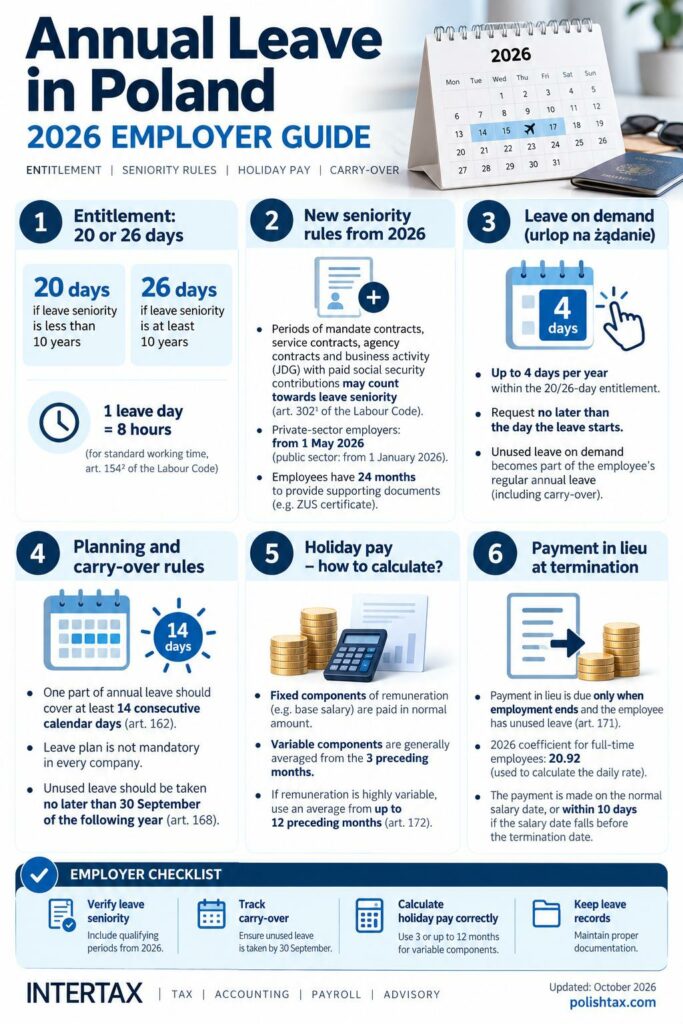
Annual leave in Poland is a statutory, paid employment right. Full-time employees normally receive 20 days a year if their leave seniority is below 10 years and 26 days once it reaches at least 10 years. In 2026 this calculation became more important because documented periods of mandate contracts, service arrangements and qualifying business activity can now count towards employment seniority. Employers must also control pro-rata entitlements, leave on demand, the 30 September carry-over deadline and payroll calculations for holiday pay and unused-leave compensation.
Key Takeaways
- 20 days of annual leave for employees with less than 10 years of leave seniority; 26 days from 10 years.
- From 2026, documented mandate/service periods and qualifying business activity may count towards seniority; for private employers the rules apply from 1 May 2026.
- Leave on demand is up to 4 days, but it is part of the 20/26-day annual entitlement, not an extra pool.
- At the employee’s request, annual leave may be split, but at least one part should cover 14 consecutive calendar days.
- Unused leave should be granted by 30 September of the following year; cash substitution is generally allowed only when employment ends.
Annual Leave in Poland at a Glance
| Rule | What the Labour Code says | Article |
|---|---|---|
| Basic entitlement | 20 days (<10 years) or 26 days (≥10 years) | Art. 154 |
| First job | 1/12 of annual entitlement after each month of work in the first calendar year | Art. 153 |
| Part-time | Pro rata to working-time fraction; incomplete day rounded up | Art. 154 §2 |
| Leave on demand | Up to 4 days within the annual pool | Art. 167²–167³ |
| Minimum continuous part | At least one part should cover 14 consecutive calendar days if leave is split | Art. 162 |
| Unused leave | Grant by 30 September of the following calendar year | Art. 168 |
| Cash payment instead of leave | Generally only on termination/expiry of employment | Art. 171 |
How Many Days of Annual Leave Do Employees Get? (20 or 26 Days)
For a full-time employee the statutory annual entitlement is 20 days where total leave seniority is below 10 years and 26 days where it is at least 10 years. Previous employment periods are counted regardless of breaks between jobs or how earlier employment ended. If the employee reaches the 10-year threshold during the calendar year, they acquire a supplementary leave entitlement so that the annual pool increases to 26 days.
Annual leave is administered in hours. As a general rule, one day of leave corresponds to 8 hours. Leave is granted on days that are working days for the employee, in the number of hours the employee was scheduled to work that day. Example: an employee in an equivalent working-time system who is scheduled for a 12-hour shift and takes that day off uses 12 hours from the annual leave pool, i.e. 1.5 standard leave days for accounting purposes.
Education Counts Towards Leave Seniority
| School completed | Years counted towards leave seniority |
|---|---|
| Basic vocational / equivalent school | Programme duration, up to 3 years |
| Secondary vocational school | Programme duration, up to 5 years |
| General secondary school | 4 years |
| Post-secondary school | 6 years |
| Higher education | 8 years |
These education periods are statutory equivalents under Article 155 of the Labour Code. They are not simply added to overlapping employment. Where a person worked while studying, the employer generally uses the period that is more favourable to the employee rather than double-counting the same time.
New Seniority Rules from 2026: Mandate Contracts and Business Activity Count
The 2025 amendment introduced Article 302¹ of the Labour Code and materially expanded which periods can count towards employment seniority. From 1 January 2026 in the public sector and from 1 May 2026 for other employers, qualifying periods of mandate contracts, service contracts, agency contracts and non-agricultural business activity may be added where the statutory conditions are met, including relevant social-insurance coverage or contributions.
Evidence matters. For periods recorded by ZUS, employees obtain a dedicated certificate through eZUS. Employees who were already employed when the rules took effect have 24 months to provide the documentation for earlier qualifying periods. Employers should therefore update seniority only on the basis of evidence that satisfies the new statutory rules.
Worked example: why the 2026 reform matters
| Stage | Effect on leave seniority |
|---|---|
| Starting point | Employee has 6 years of employment history and 4 documented years of qualifying B2B activity. |
| Before the reform | Before the reform, the B2B period did not count as ordinary leave seniority. |
| After the reform | After the new rules apply and the 4 years are properly documented, total seniority reaches 10 years. |
| Result | The annual leave entitlement therefore moves from 20 days to 26 days. |
Pro Rata Leave: New Hires, Leavers and Part-Time Staff
When an employee changes employers during the year, annual leave is allocated proportionally under Article 155¹. One month corresponds to 1/12 of the annual entitlement, and an incomplete calendar month is rounded up to a full month for the proportional calculation. An incomplete day of proportional entitlement is rounded up to a full day, subject to the overall annual cap.
Example: leaving on 30 April with a 26-day annual entitlement
| Step | Calculation | Result |
|---|---|---|
| Annual pool | Annual entitlement | 26 days |
| Employment with the current employer | January–April | 4/12 of the year |
| Proportional entitlement | 26 × 4/12 | 8.67 days |
| Entitlement with that employer | After statutory rounding (unless more leave has already been validly used under the applicable rules) | 9 days |
For part-time staff, the 20- or 26-day base is multiplied by the employee’s working-time fraction. A half-time employee therefore normally has 10 or 13 days. The result is rounded up to a full day, but leave is still charged in hours according to the employee’s actual schedule.
HR and payroll support
Need to recalculate leave entitlements for your team?
INTERTAX Human Resources and Payroll Services can support leave policies, payroll calculations and employee records.
Leave on Demand (Urlop na Żądanie)
An employee may request up to 4 days of annual leave on demand in a calendar year. The request must be made no later than the day the leave is to start. These 4 days are not additional to the employee’s 20- or 26-day entitlement; they are carved out of it. The annual four-day cap also applies across successive employers in the same year.
Unused leave-on-demand days do not remain a special “on demand” pool in the next year. They become ordinary carried-over annual leave. Accordingly, employers should not treat the 4-day category as a separate annual benefit that must be used or lost.
Scheduling Leave: Plans, Splitting and Recalling Employees
Leave is generally scheduled through a leave plan that takes employee requests and operational continuity into account. A leave plan is not required where the workplace trade union agrees not to prepare one, or where there is no workplace trade union; in those cases the employer agrees leave dates with employees individually.
At the employee’s request, annual leave may be split into parts, but at least one part should cover no fewer than 14 consecutive calendar days. The 14 days include weekends and other non-working days falling within the uninterrupted break; they are not 14 working days.
An employer may recall an employee from leave only when circumstances that were unforeseeable when the leave started require the employee’s presence at work. The employer must reimburse documented costs directly connected with the recall. During a notice period, the employer may instruct the employee to use annual leave without separately agreeing the dates with the employee, subject to the proportional rules for current-year leave.
If an employee becomes unable to work due to sickness during annual leave, the sickness period interrupts the annual leave for the days covered by the statutory interruption rule. Employers should coordinate the absence record with payroll and sickness documentation rather than continuing to charge those days against annual leave.
Unused Annual Leave: The 30 September Deadline
Annual leave should normally be used in the year in which it is earned. If it remains unused, the employer must grant it no later than 30 September of the following calendar year. According to the State Labour Inspectorate, it is sufficient for the carried-over leave to start by 30 September; it may continue after that date.
Missing the deadline does not make the leave disappear. The employee retains the claim, and labour-law claims generally become time-barred after three years. Failure to comply with leave rules may constitute an offence against employee rights and expose the employer to a fine of PLN 1,000 to PLN 30,000.
Important: an employer may not routinely replace annual leave with cash while employment continues. The cash equivalent is an exception linked principally to termination or expiry of employment.
Holiday Pay: How to Calculate It
Under Article 172 of the Labour Code, an employee should receive during annual leave the remuneration they would have received if they had worked. Fixed monthly components are included at the amount due in the month of leave. Variable components for periods no longer than one month are generally averaged over the 3 months preceding the month in which the leave begins; where they fluctuate significantly, the reference period may be extended to 12 months.
Worked example: PLN 9,000 fixed salary + variable bonus
Assumption: employee takes 5 working days (40 hours) of leave in October 2026.
| Step | Calculation | Amount |
|---|---|---|
| Fixed monthly salary | Paid in the normal monthly amount | PLN 9,000 |
| Variable bonuses paid in July–September | PLN 1,200 + PLN 800 + PLN 1,000 | PLN 3,000 |
| Hours actually worked in those months | 184 + 160 + 176 | 520 hours |
| Variable hourly holiday rate | PLN 3,000 / 520 | approx. PLN 5.77 |
| Variable holiday pay for 40 hours | Variable hourly holiday rate × 40 hours | approx. PLN 230.77 |
Total October remuneration therefore includes the normal PLN 9,000 fixed salary plus approx. PLN 230.77 of holiday pay from the variable components.
Certain payments are excluded from the holiday-pay base under the 1997 regulation, including selected one-off or non-periodic payments, jubilee awards, remuneration for periods of absence and some other statutory categories. Payroll should classify each remuneration component before applying the averaging formula.
Payment in Lieu of Leave (Ekwiwalent) at the End of Employment
The right to a cash equivalent arises when employment ends and annual leave remains unused, unless the parties agree that the employee will use the leave under an immediately consecutive employment contract with the same employer in the circumstances permitted by law. From 27 January 2026, the Labour Code also expressly links the payment deadline to the employer’s normal salary date; if that date falls before employment ends, payment is due within 10 days after termination or expiry.
| Year | Full-time coefficient (standard Mon–Fri schedule) | Comment |
|---|---|---|
| 2026 | 20.92 | 251 relevant working days / 12 under the statutory coefficient formula |
| 2027 | 20.92 | Calculated on the same statutory formula for the 2027 calendar |
Example: PLN 9,000 fixed salary and 5 unused days at termination in 2026
| Step | Calculation | Amount |
|---|---|---|
| Unused leave | 5 days × 8 hours | 40 hours |
| Daily equivalent basis | PLN 9,000 / 20.92 | approx. PLN 430.21 |
| Hourly rate | PLN 430.21 / 8 | approx. PLN 53.78 |
| Cash equivalent | PLN 53.78 × 40 hours | approx. PLN 2,151.20 gross |
The actual payroll amount can differ if variable components must also be included.
The cash equivalent is employment remuneration for payroll purposes and is generally subject to PIT and social-security contributions. Employers should calculate it using the coefficient applicable in the calendar year in which the employee acquires the right to the equivalent, not the year in which the underlying leave was earned.
Payroll support
Get holiday pay and leave settlements right
- Holiday pay and unused-leave equivalent calculations
- Leave policies and employee records
- Payroll for employers in Poland
Other Days Off That Are Not Annual Leave
| Entitlement | Amount | Pay status |
|---|---|---|
| Carer’s leave (urlop opiekuńczy) | 5 days per calendar year | Unpaid |
| Force majeure leave | 2 days or 16 hours | 50% of remuneration |
| Child-care leave for a child under 14 | 2 days or 16 hours | Paid |
| Special/circumstantial leave | Depending on event under separate rules | Usually paid where conditions are met |
These absences should not be deducted from the employee’s 20- or 26-day annual leave pool. Similarly, a compensatory day off due to a public holiday falling on the employee’s scheduled day off is a working-time issue, not annual leave.
Contractors, B2B and Foreign Employees
Statutory annual leave under the Labour Code is tied to employment. A contractor working under a mandate agreement or B2B arrangement does not automatically receive 20 or 26 paid vacation days; any paid time off must arise from the contract or another applicable rule. This contractual freedom should not be used to imitate an employment relationship where the factual working model is actually subordinate employment.
Employees posted to Poland are different. During posting, Polish minimum employment conditions can apply, including the minimum annual paid leave entitlement, where Polish rules are more favourable under the posting legislation. Cross-border employers should therefore separate annual-leave analysis from social-security and immigration compliance.
Annual Leave Checklist for Employers
- Recalculate seniority under the 2026 rules where employees provide qualifying ZUS certificates or other statutory evidence.
- Confirm whether each employee is on the 20-day or 26-day entitlement and record any supplementary leave acquired during the year.
- Apply proportional rules correctly for joiners, leavers and part-time staff.
- Maintain a compliant leave-planning process and monitor the 14-calendar-day uninterrupted-break principle.
- Track leave on demand within the annual pool and across successive employment where relevant.
- Review carried-over leave early enough to ensure it starts no later than 30 September.
- Calculate holiday pay separately for fixed and variable components and document payroll assumptions.
- At termination, calculate the unused-leave equivalent with the coefficient for the year the right arises and use the post-27 January 2026 payment deadline.
- Keep leave records consistent with working-time records, sickness absences and payroll.
Need help with Polish HR and payroll compliance? Intertax Human Resources and Payroll Services can support leave policies, payroll calculations and employee records. Contact us.
FAQ: Annual Leave in Poland
How many days of annual leave do employees get in Poland?
A full-time employee normally receives 20 days of annual leave where total leave seniority is below 10 years and 26 days once seniority reaches at least 10 years. Education and, from 2026, certain properly documented mandate/service periods and business activity can count towards the seniority calculation.
Do mandate contracts and business activity count towards leave seniority in Poland?
Yes, from 2026 qualifying periods can count under the new seniority rules. The change applies from 1 January 2026 in the public sector and from 1 May 2026 for other employers. The employee must provide evidence, commonly a dedicated ZUS certificate obtained through eZUS.
What happens to unused annual leave in Poland?
Unused annual leave becomes carried-over leave and should be granted by 30 September of the following calendar year. PIP states that it is enough for the employee to start that leave by 30 September. The entitlement does not automatically expire on that date, although limitation periods still apply.
Can an employer pay out unused leave instead of granting it?
Generally no. During ongoing employment, annual leave should be taken in kind and cannot routinely be exchanged for cash. A cash equivalent is principally due when the employment relationship ends and leave remains unused, subject to the limited exception for an immediately consecutive contract with the same employer.
How is holiday pay calculated in Poland?
Fixed monthly remuneration is paid at the amount due for the month of leave. Variable monthly components are generally averaged over the 3 preceding months and converted into an hourly holiday-pay rate based on hours actually worked. Significant fluctuations may justify extending the averaging period to 12 months.
Is leave on demand extra to the 20 or 26 days?
No. Leave on demand is part of the ordinary annual leave entitlement. An employee may use up to 4 days under the on-demand procedure in a calendar year, but those days reduce the same 20- or 26-day annual pool. Unused on-demand leave carries over only as ordinary annual leave.
Does sick leave during annual leave extend the holiday?
Illness can interrupt annual leave for the period of certified incapacity to work. The affected days should no longer be charged as annual leave and the remaining leave must be rescheduled. Employers should ensure that HR absence records, sickness documentation and payroll treatment are updated consistently.
Related Intertax Guides
- Working time in Poland
- Employment contract in Poland
- Employment termination in Poland
- Polish Labour Code
- Remote work in Poland
- True cost of hiring an employee
- Contract of employment vs B2B
- Contract of mandate in Poland
- Sick leave in Poland
- Posting workers to Poland
- Employee benefits in Poland
Legal Basis and Official Sources
- Polish Labour Code — consolidated text (ELI)
- MRPiPS — Leave and time-off guidance
- MRPiPS — 2026 seniority rules Q&A
- MRPiPS — ZUS certificate and 24-month documentation window
- PIP — Annual leave guidance
- PIP — 30 September carry-over deadline
- 1997 regulation on holiday pay and cash equivalent (ELI)
- PIP — payment deadline for unused-leave equivalent