


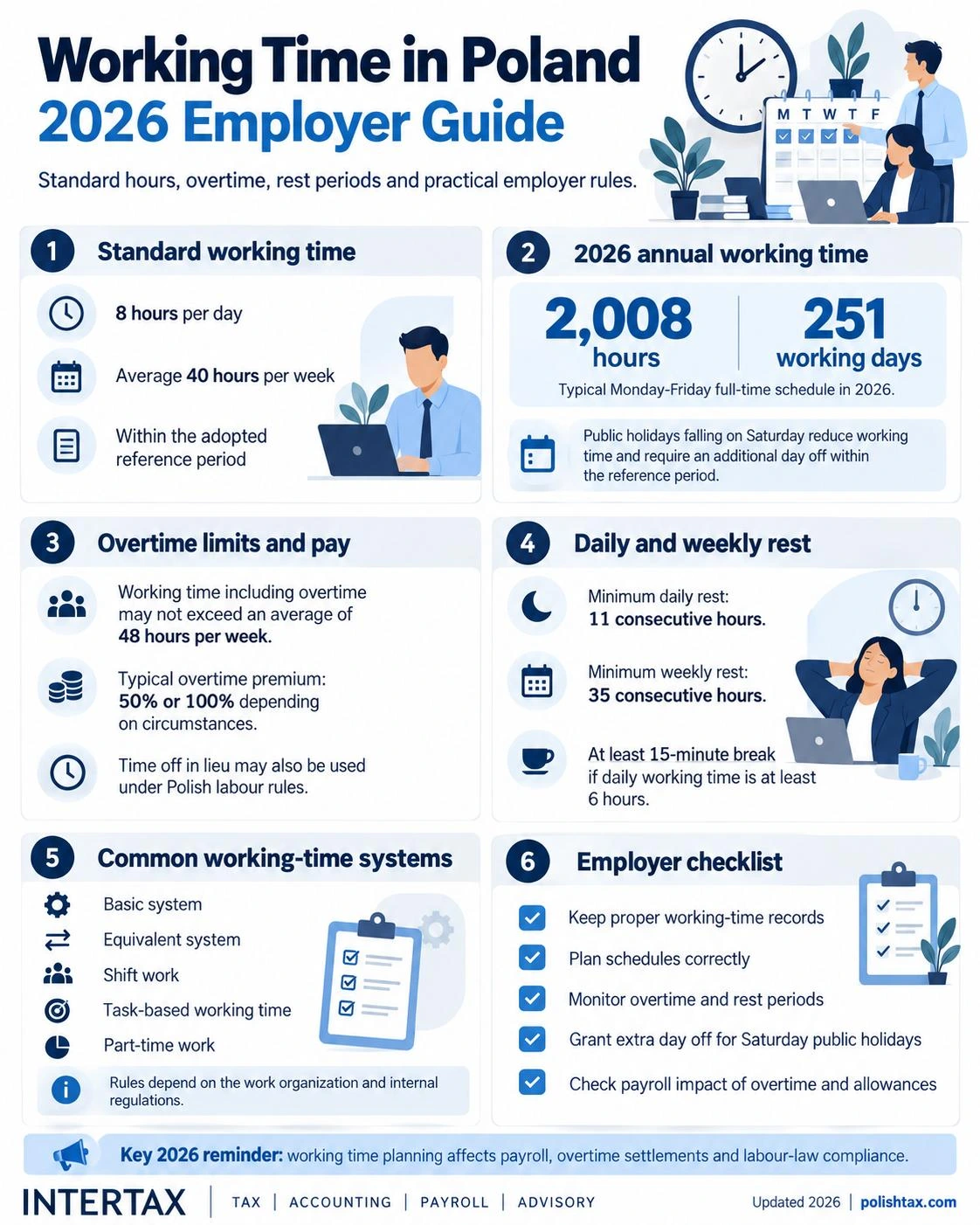
Working time in Poland is tightly regulated by the Labour Code. A standard full-time employee normally works up to 8 hours per day and an average of 40 hours per week in an average five-day working week. Employers must also observe daily and weekly rest, overtime limits, break entitlements, scheduling rules and detailed working-time records. In 2026, a standard Monday-to-Friday full-time schedule produces 2,008 working hours in the year. This guide explains the rules from an employer and payroll perspective, including how overtime is compensated, how Saturday and Sunday work should be handled and what must be documented for a labour inspection.
Working Time in Poland at a Glance (2026)
|
Topic |
2026 rule |
|
Standard daily norm |
8 hours |
|
Standard weekly norm |
Average 40 hours in an average five-day week |
|
Maximum with overtime |
Average 48 hours per week in the reference period |
|
Daily rest |
At least 11 consecutive hours |
|
Weekly rest |
At least 35 consecutive hours (limited exceptions) |
|
Default annual overtime limit |
150 hours for overtime due to the employer’s special needs; another limit may be set lawfully |
|
2026 annual full-time dimension |
2,008 hours / 251 working days for a standard Mon-Fri schedule |
|
Work schedule |
Normally at least 1 month, delivered at least 1 week before the covered period |
|
Breaks |
15 minutes at 6+ hours; another 15 minutes above 9 hours; another 15 minutes above 16 hours |
What Counts as Working Time?
Working time is the time during which an employee remains at the employer’s disposal at the workplace or at another place designated for work. The practical question is therefore not limited to time spent actively performing tasks. Certain waiting periods, mandatory meetings, required training or employer-controlled availability may also count, depending on the facts.
For employers, this distinction matters because payroll and compliance are based on actual working time, not only the nominal timetable. Time records should therefore be reconciled with overtime orders, travel or on-call arrangements, absences and work performed outside normal hours.
Standard Working-Time Limits
Under the basic system, working time may not exceed 8 hours per day and an average of 40 hours per week in an average five-day working week over the applicable reference period. The standard reference period is generally up to four months. Where objective, technical or work-organisation reasons justify it, a reference period may be extended up to 12 months, provided health and safety protections are maintained.
The 40-hour rule is an average, not necessarily a rigid requirement that every individual week contain exactly 40 hours. A lawful schedule may contain longer and shorter weeks, provided the applicable system, reference-period rules, rest periods and overall limits are respected.
2026 Working-Time Dimension by Month
For a full-time employee working in the standard Monday-to-Friday model, the 2026 dimensions are:
|
Month |
Hours / days |
Month |
Hours / days |
|
January |
160 h / 20 days |
February |
160 h / 20 days |
|
March |
176 h / 22 days |
April |
168 h / 21 days |
|
May |
160 h / 20 days |
June |
168 h / 21 days |
|
July |
184 h / 23 days |
August |
160 h / 20 days |
|
September |
176 h / 22 days |
October |
176 h / 22 days |
|
November |
160 h / 20 days |
December |
160 h / 20 days |
2026 total: 2,008 hours and 251 working days. Two public holidays fall on Saturday in 2026: 15 August and 26 December. Each reduces the working-time dimension by 8 hours for a full-time employee under the standard norm, so the employer must schedule an additional day off within the relevant reference period.
Working-Time Systems Employers Can Use
The Labour Code allows several working-time systems. The appropriate system should reflect the operational model and must be introduced through the correct internal instrument. Common examples include:
-
Basic working time – normally up to 8 hours per day.
-
Equivalent working time – daily work may be extended, commonly up to 12 hours, with shorter work or days off elsewhere in the reference period; special variants allow longer shifts in narrowly defined situations.
-
Task-based working time – suitable only where the type and organisation of work genuinely allow tasks to be set so they can be completed within statutory norms.
-
Shortened working week – at the employee’s written/electronic request, work may be concentrated into fewer than five days, with longer daily hours within statutory limits.
-
Weekend work – at the employee’s request, work may be scheduled only on Fridays, Saturdays, Sundays and public holidays under a special system.
-
Flexible or variable start-time schedules – can support hybrid teams and shift operations when introduced in accordance with statutory rules.
A contract clause alone does not cure a schedule that violates mandatory rest, average weekly limits or statutory protections.
Work Schedules: What Employers Must Prepare
Where an individual schedule is required, it may cover a period shorter than the reference period, but normally at least one month. The employer should provide it to the employee at least one week before the period covered by the schedule begins. In 2026 the Labour Code expressly uses paper or electronic form for relevant schedule-related documentation.
An employer does not always need to prepare a separate individual roster, for example where the employee works according to a fixed schedule resulting directly from workplace rules, the employment contract or an agreed flexible arrangement. Nevertheless, the employer must still be able to demonstrate the applicable working-time pattern and actual hours worked.
Breaks During the Working Day
|
Daily working time |
Statutory paid break included in working time |
|
At least 6 hours |
At least 15 minutes |
|
More than 9 hours |
A second break of at least 15 minutes |
|
More than 16 hours |
A third break of at least 15 minutes |
These statutory breaks count as working time. Separate rules may apply to specific employee groups or workplaces, including employees working at screen monitors, employees with disabilities, breastfeeding employees and employees performing particularly burdensome work.
Daily and Weekly Rest
Daily rest: employees are generally entitled to at least 11 consecutive hours of rest in each 24-hour employee day.
Weekly rest: employees are generally entitled to at least 35 consecutive hours of rest each week, including at least 11 hours of daily rest. In specified exceptional situations, weekly rest may be shortened to not less than 24 hours.
Rest rules are among the most important controls when planning overtime or late/early shifts. Even where overtime is permissible and paid correctly, a schedule can still breach the Labour Code if required rest is not provided.
Overtime in Poland: When Is It Allowed?
Overtime is work performed beyond the applicable daily working-time norm or beyond an extended daily limit resulting from the employee’s working-time system and schedule. It is permitted primarily when required for:
-
rescue operations necessary to protect life or health, property or the environment, or to remove a breakdown;
-
the employer’s special needs.
As a rule, an employee must comply with a lawful overtime instruction. However, statutory prohibitions or consent requirements apply to certain groups.
Overtime Limits
Three separate controls should be checked:
-
The employee must still receive the required daily rest. In the basic system this normally means work plus overtime cannot routinely occupy more than 13 hours of the employee day.
-
Average weekly working time, including overtime, may not generally exceed 48 hours in the reference period.
-
Overtime due to the employer’s special needs is subject to a default limit of 150 hours per calendar year. A collective agreement, workplace regulations or—where applicable—the employment contract may set a different annual limit, but the 48-hour average weekly ceiling and rest rules remain binding.
How Overtime Is Compensated
|
Situation |
Typical compensation |
|
Overtime at night |
Normal remuneration + 100% overtime supplement |
|
Overtime on Sundays/public holidays not scheduled as working days |
Normal remuneration + 100% supplement where statutory day-off compensation is not provided as required |
|
Overtime on a day granted in exchange for Sunday/holiday work |
Normal remuneration + 100% supplement |
|
Overtime resulting from exceeding the average weekly norm |
Generally 100% supplement, unless already compensated as daily overtime |
|
Other overtime |
Normal remuneration + 50% supplement |
|
Time off at employee’s request |
1 hour off for 1 overtime hour |
|
Time off granted by employer without employee request |
1.5 hours off for each overtime hour; must be granted by the end of the reference period and cannot reduce full monthly remuneration |
The exact payroll calculation depends on the employee’s remuneration structure. The overtime supplement is separate from the normal remuneration due for the overtime hour. Employers should therefore avoid treating overtime as a single flat premium unless the statutory conditions for a specific arrangement are met.
Saturday, Sunday and Public-Holiday Work
A common mistake is to treat every Saturday as automatic “100% overtime”. That is not the correct starting point. If Saturday is the employee’s day off resulting from the average five-day working week, work on that day should generally be compensated with another full day off by the end of the reference period, regardless of the number of hours worked. Additional overtime consequences may arise if the employee works beyond the daily norm or if no day off can be provided and the average weekly norm is exceeded.
Work on Sundays and public holidays is permitted only in cases listed by law. Where such work is lawful, the employer should first follow the statutory day-off compensation rules. If a substitute day off cannot be provided within the relevant statutory window, a 100% supplement may become due.
Christmas Eve (24 December) is a public holiday from 2025 onwards. In 2026 it falls on Thursday and therefore reduces the December working-time dimension.
Night Work
The employer defines an eight-hour night period falling between 21:00 and 07:00. Employees performing night work receive a statutory night-work allowance for each hour worked at night. The allowance is linked to the minimum wage and the monthly working-time dimension, so its amount varies by month.
A worker whose schedule includes at least three night hours in each working day, or whose night work constitutes at least one quarter of working time in the reference period, is treated as a night worker. Additional restrictions apply where night workers perform particularly dangerous work or work involving significant physical or mental effort.
Employees with Special Working-Time Protection
|
Employee group |
Key protection |
|
Pregnant employee |
No overtime and no night work; additional restrictions apply to extended daily schedules. |
|
Juvenile employee |
No overtime and no night work; separate working-time limits apply. |
|
Employee raising a child under 8 |
Overtime, night work, interrupted working time and business travel away from the permanent workplace require the employee’s consent. |
|
Employee with a disability |
Separate working-time rules may apply depending on degree of disability and statutory exceptions. |
|
Employee exposed above occupational limits |
Extended daily schedules may be restricted; overtime may also be limited in specific circumstances. |
Working-Time Records: What Must Be Documented?
Employers must maintain records enabling correct determination of remuneration and other employment-related benefits. From a PIP inspection perspective, the most important question is whether the records reflect the employee’s actual working pattern.
-
actual start and end times where required by the applicable record format;
-
number of hours worked and overtime;
-
night work;
-
days off and the legal basis for them;
-
on-call duty where relevant;
-
leave and other excused absences;
-
unexcused absences;
-
special working-time arrangements and employee requests where applicable.
Payroll data, access-control logs, email or system activity and manager instructions can expose discrepancies between official records and actual practice. For this reason, working-time compliance should be treated as an HR-and-payroll process rather than a purely administrative formality.
Remote and Hybrid Work: Working Time Still Applies
Remote work does not remove Labour Code working-time limits. A remote employee remains subject to the applicable system, schedule, rest periods and overtime rules. The practical risk is evidentiary: after-hours emails, chat messages and task requests may show that work was performed outside the recorded schedule.
For the dedicated 2026 rules on home office costs, occasional remote work and cross-border risk, see Remote Work in Poland.
Employer Compliance Checklist
1. Confirm the working-time system and reference period used for each group of employees.
2. Calculate the correct working-time dimension for each reference period, including public holidays.
3. Prepare schedules on time and retain evidence of delivery where schedules are required.
4. Check the 11-hour daily and 35-hour weekly rest rules before approving overtime or shift changes.
5. Keep overtime approval and compensation rules consistent between HR, managers and payroll.
6. Provide substitute days off for work on five-day-week rest days and handle Sunday/holiday work under the specific statutory rules.
7. Monitor protected groups, especially pregnant employees, juveniles and parents of children under 8.
8. Maintain working-time records that match actual work, including remote work and after-hours activity.
9. Reconcile time records with payroll before closing each month.
10. Review internal policies whenever working patterns, shift models or reference periods change.
Common Mistakes Foreign Employers Make
-
Assuming that “40 hours per week” means exactly 40 hours in every calendar week rather than an average within the reference period.
-
Treating Saturday work automatically as 100% overtime instead of first checking why Saturday was a day off and whether a substitute day off is due.
-
Paying overtime without checking whether daily or weekly rest was breached.
-
Using manager-approved spreadsheets that do not match the official working-time record.
-
Ignoring after-hours remote work because the employee was not physically in the office.
-
Changing schedules at short notice without a lawful basis or documented rules.
-
Applying one global working-time policy without adapting it to Polish Labour Code requirements.
-
Failing to give a day off for a public holiday falling on a Saturday where the holiday reduces working-time dimension.
FAQ
What is the standard working time in Poland?
The standard Labour Code norm is 8 hours per day and an average of 40 hours per week in an average five-day working week over the applicable reference period. Different working-time systems can lawfully allow longer daily shifts, but average limits, rest periods and other safeguards still apply.
How many working hours are there in Poland in 2026?
For a full-time employee on a standard Monday-to-Friday schedule, the 2026 annual dimension is 2,008 hours, equivalent to 251 working days. Monthly dimensions range from 160 to 184 hours. The actual schedule may differ depending on the working-time system and reference period.
What is the maximum working week including overtime?
As a rule, weekly working time together with overtime may not exceed an average of 48 hours in the adopted reference period. This is separate from the default annual overtime limit and from the employee’s rights to daily and weekly rest.
How much is overtime paid in Poland?
Overtime normally requires the employee’s ordinary remuneration plus either a 50% or 100% statutory supplement, depending on when the overtime occurs and why the supplement is due. Instead of a supplement, overtime may be compensated with time off under the statutory 1:1 or 1:1.5 rules.
Is Saturday work always overtime in Poland?
No. Saturday is not automatically an overtime day. If it is the day off granted because of the average five-day working week, the employer generally owes another full day off within the reference period. Overtime supplements may arise separately if daily or average weekly norms are exceeded.
How much rest must an employee receive?
Employees are generally entitled to at least 11 consecutive hours of daily rest and at least 35 consecutive hours of weekly rest. Limited statutory exceptions exist, but employers should not treat them as routine scheduling tools.
Can a parent of a young child be required to work overtime?
An employee raising a child under 8 cannot be assigned overtime, night work, interrupted working time or work away from the permanent workplace without consent. Employers should keep the employee’s relevant declaration current in the personnel file.
Does working time apply to remote employees?
Yes. Remote and hybrid employees remain subject to working-time norms, overtime rules and rest periods. Employers should ensure that remote-work processes do not encourage unrecorded after-hours work and that time records remain consistent with actual practice.
How Intertax Can Help
Working-time errors often become payroll errors and can create exposure during a State Labour Inspectorate (PIP) review. Intertax can support foreign-owned employers with Polish working-time rules, payroll reconciliation, HR procedures, remote-work policies and employment compliance.
Payroll Services | Human Resources | Payroll and Employment in Poland
Related Intertax Guides
Official Sources
-
Ministry of Family, Labour and Social Policy – setting and settling working time
-
Ministry of Family, Labour and Social Policy – overtime work
-
State Labour Inspectorate – questions and answers on overtime and days off
