


Sick leave in Poland usually involves two payments: employer-funded sick pay for the first 33 qualifying calendar days in a year, or 14 days under the age-related rule, followed by a sickness benefit financed through the social insurance system. The standard rate is 80% of the assessment base, with statutory exceptions at 100%. However, the organisation funding a payment is not always the organisation transferring it to the employee. For foreign employers, understanding that distinction is essential to calculating payroll, sending documents to ZUS and managing absence correctly. This guide explains the rules applying in October 2026 and separates them from enacted changes taking effect in 2027.
Key Takeaways
- The employer generally funds 33 calendar days of sick pay per year. The 14-day limit applies from the year after the employee turns 50.
- After that limit, the benefit is financed by the Social Insurance Fund, or FUS, and paid by ZUS or an authorised benefit-paying employer.
- The normal rate is 80% of the assessment base, including hospital stays. It is not 80% of take-home pay.
- Rules on using sick leave and conducting checks changed on 13 April 2026; document procedures were simplified from 1 July 2026.
- From 1 January 2027, enacted rules will permit different treatment of separate jobs where statutory conditions are met. This will not create a general right to work while on sick leave (called sometimes ZLA or L4).
Sick Leave in Poland at a Glance
“ZLA” and “L4” is the common Polish term for medically certified absence. The official electronic certificate is called e-ZLA. The table distinguishes the funding source from the paying organisation. Rates refer to the assessment base, and entitlement conditions must still be met.
| Situation | Funded by | Paid by | Applicable period | Rate |
|---|---|---|---|---|
| Ordinary illness | Employer | Employer | First 33 qualifying days in the calendar year | usually80% |
| Employee covered by the age-related limit | Employer | Employer | First 14 qualifying days, from the year after turning 50 | usually80% |
| Illness after the employer-funded limit | FUS | ZUS or an authorised benefit payer | Normally from day 34 or 15 | usually80% |
| Hospital stay | Employer or FUS, depending on the stage | The payer applicable to that stage | Within the relevant entitlement period | usually80% |
| Illness during pregnancy or a qualifying commuting accident | Employer, then FUS | Employer, then the appropriate benefit payer | According to the applicable stage | 100% |
| Qualifying donor examinations or donation procedure | Employer, then FUS | The appropriate payer | Qualifying certified absence | 100% |
| Occupational accident or occupational disease | Accident insurance fund | ZUS or the appropriate benefit payer | From the first day of qualifying incapacity | 100% |
The 80% rate is the ordinary statutory level. Employer rules may provide more favourable sick pay. An occupational accident must not be confused with an accident on the way to or from work: the funding arrangements and required evidence differ.
Sick Pay vs Sickness Benefit: Who Funds It and Who Pays It?
Employer-funded sick pay, or wynagrodzenie chorobowe, is governed by Article 92 of the Polish Labour Code. Sickness benefit, or zasiłek chorobowy, is a social insurance payment governed by the Act of 25 June 1999. A company may administer both, but only the first is ordinarily financed from its own funds.
The 33-day or 14-day employer-funded limit is cumulative across qualifying absences in the calendar year. A new certificate does not restart it. A change of employer does not create a fresh allowance either, so payroll needs accurate information about earlier sick pay in the same year. Calendar days include weekends and other days off covered by the incapacity.
How the Rule for Employees Over 50 Works
If an employee turns 50 in 2026, the ordinary 33-day limit continues to apply for 2026. The 14-day limit starts in 2027. For an employee already covered by that shorter limit, the usual transition to sickness benefit is from the 15th qualifying day rather than the 34th.
The 20-Insured-Person Rule
A contribution payer reporting more than 20 people for sickness insurance generally determines and pays benefits to insured people during their insurance. If the number is 20 or fewer, ZUS generally handles that payment. This is an insured-person count, not a count of full-time positions.
The number is normally established using the position on 30 November of the preceding calendar year. If the payer reported nobody for sickness insurance on that date, the reference is the first month in which it makes such a registration. Benefits for periods after insurance ends are generally paid by ZUS. A benefit paid through the employer is settled through the social insurance contribution system; it does not become ordinary employer-funded sick pay.
What Happens When Illness Continues Into January?
Check which payment the employee was entitled to on 31 December. If it was employer-funded sick pay, the new year’s 33-day or 14-day limit becomes relevant from January. If it was sickness benefit, that benefit continues during uninterrupted incapacity into the new year. Payroll should not automatically switch every continuing absence back to employer-funded sick pay on 1 January.
How Much Is Sick Pay? Calculation Step by Step
For a typical employee, the assessment starts with average monthly remuneration from the 12 calendar months preceding the month in which incapacity begins. The calculation deducts employee-financed social insurance contributions withheld from that remuneration. In a straightforward case, those deductions total 13.71%. Shorter insurance history, changed working hours, bonuses and contribution limits can require different treatment.
The daily benefit uses one thirtieth of the monthly assessment base, multiplied by the appropriate percentage. This daily amount is then multiplied by the number of payable calendar days. Do not use the number of working days in the month as the divisor.
Example: PLN 8,000 Gross Salary and 10 Days of L4
Assume an employee earned a fixed PLN 8,000 gross each month throughout the relevant 12-month period, with no changes in working hours or other pay components. The employee is entitled to ordinary sick pay at 80%, and the absence covers 10 payable calendar days.
| Step | Calculation | Amount |
|---|---|---|
| Employee social insurance deduction | PLN 8,000 × 13.71% | PLN 1,096.80 |
| Monthly assessment base | PLN 8,000 − PLN 1,096.80 | PLN 6,903.20 |
| Daily assessment base | PLN 6,903.20 ÷ 30, rounded | PLN 230.11 |
| Daily payment at 80% | PLN 230.11 × 80%, rounded | PLN 184.09 |
| Payment for 10 calendar days | PLN 184.09 × 10 | PLN 1,840.90 gross |
This is the gross sickness-related payment, not the employee’s total monthly payroll or net receipt. Salary for work performed during the rest of the month must be calculated separately. The example also excludes contractual top-ups, replacement staff and the employer’s administrative costs.
Payroll support
Not sure who pays for an employee’s sick leave?
INTERTAX helps employers calculate sick pay and sickness benefit, prepare ZUS documentation and set up absence procedures in Poland.
Social Insurance, Health Insurance and PIT
Neither statutory employer-funded sick pay nor sickness benefit forms the basis for employee social insurance contributions. However, employer-funded sick pay is included in the health insurance contribution base, while sickness benefit is not. Describing both as simply “free of ZUS contributions” can therefore produce an incorrect payroll result.
Both payments are generally subject to personal income tax, but sick pay is employment income and sickness benefit is income from another source. Tax reliefs and payroll deductions must be checked for the relevant income category. A person’s tax treatment cannot be established from the 80% rate alone.
Waiting Period and the Benefit Period
The standard waiting period is 30 days of continuous compulsory sickness insurance or 90 days of voluntary insurance. Previous insurance periods may count under the statutory continuity rules. Exceptions include qualifying graduates insured within 90 days and compulsorily insured people with at least 10 years of earlier compulsory sickness insurance. A qualifying commuting accident is another exception.
The usual benefit period is 182 days, extended to 270 days where incapacity is caused by tuberculosis or occurs during pregnancy. It includes qualifying employer-paid sickness periods; it is not an additional 182 days after the employer’s 33 days. Absences separated by no more than 60 days are generally aggregated, with a special pregnancy exception. After insurance ends, a separate 91-day restriction can apply, subject to exceptions.
If the person remains incapable of work after exhausting sickness benefit, rehabilitation benefit may be available where further treatment or rehabilitation is expected to restore capacity. It requires a separate assessment and decision, and is not an automatic extension of L4.
How ZLA Works: e-ZLA, Employee Duties and Documents
An e-ZLA is transmitted electronically through the ZUS system and made available to the employer through PUE/eZUS. That normally removes the need to carry a paper certificate to payroll. It does not remove the employee’s obligation to notify the employer of the absence.
The employee should notify the employer without delay, normally no later than the second day of absence, explaining the cause and expected duration. Workplace rules can specify the communication channel. Circumstances that genuinely prevent timely notification must be considered. The employer should make the process clear to foreign employees rather than assume they understand how e-ZLA works.
The certificate should contain the address where the employee will actually stay during the absence. A change of that address must be reported to ZUS and the contribution payer within three days. An accurate address matters for correspondence and possible checks.
Document Procedures Since 1 July 2026
The amendment of the Act on cash benefits from social insurance in the event of sickness and maternity of 13 February 2026, (Dz.U. 2026 item 441), simplified the handling of applications and supporting documents from 1 July 2026. The procedure depends on whether ZUS or the contribution payer pays the benefit. Electronic copies and scans can be used within the statutory arrangements; properly transmitted electronic documents do not need to be duplicated on paper.
For an employee whose employer pays sickness benefits, an e-ZLA available through the system normally removes the need for a separate sickness benefit application. Where ZUS pays, the employer still needs to provide the required payer information, usually through Z-3 for an employee. Other situations can require additional documents. Care allowance has its own application requirements and should not be treated as identical to ordinary sickness benefit.
Where ZUS pays the benefit, the contribution payer must send the documents needed to grant and pay it within seven days of receiving them. This is not a general seven-day period measured from the first day of illness. Assigning a payroll owner and recording receipt dates helps prevent avoidable delays.
Payroll and HR support
Let us handle sick leave in your Polish payroll
- Sickness-related payroll calculations
- ZUS documentation and reporting
- Absence procedures for employers
What Changed in 2026: Sick Leave Use and ZUS Checks
The Act of 18 December 2025 amending the social insurance system act and other acts (Dz.U. 2026 item 26), introduced changes in stages. From 13 April 2026, the rules expressly define gainful work and activity inconsistent with the purpose of sick leave, alongside a statutory framework for checks. These changes must be distinguished from the document reform effective in July and the further provisions scheduled for January 2027.
Gainful work broadly covers activities of an earning character, regardless of the legal relationship under which they are performed. The exception concerns incidental acts required by important circumstances. An employer’s instruction is expressly excluded as such a circumstance. Asking an employee to “just deal with one urgent task” does not itself protect their benefit.
Activity inconsistent with sick leave means conduct that obstructs or prolongs treatment or recovery. Ordinary daily activities and qualifying incidental acts are excluded, but circumstances still matter. Employers should avoid creating internal lists claiming that every shopping trip, email or journey is automatically permitted or prohibited.
From 1 January 2027: Conditional Rules for Multiple Jobs
Under the enacted Article 17(1d), if work under a particular insurance title can be performed because of the nature of that work, a certificate need not be issued for that title at the insured person’s request. Article 17(1e) also requires the insured person to inform the benefit-paying contribution payer identified in Article 61(1)(1) of the period certified under the other title. These provisions take effect on 1 January 2027.
This can allow different outcomes for different jobs, but does not create a general right to choose whichever job the employee wishes to continue. An employer should update reporting procedures and obtain the information needed for payroll without collecting unnecessary medical details. The 2027 exception must not be applied in advance to justify work during sick leave in 2026.
Can an Employer Check an Employee on Sick Leave?
Two checks need to be distinguished. A medical check concerns whether incapacity was correctly certified and how long it should last. A check of the use of sick leave concerns what the person does during the certified period. Employers cannot replace a ZUS medical assessment with their own opinion about whether an employee looks healthy.
Every employer may check the use of absence for which it pays employer-funded sick pay under Article 92. An authorised benefit-paying employer may also check periods for which it pays sickness or care benefits. An employer reporting no more than 20 insured people asks ZUS to check the relevant ZUS-paid benefit period. The threshold therefore does not mean that smaller employers have no checking rights.
Checks require proper authorisation, identification, proportionate measures and respect for privacy and recovery. The framework allows identification of the person and collection of information relevant to the check, but does not give an employer unrestricted access to medical records. Findings and objections should be handled through the applicable procedure.
ZUS reported 108,100 checks of people holding certificates of temporary incapacity in the second quarter of 2026 and 5,300 decisions stopping further sickness benefit payments. These figures are not equivalent to 5,300 proven cases of employee fraud, nor do they establish that the April reform caused the outcomes.
Conduct falling within Article 17 can result in loss of benefit for the whole period covered by the relevant certificate. Employment consequences require a separate assessment. Dismissal without notice under Article 52 of the Labour Code is not an automatic consequence of every adverse ZUS decision.
Sick Leave for Contractors and Foreign Employees
Contracts of Mandate and Self-Employment
A person working under an umowa zlecenia does not receive the employee’s statutory 33 or 14 days of employer-funded sick pay. They may qualify for sickness benefit if covered by sickness insurance and all conditions are met. Voluntary sickness insurance normally involves a 90-day waiting period; eligibility to join that insurance must first be established.
“Benefit from the first day” means the first qualifying day of incapacity after entitlement conditions are satisfied. It does not mean the first day after registering for insurance. An authorised contribution payer may make the payment; it is not invariably transferred directly by ZUS.
Self-employed people may also qualify for sickness benefits under the applicable insurance rules. Their assessment base is not calculated from business turnover as though it were an employee salary. This article does not cover the detailed requirements concerning insurance coverage, contribution history, the applicable contribution base or contribution arrears for self-employed people.
Foreign Employees, A1 and Certificates Issued Abroad
Nationality does not determine the applicable social insurance system. A foreign national insured as an employee in Poland generally comes within the Polish framework. A properly posted worker may remain subject to another country’s social security legislation, as evidenced by a relevant A1 certificate. The employer must identify the applicable system before assuming Polish ZUS benefit rules apply.
A foreign medical certificate can support a Polish sickness benefit claim if it contains the required information. The ZUS guidance identifies the issuing medical institution or doctor, the start and end dates of incapacity, the issue date and the issuer’s signature. Translation is not required in every case, including qualifying certificates from EU/EFTA countries. A foreign certificate should not be assumed to appear automatically in eZUS.
For cross-border arrangements, also consider the employment terms separately from social insurance coverage. Our guide to posting workers to Poland versus local hiring explains the broader distinction.
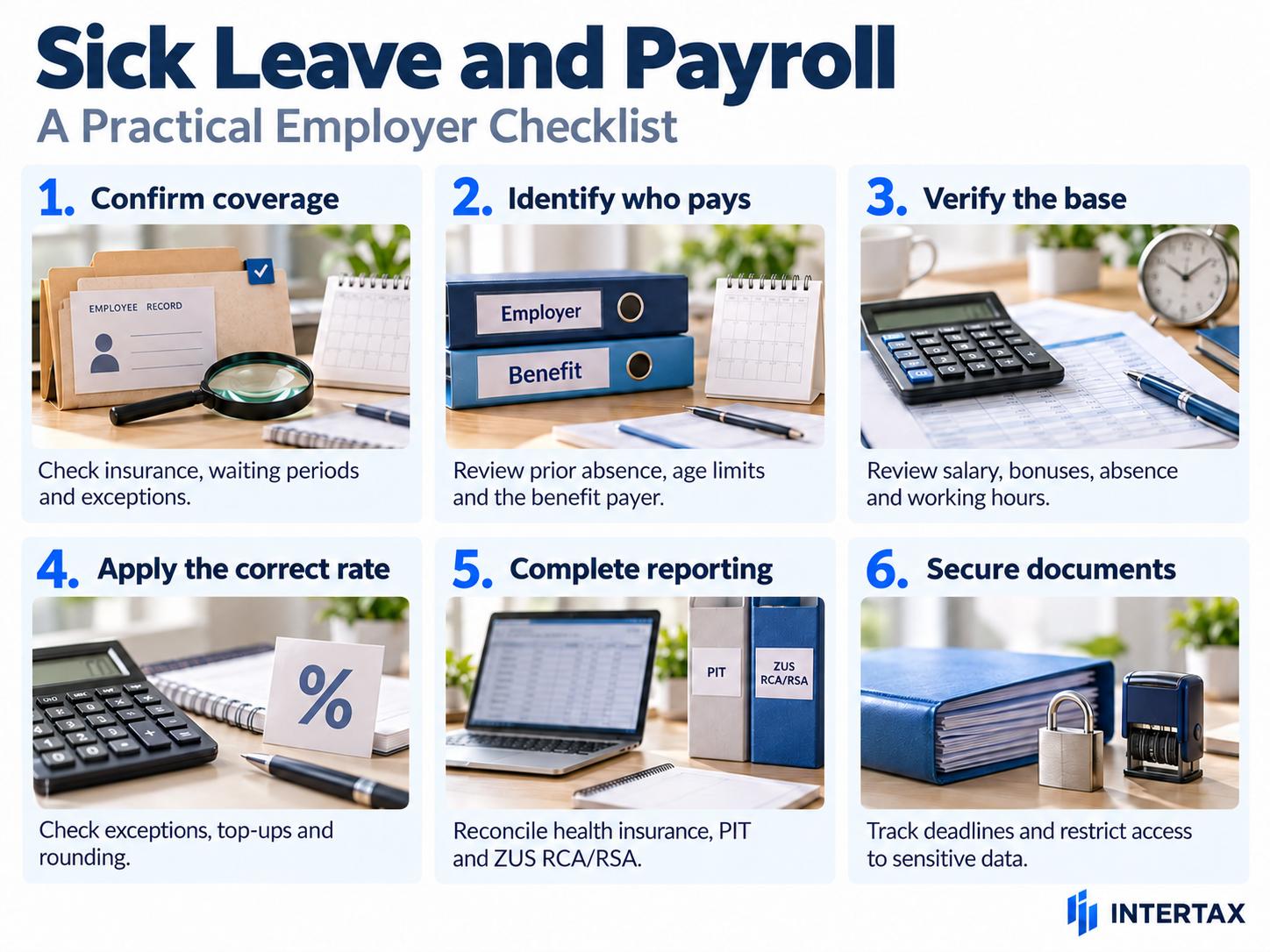
Sick Leave and Payroll: A Practical Employer Checklist
| Step | Step name | Step description |
|---|---|---|
| 1 | Confirm coverage and entitlement | Establish the insurance title, waiting period and any exception before calculating the payment. |
| 2 | Identify the funding stage | Check earlier qualifying absence in the year, the age-related limit and which organisation pays the benefit. |
| 3 | Verify the assessment base | Review fixed and variable pay, bonus rules, earlier absences and changes in working hours. |
| 4 | Apply the correct rate and rounding | Distinguish ordinary illness from documented exceptions and contractual top-ups. |
| 5 | Complete payroll and reporting | Apply the appropriate health insurance and PIT treatment, and reconcile the relevant ZUS RCA/RSA entries with the payment and absence records. |
| 6 | Manage documents and access | Record receipt dates, transmit required documents on time and restrict access to sensitive information. |
These controls link absence management to the wider cost of hiring an employee in Poland. An employer should distinguish the statutory payment from replacement costs and any additional benefit promised in the employment contract.
Need help calculating sick pay or preparing ZUS documents?
Contact INTERTAXAnnual Leave and Returning to Work
An employee’s own illness during annual leave means the unused part of that leave must be granted later under Article 166 of the Labour Code. It should not simply be consumed as holiday. Caring for a sick child is a different situation and does not have the same effect.
Where incapacity caused by illness lasted longer than 30 days, Article 229 requires a follow-up occupational health examination to establish fitness for the previous position. Arrange this before allowing the employee to resume work. This examination is separate from checking whether L4 was used correctly.
Enacted Changes to Track for 2027
The following table separates provisions already enacted from current payroll practice. Check the legislation again when updating procedures for January. Political announcements about transferring further sick pay costs to ZUS should not be used as payroll rules without an applicable enacted provision.
| Change | Status on 20 October 2026 | Effective date and impact |
|---|---|---|
| Conditional exception for different jobs | Enacted; not yet applicable | 1 January 2027. Review medical certification and employee reporting procedures. |
| One benefit period irrespective of the number of sickness insurance titles | Enacted; not yet applicable | 1 January 2027. Coordinate benefit-period monitoring across titles. |
Legal basis: the Act of 18 December 2025, particularly its amendments to Articles 9 and 17 of the benefit act and its commencement provisions.
Frequently Asked Questions
Who Pays for Sick Leave in Poland, the Employer or ZUS?
The employer normally funds sick pay for the first 33 qualifying calendar days in a year, or 14 days under the age-related rule. Afterwards, FUS finances sickness benefit. ZUS or an authorised benefit-paying employer transfers that benefit, so its funding source and paying organisation can be different.
How Much Is Sick Pay in Poland?
The standard rate is 80% of the assessment base, including an ordinary hospital stay. The base usually reflects average eligible remuneration after deducting employee social insurance contributions. Statutory exceptions can attract 100%. The result is not automatically 80% of the employee’s normal gross salary or take-home pay.
How Many Days of Sick Leave Does an Employer Pay in Poland?
The ordinary employer-funded limit is 33 calendar days per year. It falls to 14 days from the calendar year after the employee turns 50. Qualifying absences are added together, including relevant periods with earlier employers. A new certificate or a new employment contract does not restart the annual limit.
Is Sick Leave Paid at 100% in Poland?
Yes, in specified cases, including illness during pregnancy, a qualifying commuting accident and qualifying donor procedures. Occupational accidents and diseases have their own accident insurance rules providing 100% benefit. The percentage applies to the relevant assessment base. Employers can also provide more favourable sick pay under applicable employment arrangements.
Can an Employer Check an Employee on L4?
Yes. Every employer can check the use of periods for which it funds sick pay. Authorised benefit-paying employers can also check relevant benefit periods. Smaller employers request ZUS checks for ZUS-paid benefit periods. Checks must follow the statutory procedure and respect privacy; they do not give employers unrestricted medical access.
Can You Work for Another Employer While on Sick Leave in Poland?
In October 2026, working during certified incapacity can cause loss of benefit. From 1 January 2027, an enacted exception allows a certificate not to be issued for a particular title at the insured person’s request if that work can be performed because of its nature. Statutory reporting requirements also apply.
Do Contractors on a Contract of Mandate Get Sick Pay?
They do not receive the employee’s statutory employer-funded sick pay. They may receive sickness benefit if covered by sickness insurance and otherwise eligible, usually after the 90-day voluntary-insurance waiting period. There is no employee-style 33-day funding stage. The benefit can be paid by ZUS or an authorised contribution payer.
Payroll and HR Support for Employers in Poland

INTERTAX supports employers with payroll services in Poland and HR administration, including sickness-related calculations, ZUS documentation and absence procedures. If your team needs help distinguishing employer-funded sick pay from social insurance benefits, contact INTERTAX to discuss the employment arrangements and documents involved.
Legal Sources and Official Guidance
[1] Act of 25 June 1999 on cash benefits from social insurance in the event of sickness and maternity, consolidated text Dz.U. 2026 item 854, as amended: Articles 3–4, 8–9, 11, 17–18, 36–43, 59, 61–61b and 68–68g.
[2] ZUS: Entitlement to sickness benefit and the benefit period, including waiting periods and the 33/14-day rule.
[3] ZUS: Sickness benefit rates, including hospital stays and statutory 100% cases.
[4] ZUS: Benefit payers, including the insured-person threshold and reference date.
[5] ZUS: The assessment base for employees.
[6] ZUS: Health insurance contribution base; Article 81 of the Health Care Benefits Act.
[7] Ministry of Finance: Employment income and social insurance benefits; Articles 12 and 20 of the Personal Income Tax Act.
[8] Act of 18 December 2025 amending the social insurance system act and other acts, Dz.U. 2026 item 26; and ZUS guidance on the April 2026 changes.
[9] Act of 13 February 2026 amending the Act on cash benefits from social insurance in the event of sickness and maternity, Dz.U. 2026 item 441; and ZUS guidance on simplified benefit application procedures from July 2026.
[10] National Labour Inspectorate: Notifying the employer of sickness absence; section 2 of the Regulation of 15 May 1996.
[11] ZUS: How to claim sickness benefit during insurance, including e-ZLA and foreign medical certificates.
[12] Occupational Accident and Occupational Disease Insurance Act, consolidated text Dz.U. 2025 item 1644, Articles 8–9.
[13] ZUS: Employer checks of the proper use of sick leave, guidance dated 13 April 2026.
[14] ZUS: Statistics on checks in the second quarter of 2026.
[15] Gov.pl: Applying for rehabilitation benefit.
[16] European Union: Social security coverage when working in another EU country; Regulations 883/2004 and 987/2009.
[17] ZUS commentary: Sickness-related payments across the end of a calendar year.
[18] Social Insurance System Act, Article 18(2), excluding sick pay and social insurance benefits from the relevant employee contribution base.
[19] ZUS: Assessment base for insured people who are not employees.
[20] National Labour Inspectorate: Annual leave; Article 166 of the Labour Code.
[21] Ministry of Health: Follow-up occupational health examinations; Article 229 of the Labour Code. Labour Code: also Article 92 on sick pay and Article 52 on dismissal without notice.