

CRBR is Poland’s Central Register of Beneficial Owners, and having a foreign owner does not exempt a Polish company from reporting to it. A newly registered Polish limited liability company must identify the individuals who ultimately control it and report them electronically, generally within 14 days calculated without Saturdays or statutory non-working days. The practical challenge is often tracing control through an international group and arranging valid signatures before the deadline. This guide explains who must report, which event starts the clock, how a foreign director can sign without a PESEL number, and what proposed changes could mean for future filings.
Key Takeaways
- A Polish company owned by a foreign parent still has to report to CRBR: foreign ownership does not create an exemption, and a listed parent does not automatically exempt its Polish subsidiary.
- A UBO is the individual who ultimately controls the company. Look through corporate shareholders to people with more than 25% of shares or votes and other decisive control rights; reporting senior management is a documented fallback, not a default.
- A newly registered company generally files within 14 days of KRS entry, excluding Saturdays and statutory non-working days. Updates run from the date a change becomes effective, which may precede the KRS update.
- The notification is signed with a qualified electronic signature or a Polish Trusted Profile. A foreign director without PESEL can use an eIDAS-compliant qualified signature, and an ordinary power of attorney is not enough.
- Penalties reach up to PLN 1,000,000 for the company and up to PLN 50,000 for a UBO whose failure to provide information causes a late, missing or incorrect notification.
- The reform in Sejm print 3163, including restricted access and new deadline counting, is still a draft. Do not apply it to current filings.
CRBR at a Glance
| Question | Answer |
|---|---|
| What is CRBR? | The Central Register of Beneficial Owners, known in Polish as Centralny Rejestr Beneficjentów Rzeczywistych. |
| Legal basis? | The AML Act of 1 March 2018, particularly Articles 2(2)(1), 58–63 and 153. |
| Who reports? | Entities in the statutory list, including Polish limited liability companies and most other commercial company forms. |
| Deadline? | Generally 14 days, excluding Saturdays and statutory non-working days. See the event-specific rules below. |
| Where? | The official CRBR portal. |
| Which signature? | A qualified electronic signature or Polish Trusted Profile. |
| Can an ordinary attorney file? | No. A duly authorised commercial proxy, or prokurent, is a distinct case. |
| Government filing fee? | None. Signature-provider or advisory costs are separate. |
| Maximum company penalty? | PLN 1,000,000 under Article 153(1). |
| Public access? | Public under the current rules; restrictions are proposed in the reform tracker. |
For the legislative text, use the AML Act, consolidated publication Dz.U. 2025 item 644, as amended. The Ministry of Finance CRBR information hub links to official guidance and the register.
What Is an Ultimate Beneficial Owner (UBO)?
An ultimate beneficial owner is an individual who ultimately controls an entity, directly or indirectly. Under the AML Act, the assessment concerns legal and factual powers that enable decisive influence. A corporate shareholder is therefore an intermediate ownership layer, rather than the natural person the company needs to identify.
For an ordinary corporate structure, examine individuals with more than 25% of shares or votes, people controlling relevant corporate shareholders, and other decisive control rights. Exactly 25% does not satisfy the “more than 25%” ownership test by itself. Shareholder agreements, voting arrangements and personal rights can nevertheless change the conclusion.
No shareholder above the threshold does not automatically mean “report the CEO”. The senior-management fallback requires documented inability to establish, or doubts about the identity of, the relevant controlling individuals, and the absence of money-laundering or terrorist-financing suspicions. Retain the evidence supporting that conclusion. The official Ministry FAQ, questions 14–17, explains the fallback and its documentation.
Foreign Parent Company: Looking Through the Group Structure
Example:
An individual A owns 60% of a German company, which owns 100% of a Polish sp. z o.o. Assuming ordinary voting rights and no contrary control arrangements, A is a UBO of the Polish company. The analysis must also establish whether anyone else qualifies through other rights.
Build the analysis from current registry extracts, shareholder records and governing documents. Do not stop at the parent company’s name, or mechanically multiply percentages across every chain. The question is who controls the relevant entities and, ultimately, the Polish company.
A listed parent, investment fund or trust needs a tailored assessment. A parent’s listing does not automatically exempt its Polish subsidiary. For funds, examine the actual governance and control rights. For trusts, the Act contains role-based rules covering, among others, settlors, trustees, protectors and beneficiaries. The starting points are Article 2(2)(1) and the Ministry’s guidance for additional reporting entities.
For the internal file, record each ownership layer, the documents checked, the control conclusion and the assessment date. This helps the next person reviewing the structure understand why an individual was included or excluded. Also keep AML beneficial ownership separate from the beneficial-owner analysis used for withholding-tax purposes: the same English expression does not make the tests interchangeable.
Who Must Report to CRBR?
Article 58 covers sp. z o.o., P.S.A., non-public S.A., general partnerships, limited partnerships, limited joint-stock partnerships and professional partnerships. It also covers European economic interest groupings, European companies, cooperatives, European cooperatives, associations subject to KRS registration and foundations. Trust reporting depends on the statutory connection with Poland, including the trustee’s residence or seat, relevant business relationships or property acquisition.
| Entity or situation | CRBR filing? |
|---|---|
| Polish sp. z o.o. owned entirely by a foreign company | Yes Foreign ownership does not create an exemption. |
| Branch of a foreign company | No Not merely because it is a branch; branches are not a separate Article 58 category. |
| Representative office of a foreign company | No Not merely because it is a representative office. |
| Polish S.A. qualifying as a public company under the legislation referenced in Article 58 | No Apply the statutory public-company definition. |
| Polish subsidiary of a listed foreign parent | Yes If the subsidiary’s own legal form is covered. |
| Polish family foundation | Yes Its initial deadline runs from the family-foundation register. |
The branch and representative-office answers do not determine a trust’s separate obligations or any foreign registration requirement. See our guides to branch vs subsidiary in Poland and representative office registration when choosing the operating form.
Family foundations are addressed expressly in the Ministry’s family-foundation FAQ. As family foundations are not registered in KRS, their 14-day deadline runs from the date of entry in the Register of Family Foundations maintained by the registry court in Piotrków Trybunalski.
For formation and governance context, the related guides cover a limited liability company in Poland, a joint-stock company in Poland, a limited partnership in Poland and a family foundation in Poland.
Post-registration compliance
Setting up a Polish company within an international group?
INTERTAX can help organise post-registration compliance, collect the group documents needed for the UBO analysis and coordinate with the company’s authorised representatives.
CRBR Deadlines: 14 Days from KRS Entry or from the Change
For a newly registered company covered by Article 58, the first filing is due within 14 days of KRS entry. Article 60 excludes Saturdays and statutory non-working days. The former seven-day period was extended on 10 November 2022; the Ministry explains the historical distinction in its notification guidance.
For updates, distinguish a change that becomes effective through KRS entry from one that is effective independently of that entry. In the latter case, waiting for the court to update KRS can make the CRBR filing late. A share transfer or board appointment therefore requires an immediate assessment of its effective date and its effect on reportable information.
Worked example:
A company is entered in KRS on Monday, 19 October 2026. Counting starts the following day. With Saturdays and statutory non-working days excluded, its fourteenth counted day is Friday, 6 November 2026. This illustration assumes no officially recognised CRBR outage affecting the period.
The statutory update rules and counting exclusions are in Article 60. For official outages, follow the Ministry’s explanation of announced system interruptions; an individual computer problem is not the same as an officially announced CRBR disruption.
Review CRBR whenever shares, voting arrangements, upper-tier ownership or a UBO’s reportable personal details change. A new board appointment may matter where the person is reported under the senior-management fallback. It does not automatically make every director a UBO. Keep submitting documents to KRS and the CRBR update as separate tasks in the closing checklist.
For a transaction, assign someone to obtain the effective documents on completion day. A useful handover states: what changed, when it became effective, which UBO conclusion or field it affects, who signs, and when the filing must be completed. The group’s legal team and the Polish finance team should use the same event date.
How to File: Step by Step
| Step | Step name | Step description |
|---|---|---|
| 1 | Establish the UBOs | Complete the ownership and control analysis and retain its evidence before entering the form. |
| 2 | Prepare entity and individual data | Check the company’s identifiers and each UBO’s names, all citizenships, country of residence, PESEL or date of birth, and the nature and extent of ownership or control. Articles 59 and 61 distinguish UBO data from the filing person’s details. |
| 3 | Choose the correct event date | Use the company’s initial entry date or the relevant effective change date. |
| 4 | Create and review the notification | Use the official portal. Compare the completed record against the analysis, especially where control is indirect. |
| 5 | Obtain the required signatures | Follow the company’s representation rules and check that every required signatory signs the same final document. |
| 6 | Submit and retain confirmation | Finish the sending process, keep the reference number and download the official acknowledgement, or UPO. |
An ordinary power of attorney does not authorise a lawyer or accountant to make the notification. They can assist with preparation and analysis, but the authorised filing person remains responsible for signing. Ministry FAQ questions 9 and 11 distinguish an ordinary attorney from a prokurent who is entitled to represent the entity.
Joint representation requires the necessary combination of signatures, rather than every board member regardless of the company’s rules. Ministry FAQ question 24 describes multiple qualified signatures, multiple Trusted Profile signatures and combinations of the two. Article 61(5) requires the truthfulness statement under criminal liability.
Foreign Directors Without PESEL: Which Signature Works?
A PESEL number is not a prerequisite for every CRBR signature. The Ministry’s technical FAQ, question 2, expressly accepts an eIDAS-compliant qualified signature whose certificate contains no PESEL. This provides a route for foreign directors without that number.
A Polish Trusted Profile is linked to PESEL. For a director who does not have one, arranging a qualified signature is therefore the practical starting point. Check the provider’s qualified status and the signing format before purchase: a scanned signature, a pasted image or an ordinary document-signing account is insufficient simply because it is described as an electronic signature.
The official technical guidance discusses XML and enveloped XAdES. Ask the provider to confirm compatibility with the CRBR workflow. For joint representation, coordinate the order of signing and avoid editing the file afterwards. The signature step must be followed by actual submission; retain the UPO.
Start this preparation before company registration in Poland. If a director also needs a Polish identifier for other procedures, see how to obtain a PESEL number. Obtaining PESEL and obtaining a qualified signature are separate planning decisions.
Recommended internal control: appoint one coordinator, circulate one approved version and confirm who will complete the portal submission. Keep the signed file and acknowledgement in the company’s compliance records, rather than leaving the only copies in a director’s personal inbox.
CRBR coordination
Keep your CRBR filing on schedule
- Document collection from the group
- Coordination with authorised representatives and signatories
- Ongoing post-registration compliance
Penalties for Late, Missing or False CRBR Filings
Article 153(1) provides for an administrative penalty of up to PLN 1,000,000 where a covered entity fails to report or update on time, or reports information inconsistent with the facts. The maximum is a statutory ceiling, not an automatic bill for every delay.
A UBO has a separate duty under Article 60a to supply the information and documents needed for reporting. Under Article 153(3), failure that causes a late, missing or factually incorrect notification can attract a penalty of up to PLN 50,000. This is more specific than a general allegation that the owner was unhelpful.
The Director of the Tax Administration Chamber in Bydgoszcz performs designated CRBR authority tasks, including penalty decisions. The facts and applicable administrative-penalty rules matter when the amount is assessed; companies should preserve an accurate chronology and evidence of corrective action.
The person signing also makes a truthfulness statement under Article 61(5). Criminal liability for a false statement is separate from the administrative penalty. An honest identification issue and a knowingly false declaration should not be treated as equivalent without assessing the facts. If an omission is discovered, establish the correct reporting history and address it promptly; do not invent an earlier event or submission date.
Discrepancy Reports: Why Your Bank or Accountant May Flag Your Entry
A bank’s request for a group chart may expose a difference between its own findings and CRBR. Accountancy practices, tax advisers and notaries may also have relevant duties when acting within their statutory AML scope.
Article 61a requires an obliged institution to record discrepancies and investigate their cause. Confirmed discrepancies are then reported with supporting information. The GIIF’s Communication No. 37 explains the process and the distinction between UBO information and information about the filing person.
For the company, the useful response is a coherent evidence pack: current structure, governing rights, identification rationale and relevant event dates. A public entry is not a substitute for that analysis. Preparing the same material for CRBR and a business bank account in Poland helps avoid inconsistent answers during onboarding.
Need help collecting group documents for a CRBR filing or update?
Contact INTERTAXCRBR Reform: Access Rules and Filing Changes (Tracker)
The CJEU judgment of 22 November 2022 in joined cases C-37/20 and C-601/20 invalidated the EU provision requiring access for any member of the general public. It provides important background to the access reform, rather than removing companies’ filing duties.
The Polish government’s proposal is now identifiable as Sejm print No. 3163. The tracker records the proposal reviewed for this guide; it does not certify completion of the parliamentary process or a final commencement date.
| Change | Status | Expected date | Practical impact |
|---|---|---|---|
| Restricted access, including access based on legitimate interest | Draft as of 19 October 2026; print 3163 | 1 October 2027 in the reviewed bill | Changes how counterparties obtain ownership information. |
| Filing authentication and signature framework | Draft as of 19 October 2026; implementing rules also proposed | CRBR framework proposed for 1 October 2027 | Check final technical requirements. The attached draft still specifies qualified or Trusted Profile signatures for notifications. |
| Removal of current Article 60(2)–(3) counting exclusions | Draft as of 19 October 2026; Article 1(10) of print 3163 | 1 October 2027 in the reviewed bill | Recheck deadline calculation if enacted. Do not apply this proposal to current filings. |
| Wider EU AML framework | EU legislation adopted; separate from draft UC75 | See the staged commencement and application provisions of the EU acts | Avoid assuming one date governs every CRBR and AML change. |
The Ministry’s announcement gives 1 January 2027 as the bill’s general proposed commencement, but Article 11 of print 3163 postpones the specified CRBR provisions until October. The wider AMLR, Regulation (EU) 2024/1624, and Directive (EU) 2024/1640 have their own schedules. Recheck the enacted Polish text and final technical rules before relying on a future date.
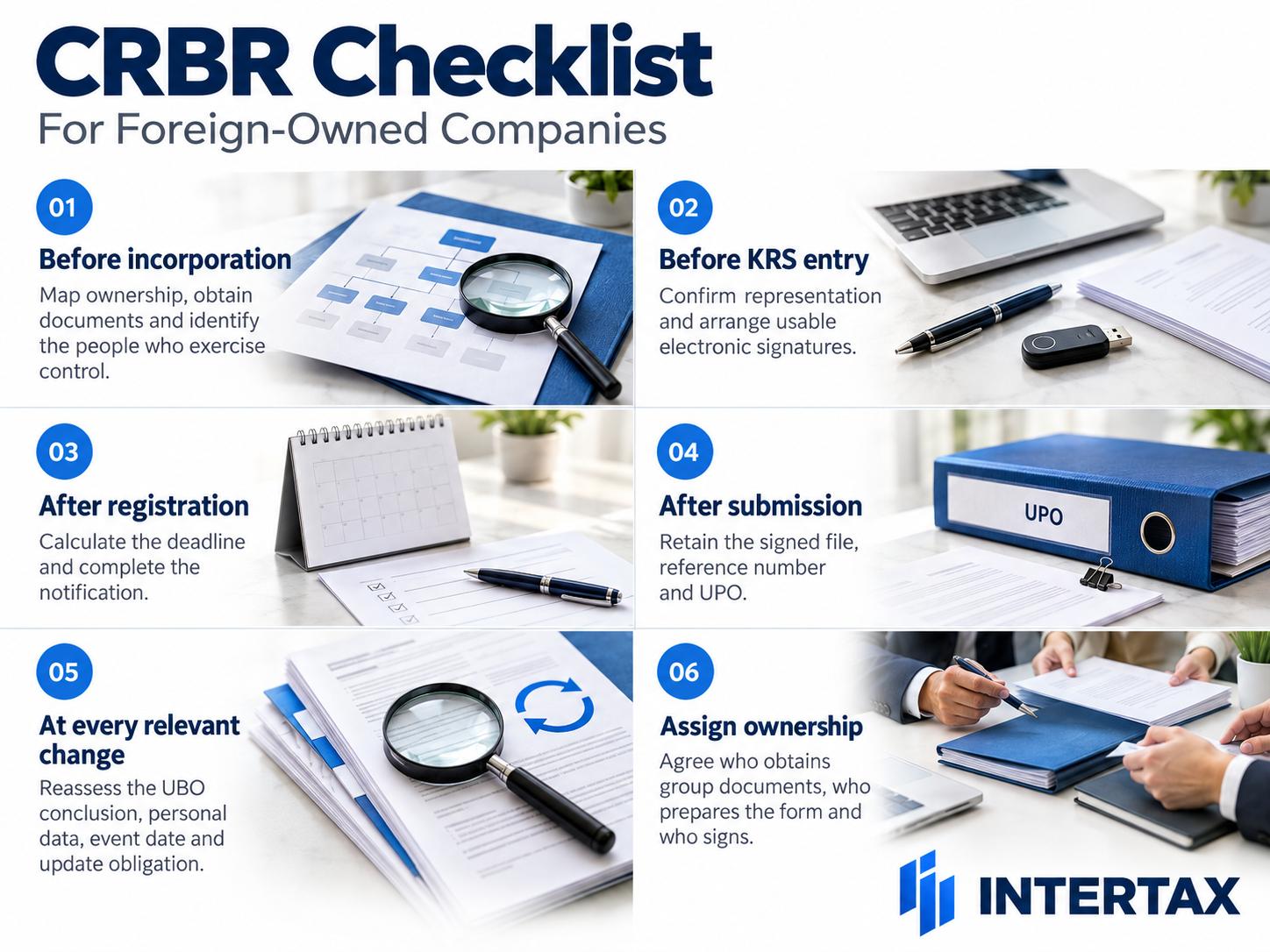
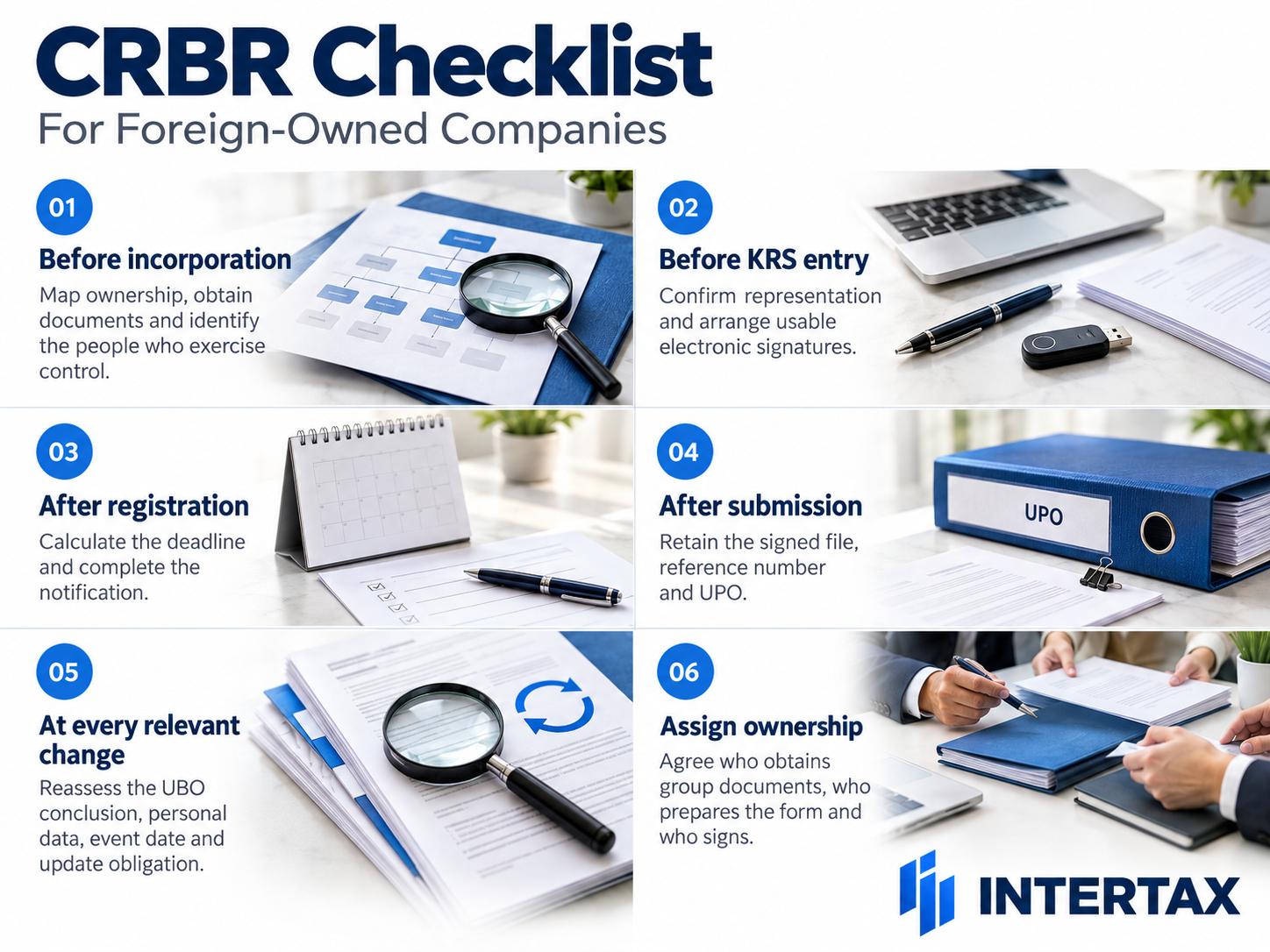
CRBR Checklist for Foreign-Owned Companies
- Before incorporation: map ownership, obtain documents and identify the people who exercise control.
- Before KRS entry: confirm representation and arrange usable electronic signatures.
- After registration: calculate the deadline and complete the notification.
- After submission: retain the signed file, reference number and UPO.
- At every relevant change: reassess the UBO conclusion, personal data, event date and update obligation.
- Assign ownership: agree who obtains group documents, who prepares the form and who signs.
INTERTAX can help organise post-registration compliance, document collection and coordination with authorised representatives. Our accounting services and business consulting can support the company’s ongoing processes. Contact INTERTAX to discuss the scope of assistance and responsibilities.
FAQ
What is the deadline for filing with CRBR in Poland?
A newly registered company generally has 14 days from KRS entry, excluding Saturdays and statutory non-working days. Updates depend on when the relevant change becomes effective. Where KRS entry is not required for effectiveness, count from the change itself. Officially announced CRBR outages can also affect the calculation.
Does a Polish company owned by a foreign parent have to report to CRBR?
Yes, if its legal form is covered by Article 58 of the Polish AML Act. A wholly foreign-owned Polish limited liability company must identify and report its individual beneficial owners. The parent’s foreign register entry does not replace that obligation, and a listed parent does not automatically exempt the subsidiary.
Who is the beneficial owner if no one holds more than 25%?
First examine voting rights, agreements, indirect control and other powers of decisive influence. An absence of shareholders above 25% does not automatically justify reporting management. The senior-management fallback requires documented grounds under the statutory definition, including the absence of money-laundering or terrorist-financing suspicions. Preserve the evidence supporting the conclusion.
Can a lawyer or accountant file the CRBR notification on behalf of the company?
An ordinary power of attorney is insufficient for making the CRBR notification. A lawyer or accountant can assist with analysis and preparation, while the required authorised representative signs. A duly empowered commercial proxy, or prokurent, is a separate case recognised in Ministry guidance. The company’s representation rules still apply.
How can a foreign director without a PESEL sign the CRBR filing?
The director can use an eIDAS-compliant qualified electronic signature with a certificate that contains no PESEL number. The Ministry expressly confirms this route. Check the signing format and CRBR workflow with the provider beforehand, coordinate any joint signatures, and retain the UPO after completing the actual submission.
Does a branch of a foreign company have to register in CRBR?
A foreign company’s Polish branch is not a separate reporting category in Article 58, so operating through a branch does not itself create a standalone CRBR notification obligation. This differs from incorporating a Polish subsidiary. Separate trust-related duties or beneficial-ownership reporting in another jurisdiction must still be assessed where relevant.
What is the penalty for not reporting beneficial owners in Poland?
A covered company can face an administrative penalty of up to PLN 1 million for missing, late or factually incorrect reporting. A UBO’s failure to provide necessary information can separately attract up to PLN 50,000 where the statutory consequences follow. False declarations can also raise separate criminal-liability issues for the signatory.
Official Sources
- AML Act of 1 March 2018, consolidated publication Dz.U. 2025 item 644, as amended: UBO definition, reporting, signatures, discrepancies and administrative penalties.
- Ministry of Finance: CRBR filing FAQ: control analysis, senior management, prokurent and multiple signatures.
- Ministry of Finance: technical FAQ: qualified signatures without PESEL, XML and UPO.
- Ministry of Finance: family-foundation FAQ.
- GIIF Communication No. 37: discrepancy reporting.
- Ministry announcement of 22 September 2026 and Sejm print 3163: proposed reform and staged dates.
- CJEU judgment, joined cases C-37/20 and C-601/20: general-public access to beneficial-ownership information.