


Poland’s family foundation (fundacja rodzinna) has been available for just over three years, and it has already become the default succession vehicle for Polish family businesses — with almost 3,000 foundations registered. It is also increasingly relevant for foreign entrepreneurs who hold Polish companies, real estate or other assets and need a structure that survives a generational change.
This guide explains what a Polish family foundation is, how it is taxed, who can set one up, and — the question most owners actually ask — whether it is worth establishing in 2026, when the Ministry of Finance has once again announced changes to its tax treatment.
Key takeaways
-
A family foundation is a separate legal person introduced by the Act of 26 January 2023 on the family foundation (Journal of Laws 2023, item 326), in force since 22 May 2023.
-
Minimum founding fund: PLN 100,000. The founder must be a natural person with full legal capacity.
-
The foundation is a CIT taxpayer but its qualifying income is exempt from ongoing CIT. CIT of 15% is due only when benefits are distributed, when hidden profits arise, or on liquidation.
-
Distributions to the founder and the “zero group” of relatives are exempt from PIT; other individuals pay 10% or 15% PIT.
-
Business activity outside the statutory catalogue is taxed at a penalty rate of 25% CIT.
-
The rules have not changed since 2023 — the amendment that was to apply from 1 January 2026 was vetoed by the President on 27 November 2025. A new Ministry of Finance proposal (item UD447 in the government’s legislative programme, announced August 2026) would raise the 15% rate to 19% and add a 36-month holding requirement. It is a plan, not law.
What Is a Family Foundation in Poland?
A Polish family foundation (fundacja rodzinna) is a legal person established to accumulate assets, manage them in the interest of beneficiaries, and provide benefits to those beneficiaries. It was introduced by the Act of 26 January 2023 on the family foundation and has been available since 22 May 2023. Its purpose is business succession and asset preservation — not day-to-day trading.
The family foundation is a genuinely new category of entity in Polish law. It is not a company: it has no shareholders, no share capital and no owners. It is also not a classic Polish foundation, which must pursue a socially or economically useful public purpose. A family foundation exists for a private purpose — the founder’s family and whoever else the founder designates.
Before May 2023, Polish entrepreneurs who wanted this kind of structure had to look abroad, typically to Liechtenstein, Austria or Malta, with the cost, language barrier and cross-border tax exposure that came with it. Since 2023 the same economic result can be achieved under Polish law, with Polish courts and a Polish tax regime.
Scale, for context: from the entry into force of the Act on 22 May 2023 until 1 October 2025, 2,940 family foundations were entered into the register, out of 4,954 registration applications filed (data from the Regional Court in Piotrków Trybunalski).
Main Objectives and Purpose of a Polish Family Foundation
The Act defines three functions, and they are worth reading in order — the order reflects how the structure actually works.
-
Accumulating assets. Shares, real estate, securities, cash and other assets are transferred out of the founder’s personal estate into a separate legal person.
-
Managing those assets in the interest of beneficiaries. The foundation holds and administers the estate as a single block, under a statute the founder writes.
-
Providing benefits to beneficiaries. The family receives distributions — cash, the right to use property, other assets — rather than ownership of the business itself.
The critical difference from ordinary inheritance is this: heirs do not become shareholders. In a conventional succession, a company is divided among several heirs, each with a vote, each with a different view of the business, and each free to sell. In a family foundation the operating business stays undivided and under a single management structure, while the family is financed from its profits.
This matters commercially in Poland right now. The first large wave of generational change in Polish family businesses — companies founded in the early 1990s — is arriving, and the founders are reaching retirement age.
Who Can Establish a Family Foundation? (Founder and Beneficiaries)
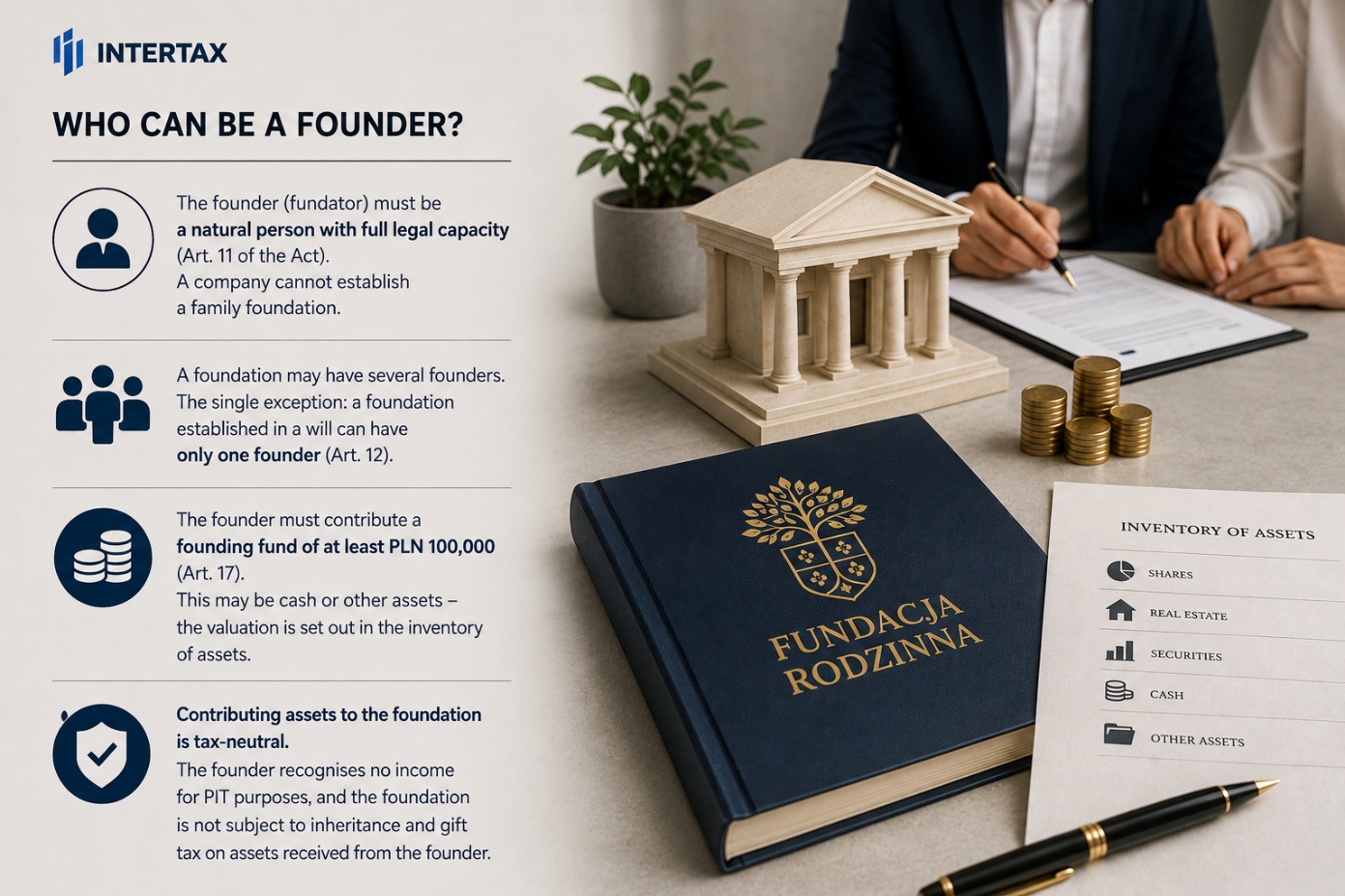
Who Can Be a Founder?
-
The founder (fundator) must be a natural person with full legal capacity (Art. 11 of the Act). A company cannot establish a family foundation.
-
A foundation may have several founders. The single exception: a foundation established in a will can have only one founder (Art. 12).
-
The founder must contribute a founding fund of at least PLN 100,000 (Art. 17). This may be cash or other assets — the valuation is set out in the inventory of assets.
-
Contributing assets to the foundation is tax-neutral. The founder recognises no income for PIT purposes, and the foundation is not subject to inheritance and gift tax on assets received from the founder.
There is no requirement that the founder be a Polish citizen or a Polish tax resident. For a foreign owner of a Polish company, the practical questions are different ones: where the founder is tax-resident when distributions are made, and how the founder’s home jurisdiction characterises the Polish foundation. Those questions must be answered before, not after, the foundation is set up.
Who Can Be a Beneficiary?
-
Natural persons — with no age limit. Beneficiaries can be family members, but also people outside the family: a long-standing manager, a partner, a friend.
-
Non-governmental organisations conducting public benefit activity.
-
The founder can also be a beneficiary.
Two features surprise people coming from a corporate background:
-
Beneficiaries are not owners. They hold a right to receive benefits on the terms set out in the statute — nothing more. There is no equity, no capital account, no share in liquidation proceeds by right.
-
Beneficiary rights cannot be sold or transferred. They are non-assignable, which is precisely the point: the family’s entitlement cannot be pledged to a bank, seized in a divorce settlement in the same way as shares, or sold to a third party.
The statute can make entitlements conditional — for example, distributions only after a beneficiary reaches a certain age, completes education, or on other objective conditions the founder defines.
Tax Treatment of a Polish Family Foundation — Key Rules
This is where the structure earns its reputation, and also where most of the misunderstandings sit.
CIT at Foundation Level
A family foundation is a CIT taxpayer, but it benefits from a subjective exemption under Art. 6(1)(25) of the CIT Act. In practice:
-
Income earned and retained inside the foundation is not taxed on an ongoing basis. Dividends from subsidiaries, rent, interest, gains on the sale of shares — none of it triggers current CIT as long as it stays within the foundation and within the permitted scope of activity.
-
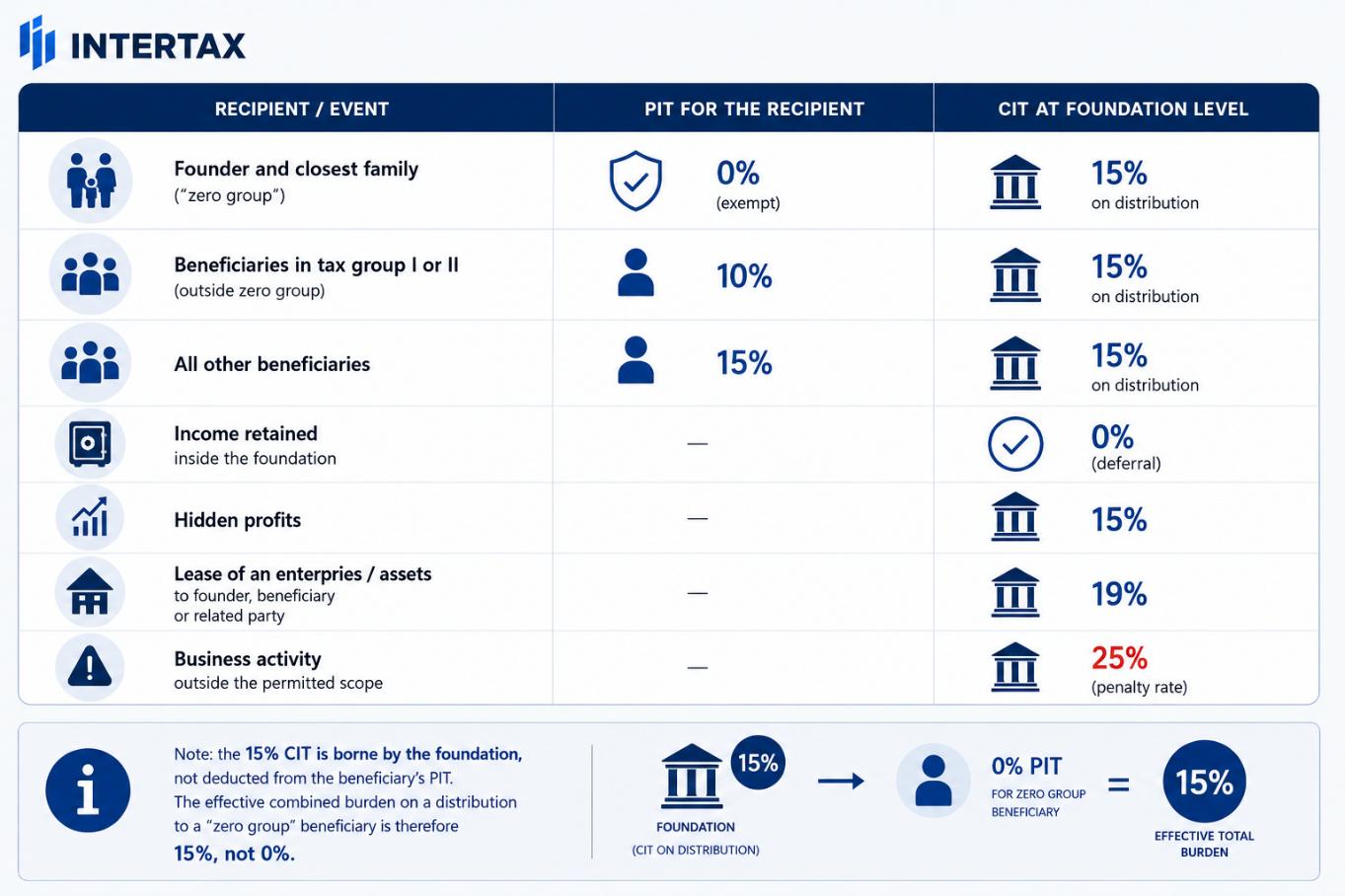
CIT of 15% is due on distribution. The tax arises when the foundation provides a benefit to a beneficiary, transfers assets on dissolution, or generates so-called hidden profits (Art. 24q of the CIT Act). Hidden profits include, among others, interest and fees on loans granted to the foundation by beneficiaries or related parties, gratuitous benefits to related parties, above-market pricing in related-party transactions, and loans to beneficiaries granted for at least 10 years or not repaid on time.
-
25% penalty CIT applies to income from business activity outside the statutory catalogue (Art. 6(7) and Art. 24r of the CIT Act). This is the single most expensive mistake available in the structure.
-
19% CIT applies to income from letting, leasing or otherwise making available an enterprise, an organised part of an enterprise, or assets used in business by the beneficiary, the founder or a related entity (Art. 6(8) of the CIT Act). Renting a warehouse to the founder’s own operating company therefore does not fall under the exemption.
-
The exemption also does not cover the tax on income from buildings under Art. 24b of the CIT Act.
-
A foundation in organisation loses the exemption if it is not filed for registration within six months of establishment, or if registration is refused by a final decision (Art. 6(9) of the CIT Act).
So the accurate description is not “a tax-free vehicle”. It is a deferral vehicle: capital compounds inside the foundation without leakage, and tax is paid when value leaves it.
PIT for Beneficiaries — Tax Groups
On the beneficiary side the position depends on the family relationship to the founder:
-
“Zero group” — the founder, spouse, descendants, ascendants, stepchildren, siblings, stepfather, stepmother: exempt from PIT under Art. 21(1)(157) of the PIT Act.
-
Tax group I or II (in relation to the founder) under the inheritance and gift tax rules, outside the zero group — for example nieces, nephews, in-laws: 10% flat PIT under Art. 30(1)(17) of the PIT Act.
-
All other individuals: 15% flat PIT under the same provision.
One nuance that matters in multi-founder structures: the exemption and the 10% rate apply proportionally to the founder’s share determined under Art. 27(4) of the Act on the family foundation. Where two unrelated founders contribute assets, a beneficiary who is in the zero group of only one of them is exempt only to that proportion.
Summary table — who pays what
VAT Status of a Polish Family Foundation
A family foundation is not outside the VAT system. It becomes a VAT taxable person where it carries out a supply of goods or services independently, on a continuous basis and for consideration — the ordinary test under the VAT Act, applied without regard to the purpose or result of the activity. The Director of the National Revenue Information Service confirmed this approach in individual rulings issued shortly after the regime came into force, including rulings of 19 July 2023 (ref. 0114-KDIP4-3.4012.205.2023.3.DS) and 5 October 2023 (ref. 0114-KDIP1-3.4012.534.2023.1.LM).
In practice, a foundation whose only activity is holding shares and receiving dividends will generally not act as a VAT taxable person, while a foundation that lets real estate commercially or performs other permitted business activities will. Regarding the VAT taxation of specific transactions, providing financial services—such as granting loans to beneficiaries or related companies—is generally subject to a subject-matter VAT exemption, whereas the disposal of certain assets, like commercial real estate, may be subject to standard VAT rates unless specific conditions for exemption are met. Subject-matter and threshold exemptions may apply on the usual terms. Individual rulings are fact-specific and cannot be relied on by a different taxpayer
What Business Activities Can a Family Foundation Conduct?
Article 5 of the Act sets out a closed catalogue. A family foundation may conduct business activity only in the following areas:
-
Disposal of assets — provided the assets were not acquired solely for the purpose of resale. This excludes trading as a business model.
-
Letting, leasing or otherwise making assets available for use — subject to the 19% rule described above where the user is the founder, a beneficiary or a related entity.
-
Joining commercial companies, investment funds, cooperatives and similar entities, and participating in them. This is how most holding structures are built.
-
Acquiring and disposing of securities, derivatives and similar rights.
-
Granting loans — to companies in which the foundation holds interests, to partnerships in which it is a partner, and to beneficiaries.
-
Trading in foreign currencies held by the foundation, for the purpose of making payments connected with its activity.
-
Production of plant and animal products processed other than industrially, in connection with an agricultural holding.
-
Forestry management, in connection with an agricultural holding.
Warning. Activity outside this catalogue is not prohibited — it is punished. Income from it is taxed at 25% CIT instead of benefiting from the exemption (Art. 24r of the CIT Act). Operating a trading business, providing services to third parties, or running short-term accommodation through the foundation are the classic ways of falling outside the catalogue. The boundaries of points 1 and 2 in particular are still being worked out in tax rulings and case law.
How to Establish a Family Foundation in Poland — Step by Step
-
Declaration of establishment. The founder makes a declaration on the establishment of the family foundation in a deed of establishment or in a will — in both cases before a Polish notary, in the form of a notarial deed.
-
The statute. Drafted in the form of a notarial deed. This is the governing document: beneficiaries, their entitlements, the conditions attached, the rules for the bodies, the rules for amending the statute. It deserves far more attention than the registration formalities.
-
The inventory of assets. A list of the assets contributed to the foundation, with their values, identifying the person contributing them.
-
Establishing the bodies. The management board (zarząd) is mandatory; the beneficiaries’ assembly (zgromadzenie beneficjentów) is mandatory; a supervisory board (rada nadzorcza) is optional, but becomes mandatory where the number of beneficiaries exceeds twenty-five (Art. 64 of the Act).
-
Contributing the founding fund of at least PLN 100,000.
-
Registration in the register of family foundations, maintained by the Regional Court in Piotrków Trybunalski for the whole of Poland.
Between the deed and the registration the foundation exists as a family foundation in organisation. If it is not filed for registration within six months, it is dissolved — and it loses the CIT exemption for that period.
How public is the register?
This is one of the most misreported points, so it is worth being precise.
The register itself is public: anyone may obtain extracts, copies and certificates. The publicly disclosed data include the foundation’s name, seat and address, NIP and REGON, the amount of the founding fund, the founder’s name and address for service, and the members of the bodies — management board, supervisory board and the beneficiaries’ assembly.
Beneficiaries as such are not disclosed in the public part of the register, unless they happen to be members of the beneficiaries’ assembly. The registration files, including the statute, may be inspected only by the founder, members of the foundation’s bodies, beneficiaries and persons with a legitimate legal interest.
From 29 July 2026, an amending regulation of the Minister of Justice (Journal of Laws of 2026, item 577) improved access: e-document requests can be filed by e-mail with a qualified or trusted signature, documents are delivered electronically, and a limited data set (register number, name, seat, REGON, NIP) is available for self-service download from the court’s website, updated daily.
Separately, a family foundation is subject to the Central Register of Beneficial Owners (CRBR) reporting obligations, which is a different disclosure regime with a different scope.
Polish Family Foundation vs. Foreign Foundation — Key Differences
|
Feature |
Polish family foundation |
Foreign private foundation |
|
Regulatory maturity |
In force since May 2023; tax rules under active review |
Decades of practice, established case law |
|
Regulatory stability |
Two amendment attempts in 2025–2026; one vetoed |
Generally stable, but exposed to EU-level initiatives |
|
Operating cost |
Lower — Polish notary, Polish court, Polish advisers |
Higher — local administrators, trustees, foreign counsel |
|
Founder’s control |
Full, where the founder sits on the management board |
Typically limited; local board and administrator required |
|
Disclosure |
Public register (foundation, founder, bodies) |
Usually confidential; no publicly searchable register |
|
Contribution of assets |
Tax-neutral in Poland |
Risk of Polish exit tax on transfer out of Poland |
|
CFC regime |
Does not currently apply to a Polish family foundation |
May be treated as a controlled foreign entity by a Polish resident founder |
|
Currency and reporting |
PLN, Polish accounting rules |
Foreign currency, foreign reporting, translation costs |
The exit tax point deserves emphasis for anyone considering the foreign route with Polish assets. Transferring assets out of Poland to a foreign structure can crystallise Polish tax on unrealised gains where Poland loses the right to tax future disposals — see our guide to exit tax in Poland. Contributing the same assets to a Polish family foundation does not raise that issue, because the assets remain within Polish taxing jurisdiction.
Is a Polish Family Foundation Worth Establishing? Benefits and Risks
Benefits
-
Succession without fragmentation. The business passes to the next generation as a single, managed estate rather than as divided shareholdings.
-
Continuity of control. The founder can sit on the management board and continue to run the structure while the ownership question is already settled.
-
CIT deferral. Reinvested income compounds without annual tax leakage; tax is paid when value is distributed.
-
Zero PIT for the closest family on distributions (the 15% CIT still applies at foundation level).
-
A degree of asset protection. The estate is separated from the founder’s personal estate — with important limits, set out below.
-
Multi-generational planning. The statute can define entitlements decades ahead, subject to objective conditions such as age or education.
-
An alternative to offshore structures at materially lower cost and with far less cross-border complexity.
Risks and limitations

-
The GAAR. Where the main or one of the main purposes of the structure is obtaining a tax advantage contrary to the object of the tax law, the general anti-avoidance rule applies. This is not theoretical: the Head of the National Revenue Administration has refused to issue protective opinions in family foundation cases — including refusals of 16 December 2024 (ref. DKP1.8082.3.2024) and 18 December 2024 (ref. DKP1.8082.4.2024), both published in February 2025, and an earlier refusal (ref. DKP1.8082.7.2023). The pattern in each case was similar: shares were contributed to a foundation and sold shortly afterwards, with the foundation acting essentially as a conduit for a tax-efficient exit rather than as a succession vehicle.
-
Legislative uncertainty. See the section below. The regime has been the subject of two amendment attempts in under a year.
-
Public disclosure of the foundation, the founder and the members of its bodies.
-
Loss of Estonian CIT in companies held by the foundation — see the next section.
-
Beneficiary rights are non-transferable, which is a feature for succession purposes and a constraint if the family later wants flexibility.
-
Limits on asset protection. The foundation is jointly and severally liable with the founder for the founder’s obligations arising before its establishment, capped at the value of the assets contributed (Arts. 8–9 of the Act). It bears subsidiary liability for the founder’s maintenance obligations arising after establishment, and subsidiary liability for the reserved share (zachowek) under the amended Civil Code provisions, with assets contributed more than ten years before the opening of the succession disregarded. A foundation established while creditors are already circling does not defeat those creditors.
-
Mandatory audit of asset management, the incurring and performance of obligations and public-law liabilities — at least once every four years, and annually where the foundation’s financial statements are subject to statutory audit (Art. 77 of the Act).
-
Running costs: The estimated primary ongoing expense for a Family Foundation is specialized accounting, which typically costs between PLN 18,000 and PLN 48,000+ annually. Additional costs include a mandatory audit (PLN 10,000–30,000+) usually required every four years, minor occasional court and notarial fees for registry updates, and board remuneration, which can be PLN 0 if managed by family members.
The verdict
A Polish family foundation is a strong succession instrument and a weak tax-planning instrument. Structures built around a genuine, documented succession purpose — keeping a business intact, financing a family, planning across generations — sit comfortably within what the legislator intended and what the tax authorities have accepted. Structures built to convert a planned share sale into a lower-taxed distribution are exactly what the refusals of protective opinions were addressed to.
The practical test before you commit: would you still establish this foundation if the tax treatment were neutral? If the answer is yes, the structure is probably robust. If the answer is no, it is exposed.
Before deciding, the position should be modelled for your specific facts — the assets involved, the founder’s tax residence, the beneficiaries’ residence and relationship to the founder, and the intended timeline. This is an area where a general answer is worth very little.
Family Foundation and Estonian CIT — An Important Interaction
This is the most frequently overlooked planning point, and it is a structural one rather than a detail.
A company can only apply the Estonian CIT (lump-sum tax on companies’ income) if its shareholders are exclusively natural persons (Art. 28j(1)(4) of the CIT Act). A family foundation is a legal person. The moment a family foundation becomes a shareholder, the company loses eligibility for the Estonian CIT.
The reverse is not true, and this is where the confusion arises: a natural person who is a founder or beneficiary of a family foundation may hold shares in a company applying the Estonian CIT. Founders and beneficiaries of foundations and trusts are in principle disqualified as shareholders, but an express carve-out for family foundations was added to the provision in April 2023.
The consequence for structuring is straightforward. If an operating company currently benefits from the Estonian CIT, contributing its shares to a family foundation ends that benefit — and the exit from the regime has its own tax consequences. Either the foundation holds a different tier of the structure, or the Estonian CIT is given up deliberately, having compared the two. It is not a decision to discover after the notarial deed has been signed. For the underlying rules, see our guide to Corporate Income Tax in Poland.
What Is Changing in 2026? Current Legislative Status
Anyone reading older articles about Polish family foundations will find confident statements about changes “from 1 January 2026”. They did not happen. Here is the accurate sequence.
-
October–November 2025. An amendment was passed that would have introduced a three-year lock-up on assets contributed to a foundation (removing the exemption where an asset is sold within 36 months of contribution), excluded short-term rental income from the exemption, extended CFC rules and exit tax to family foundations, and closed gaps involving foreign tax-transparent entities. It was to apply from 1 January 2026.
-
27 November 2025. The President vetoed the amendment, citing the principle of legal stability — family foundations had been introduced with an assurance that the rules would not change for three years. The 2023 rules therefore continue to apply unchanged.
-
12 June 2026. The Ministry of Development and Technology, with the Ministry of Finance, published a review of the Act on the family foundation and opened pre-consultations. The review proposes more than twenty changes, tax and non-tax — including moving the foundation register into the National Court Register, rules on division, merger and transformation of foundations, and a differentiated tax treatment depending on whether a foundation serves succession or optimisation.
-
August 2026. The Ministry of Finance entered a separate proposal (UD447) in the government’s legislative work programme, with adoption by the Council of Ministers planned for Q3 2026. The announced content: a 36-month holding requirement for preferential treatment, an increase of the Art. 24q rate from 15% to 19%, inclusion of family foundations in the CFC regime, and anti-avoidance measures concerning tax-transparent entities.
Status of this information: an announcement and a draft in the government’s legislative programme — not enacted law. As of 18 August 2026 no amendment has been adopted, and the rules described in this article are the rules in force. Commentators have also noted a tension between the June review, which recommended treatment that is neutral or favourable for genuine succession structures, and the Ministry of Finance proposal, which raises the rate for all foundations without that distinction.
For a foundation being established now, this argues for two things: build the structure so that it works on its succession merits without relying on the current rate, and revisit the plan when the draft is actually published.
Frequently Asked Questions
When was the family foundation introduced in Poland?
By the Act of 26 January 2023 on the family foundation (Journal of Laws 2023, item 326), which entered into force on 22 May 2023.
What is the minimum capital required to establish a family foundation in Poland?
PLN 100,000 — the founding fund, contributed by the founder in cash or other assets.
Is a family foundation exempt from income tax in Poland?
Partly. Its qualifying income is exempt from ongoing CIT, so profits can be reinvested without annual taxation. CIT of 15% becomes payable when benefits are distributed to beneficiaries, when hidden profits arise, and on dissolution. A 25% penalty rate applies to activity outside the statutory catalogue, and 19% to letting an enterprise or assets to the founder, a beneficiary or a related party.
Can a family foundation conduct business activities in Poland?
Yes, but only within the closed catalogue in Art. 5 of the Act — disposal of assets not acquired for resale, letting and leasing, participation in companies and funds, trading in securities and derivatives, granting loans to related companies and beneficiaries, foreign currency operations for its own payments, and agricultural production and forestry connected with an agricultural holding. Anything else is taxed at 25% CIT.
Can a foreigner establish a Polish family foundation?
Yes. The Act requires the founder to be a natural person with full legal capacity; it does not require Polish citizenship or Polish tax residence. The cross-border consequences — how the founder’s home country treats the foundation and the distributions — must be analysed separately, jurisdiction by jurisdiction.
What happens if a family foundation is used mainly for tax optimisation?
The general anti-avoidance rule may apply. The Head of the National Revenue Administration has refused protective opinions in family foundation cases where shares were contributed and then sold shortly afterwards, treating the foundation as a conduit for a tax-efficient exit. The tax advantage can be denied and the structure reassessed.
Does a family foundation affect Estonian CIT?
Yes. A company whose shareholder is a family foundation cannot apply the Estonian CIT, because the regime requires all shareholders to be natural persons.
How Intertax Can Help
Intertax tax advisers advise Polish and foreign business owners on the tax and accounting side of succession structures — including whether a family foundation fits a specific set of assets, how distributions will be taxed for beneficiaries in and outside Poland, how the structure interacts with an existing Estonian CIT election, and what the ongoing accounting, reporting and audit obligations look like once the foundation is running.
If you are considering a Polish family foundation, the analysis should start with your actual asset structure and the tax residence of everyone involved — not with the vehicle. Talk to us about our tax consultancy services before any notarial deed is signed.
Related reading: Corporate Income Tax in Poland · Personal Income Tax in Poland · Capital Gains Tax in Poland · Exit tax in Poland
This article is for information purposes only. It reflects the legal position as at 18 August 2026 and does not constitute individual tax or legal advice. Family foundation planning depends on the specific facts, including the assets involved, the parties, their tax residence and the intended timeline. Advice on an individual situation may be provided by Intertax tax advisers and cooperating lawyers.
Legal status: 18 August 2026.
Sources
Legislation
-
Act of 26 January 2023 on the family foundation, Journal of Laws 2023, item 326 — Arts. 2, 5, 8–12, 17, 21–22, 27, 30, 64, 77. Act record (ISAP)
-
Corporate Income Tax Act — Art. 6(1)(25), 6(7)–(9), 24b, 24q, 24r, 28j(1)(4). Consolidated text: Journal of Laws 2026, item 554. Consolidated text (ISAP)
-
Personal Income Tax Act — Art. 21(1)(157), Art. 30(1)(17). Consolidated text: Journal of Laws 2026, item 592. Consolidated text (ISAP)
-
Regulation of the Minister of Justice of 22 April 2026 amending the regulation on the register of family foundations, Journal of Laws 2026, item 577 — in force 29 July 2026. Full text
Tax authority positions
-
Individual rulings of the Director of the National Revenue Information Service on VAT status of a family foundation: ref. 0114-KDIP4-3.4012.205.2023.3.DS (19 July 2023) and ref. 0114-KDIP1-3.4012.534.2023.1.LM (5 October 2023). Searchable by reference number in the Ministry of Finance database. Eureka — Ministry of Finance rulings database
-
Refusals by the Head of the National Revenue Administration to issue protective opinions: ref. DKP1.8082.7.2023; ref. DKP1.8082.3.2024 (16 December 2024); ref. DKP1.8082.4.2024 (18 December 2024). Eureka — Ministry of Finance database
Legislative process 2025–2026
-
Amendment to the CIT Act concerning family foundations — Sejm print no. 1753, 10th term (1 October 2025); passed by the Sejm in November 2025. Legislative process (Sejm)
-
Presidential veto, 27 November 2025 — refusal to sign the amendment to the Corporate Income Tax Act. Veto document, PDF (President of the Republic of Poland) · Commentary: Grant Thornton, 28 November 2025
-
Review of the Act on the family foundation, Ministry of Development and Technology with the Ministry of Finance — pre-consultations, published 12 June 2026. Pre-consultations (gov.pl) · Summary: Prawo.pl, 15 June 2026
-
Ministry of Finance proposal, item UD447 in the legislative work programme of the Council of Ministers — announced August 2026, adoption planned for Q3 2026. Legislative work programme (gov.pl) · Summary: Prawo.pl, 14 August 2026 · Status as at 6 August 2026: Prawo.pl
Register and statistics
-
Register of family foundations — Regional Court in Piotrków Trybunalski. Register information (court website)
-
Registration statistics as at 1 October 2025 — 2,940 foundations registered, 4,954 applications filed (data from the Regional Court in Piotrków Trybunalski). Prawo.pl, 13 November 2025
-
Scope of disclosure in the register — which data are public and who may inspect the registration files. Grant Thornton
-
Changes in access to the register from 29 July 2026. PIT.pl, 16 June 2026
Liability and asset protection
-
Limits of the foundation’s liability for the founder’s obligations — Arts. 8–10 of the Act, reserved share (zachowek) under the amended Civil Code. FSG Prawo / Sobczyńscy i Partnerzy, 29 May 2026