


Opening a business bank account in Poland can be straightforward for a simple Polish company, but the procedure becomes more demanding when foreign shareholders, overseas directors or a multi-level ownership structure are involved.
There is no single document list or onboarding procedure used by every Polish bank. Requirements depend on the legal form of the business, its ownership structure, tax status, representatives and the bank’s internal KYC and AML procedures.
For a foreign investor, the key questions are not only how to open a company bank account in Poland, but also whether a Polish account is actually needed, what type of account should be selected, whether the procedure can be completed remotely, and what tax formalities must be completed after the account becomes active.
This guide explains the process step by step.
Does Your Business Need a Polish Bank Account?
A company’s ability to open a bank account, its legal obligation to use a payment account and the practical need to have a Polish banking relationship are three different issues.
Under Polish business law, payments related to business activity must generally be made through the entrepreneur’s payment account where the counterparty is another business and the one-off transaction value exceeds PLN 15,000 or its foreign-currency equivalent. As of September 2026, PLN 15,000 remains the statutory threshold. A legislative proposal to increase it to PLN 25,000 has been submitted to the Polish Parliament, but it should not be treated as applicable law unless and until the amendment enters into force.
This requirement does not automatically mean that every foreign company doing business with Poland must maintain an account at a Polish bank.
Polish Companies with Foreign Shareholders
A Polish limited liability company, joint-stock company or simple joint-stock company is a legal entity separate from its shareholders.
The business account therefore belongs to the company, not to the foreign shareholder or director.
In practice, a Polish company will normally need a business payment account to:
-
receive customer payments;
-
pay suppliers, employees and taxes;
-
operate in PLN;
-
make SEPA and international transfers;
-
use the Polish split-payment mechanism where required;
-
receive VAT refunds;
-
integrate payments with accounting systems;
-
provide controlled banking access to directors, finance staff and accountants.
A personal bank account of a shareholder or director should not be treated as a substitute for the company’s operational bank account.
Foreign Companies Registered for Polish VAT
VAT registration in Poland does not by itself mean that every foreign company must maintain a Polish bank account in every situation.
The analysis changes, however, when the company participates in transactions subject to Poland’s mandatory split-payment mechanism or needs banking functionality that a foreign account cannot provide.
Under the Polish split-payment mechanism, the VAT component of a qualifying payment is transferred to a special VAT account associated with the business settlement account. The Ministry of Finance confirms that mandatory split payment operates through business settlement accounts and that a personal ROR account cannot be used for such payments.
Foreign VAT-registered businesses should therefore examine:
-
whether they make or receive supplies covered by mandatory split payment;
-
whether Polish customers expect payment details visible on the VAT White List;
-
how VAT refunds will be received;
-
whether the company needs a PLN settlement account;
-
whether a Polish VAT account is necessary for its transactions.
The banking requirement should be assessed against the company’s actual transaction model rather than VAT registration alone.
Foreign Businesses Without Polish VAT Registration
Having Polish customers does not automatically create a requirement to open a bank account in Poland.
For example, a foreign company supplying Polish customers entirely from another jurisdiction may continue to use its existing foreign banking arrangements if its Polish activities do not trigger Polish VAT, banking or payment-specific obligations requiring a local account.
The company’s VAT position, place of supply, permanent or fixed establishment status and payment flows should nevertheless be reviewed separately.
|
Business scenario |
What needs to be checked |
Account implications |
|
Polish company owned by foreign shareholders |
Company operations, representation, VAT and payment requirements |
Polish business account is normally required in practice |
|
Foreign company registered for VAT in Poland |
VAT transactions, MPP, White List, refund requirements |
Polish account may be necessary depending on transactions |
|
Foreign company not registered for Polish VAT |
Nature of Polish business activity and payment flows |
Polish account is not required merely because customers are in Poland |
|
Company receiving or making mandatory MPP payments |
Whether the statutory MPP conditions apply |
Appropriate settlement account and VAT-account functionality are required |
|
Foreign company only seeking a VAT refund under the EU VAT Refund procedure |
Applicable VAT refund procedure |
A Polish account is not necessarily required |
For example, under the EU VAT Refund procedure, the Polish tax authorities may transfer a refund to an eligible applicant’s account in Poland, in its Member State of establishment or in another EU Member State.
Which Account Features Matter for Doing Business in Poland?
The cheapest account is not necessarily the most suitable account for a foreign-owned company.
Before choosing a bank, determine how the account will actually be used.
PLN and Foreign-Currency Accounts
Most companies operating in Poland need a PLN current account.
Businesses that invoice or receive funds in EUR, USD, GBP or other currencies may also benefit from foreign-currency sub-accounts. Compare not only monthly account fees but also:
-
FX spreads;
-
currency conversion fees;
-
incoming international payment fees;
-
SEPA transfer costs;
-
SWIFT transfer costs;
-
correspondent bank charges.
For businesses with significant foreign-currency turnover, exchange costs can be materially more important than the monthly account fee.
VAT Account and Split Payment
A Polish VAT account is not simply another ordinary bank account.
It is a special account connected with a business settlement account and used within Poland’s split-payment system.
Under mandatory split payment, the buyer pays the net value to the supplier’s settlement account while the VAT amount is transferred to the VAT account. The mechanism applies to payments made in PLN.
Mandatory MPP can apply where the statutory conditions are met, including invoices exceeding PLN 15,000 that contain goods or services listed in Annex 15 to the Polish VAT Act.
Accordingly, a company dealing in sectors covered by Annex 15 should check MPP functionality before selecting a banking product.
VAT White List Compatibility
The White List of VAT Taxpayers contains, among other information, business settlement accounts associated with VAT taxpayers.
The Ministry of Finance verification system uses the taxpayer’s NIP and bank account number to confirm whether the relevant settlement account appears in the register.
This can be commercially important.
For payments above the statutory threshold to an active Polish VAT taxpayer, payment to an account not disclosed in the VAT White List can create tax consequences for the payer, subject to statutory exceptions and protective procedures.
A foreign company registered for Polish VAT should therefore determine whether its customers expect its payment account to appear in the White List.
Domestic, SEPA and SWIFT Payments
Before opening a corporate bank account in Poland, verify that it supports the payment routes your company will actually use:
-
domestic PLN transfers;
-
SEPA EUR transfers;
-
SWIFT international payments;
-
standing orders;
-
mass payments;
-
payroll files;
-
tax payments.
A company with a shared-service centre outside Poland may also need compatible payment-file formats and multi-bank integration.
English-Language Banking and User Permissions
For foreign-owned businesses, practical administration is often as important as price.
Check whether the bank provides:
-
an English-language interface;
-
English-language agreements and support;
-
separate users for accounting and finance teams;
-
view-only access;
-
dual or multi-person payment approval;
-
individual transaction limits;
-
API or accounting-system integration;
-
export of statements in formats accepted by the company’s accounting system.
The bank’s authorization model should also be compared with the company’s corporate representation rules.
Bank Accounts and Payment Platforms — What Should You Verify?
Fintech services and payment institutions can be useful, particularly for foreign-currency transactions.
However, they should not automatically be treated as equivalent to a Polish corporate settlement account.
Before using a payment platform as the main account for Polish operations, check:
1. Which legal entity actually provides the account?
2. Is the account a bank account, payment account or e-money product?
3. Where are client funds held?
4. What deposit or safeguarding protection applies?
5. Can the product support Polish tax payments?
6. Can it support split payment and a Polish VAT account?
7. Can the relevant account appear on the Polish VAT White List?
8. Does it support the required PLN, SEPA and SWIFT functions?
Having an IBAN is not enough to answer these questions.
Documents and Information Your Bank May Request
The exact Polish business bank account requirements differ between banks and between customers.
Treat the following list as a typical KYC preparation checklist rather than a guaranteed document list.
|
Document or information |
Who provides it |
When it may be needed |
|
Company registration extract |
Company |
Almost always |
|
Articles of association / constitutional documents |
Company |
Commonly |
|
Rules of representation |
Company / public register |
Almost always |
|
ID documents of directors or representatives |
Representatives |
Almost always |
|
Ownership structure |
Company / shareholders |
Commonly |
|
Ultimate beneficial owner information |
Company / UBO |
Almost always |
|
Description of business activity |
Company |
Commonly |
|
Main customers and suppliers |
Company |
During KYC |
|
Expected transaction volumes |
Company |
During KYC |
|
Expected countries of incoming and outgoing payments |
Company |
During KYC |
|
Source of funds / financing documents |
Company / shareholders |
Where relevant |
|
Tax-residency information |
Company / owners |
Where relevant |
|
Foreign registry extracts |
Foreign company / shareholder |
For foreign entities |
|
Certified translation |
Company |
If requested |
|
Apostille or legalization |
Company |
Depending on document and bank |
Documents for a Polish Company
For a Polish company, the bank can usually verify part of the corporate information from Polish registers.
Nevertheless, companies should have available:
-
current corporate details;
-
Articles of Association or other constitutional document;
-
information on representation;
-
identification documents of persons signing the bank agreement;
-
information on shareholders;
-
UBO information;
-
tax identification data.
Polish companies subject to the Central Register of Beneficial Owners — Centralny Rejestr Beneficjentów Rzeczywistych (CRBR) — must maintain appropriate beneficial-owner information. The register includes, among others, limited liability companies, simple joint-stock companies and non-public joint-stock companies.
Inconsistent ownership information between the KRS, CRBR, company documents and the bank application is a common source of additional KYC questions.
Additional Documents for a Foreign-Registered Company
A foreign entity may need to provide more extensive evidence because the Polish bank cannot verify all information directly in domestic registers.
Typical additional documents can include:
-
recent extract from the foreign commercial register;
-
certificate of incorporation;
-
constitutional documents;
-
certificate of good standing, where applicable;
-
evidence of persons authorized to represent the entity;
-
ownership documents leading from the applicant to the ultimate beneficial owners;
-
identification documents of foreign directors;
-
information on the company’s Polish activities;
-
Polish NIP or VAT registration details, if applicable.
Banks may also require translations into Polish or English and, depending on the jurisdiction and document, notarization, legalization or apostille.
Confirm these requirements with the selected bank before arranging translations or certifications.
PESEL, NIP and Tax Residency Information
Foreign directors often ask whether obtaining a Polish PESEL number is always necessary to open a company account.
It is not appropriate to treat PESEL as a universal requirement for every bank and every corporate customer.
PESEL identifies an individual, while NIP is the Polish tax identification number used for businesses and other taxpayers.
A bank may also request information on:
-
citizenship;
-
country of residence;
-
tax residency;
-
foreign tax identification number;
-
FATCA status;
-
CRS status.
The information required will depend on both the applicant and the persons controlling or representing it.
The Account-Opening Process, from Application to Activation
1. Confirm That the Bank Accepts Your Type of Company
Before collecting documents, check whether the bank will onboard:
-
your legal form;
-
a foreign-owned Polish company;
-
a foreign-registered company;
-
directors resident outside Poland;
-
your ownership structure;
-
your industry.
Company action: describe the company accurately.
End result: confirmation that the bank is willing to consider the application.
2. Obtain a Customer-Specific Document List
Ask the bank what documents are required for your specific structure.
Do not rely exclusively on a general website checklist.
Company action: provide a simplified ownership and representation chart.
End result: a practical document checklist.
3. Prepare Company, Representative and Ownership Information
Collect corporate documents and ensure consistency between registers, constitutional documents and the information to be submitted to the bank.
Company action: resolve discrepancies before filing.
End result: a complete KYC package.
4. Submit the Application and Complete KYC
Banks must understand who controls the customer, what business it conducts and how the account is expected to be used.
Typical questions concern:
-
ownership;
-
beneficial owners;
-
source of funds;
-
business model;
-
expected payment volumes;
-
counterparties;
-
countries involved in payments.
Company action: provide accurate and sufficiently detailed information.
End result: application moves to compliance review.
5. Answer Follow-Up Questions
Additional questions do not automatically mean that the account will be rejected.
Complex international structures often require supplementary explanations.
Company action: respond consistently and provide documentary support.
End result: KYC review is completed.
6. Sign the Bank Agreement
The agreement must be signed in accordance with both the bank’s procedure and the company’s rules of representation.
Company action: ensure that the correct representatives sign.
End result: banking relationship is contractually established.
7. Activate the Account and User Access
Signing an agreement does not always mean that every function is immediately operational.
Confirm activation of:
-
the PLN settlement account;
-
foreign-currency accounts;
-
VAT account;
-
online banking;
-
user permissions;
-
payment authorization;
-
cards, if required.
End result: the company has a functioning business account.
Can You Open the Account Remotely or Through an Attorney?
Sometimes — but “opening an account remotely” can mean several different things.
It is useful to separate four stages:
1. submitting the application remotely;
2. providing documents electronically;
3. verifying directors and representatives remotely;
4. signing the bank agreement remotely.
A bank may allow one or more of these stages online without allowing the entire process to be completed without a visit to Poland.
Current Polish bank offers illustrate how bank-specific the rules are. For example, Bank Pekao’s online procedure for a limited liability company is subject to conditions concerning the legal form, ownership and method of representation, while other corporate structures are referred to individual onboarding.
ING currently offers remote onboarding for companies but states that a visit to a branch may be required where the representative uses an identity document other than a Polish identity card.
This is why foreign directors should confirm the identification method before assuming that no trip to Poland will be necessary.
Can an Attorney Open the Account?
A power of attorney can be useful, but its scope must be analysed carefully.
There is an important difference between authorizing someone to:
-
communicate with the bank;
-
prepare documents;
-
submit documents;
-
sign the bank agreement;
-
operate the account after opening;
-
authorize payments.
A bank may accept a power of attorney for some activities but require personal identification or direct participation of company representatives for others.
The form, wording, notarization and legalization requirements should therefore be agreed with the selected bank in advance.
How Much Time and Money Should You Allow?
There is no reliable universal opening time for a corporate bank account in Poland.
A simple Polish company with natural-person shareholders and Polish-resident representatives may go through onboarding relatively quickly.
A foreign corporate shareholder with several ownership levels, overseas directors or higher-risk jurisdictions may require considerably more review.
What Can Delay Approval?
Common causes include:
-
incomplete documentation;
-
documents that are no longer sufficiently current;
-
differences between ownership information in various documents;
-
unclear UBO structure;
-
inability to identify the source of company financing;
-
unclear business rationale for opening the Polish account;
-
complicated representation rules;
-
missing translations or certifications;
-
delayed replies to KYC questions.
The process should be divided into three periods:
Document preparation → KYC assessment → account activation
This is more realistic than promising that an account will be “opened in X days”.
Opening and Ongoing Costs
Consider more than the monthly account fee.
Potential costs include:
-
account maintenance;
-
additional PLN or currency accounts;
-
domestic and foreign transfers;
-
SWIFT fees;
-
FX spreads;
-
payment cards;
-
cash services;
-
banking-system integrations;
-
certified translations;
-
apostilles or legalization;
-
notarial services;
-
professional support.
For an international business, poor exchange rates or transaction charges can cost significantly more than the basic account fee.
What Must You Do After Opening the Account?
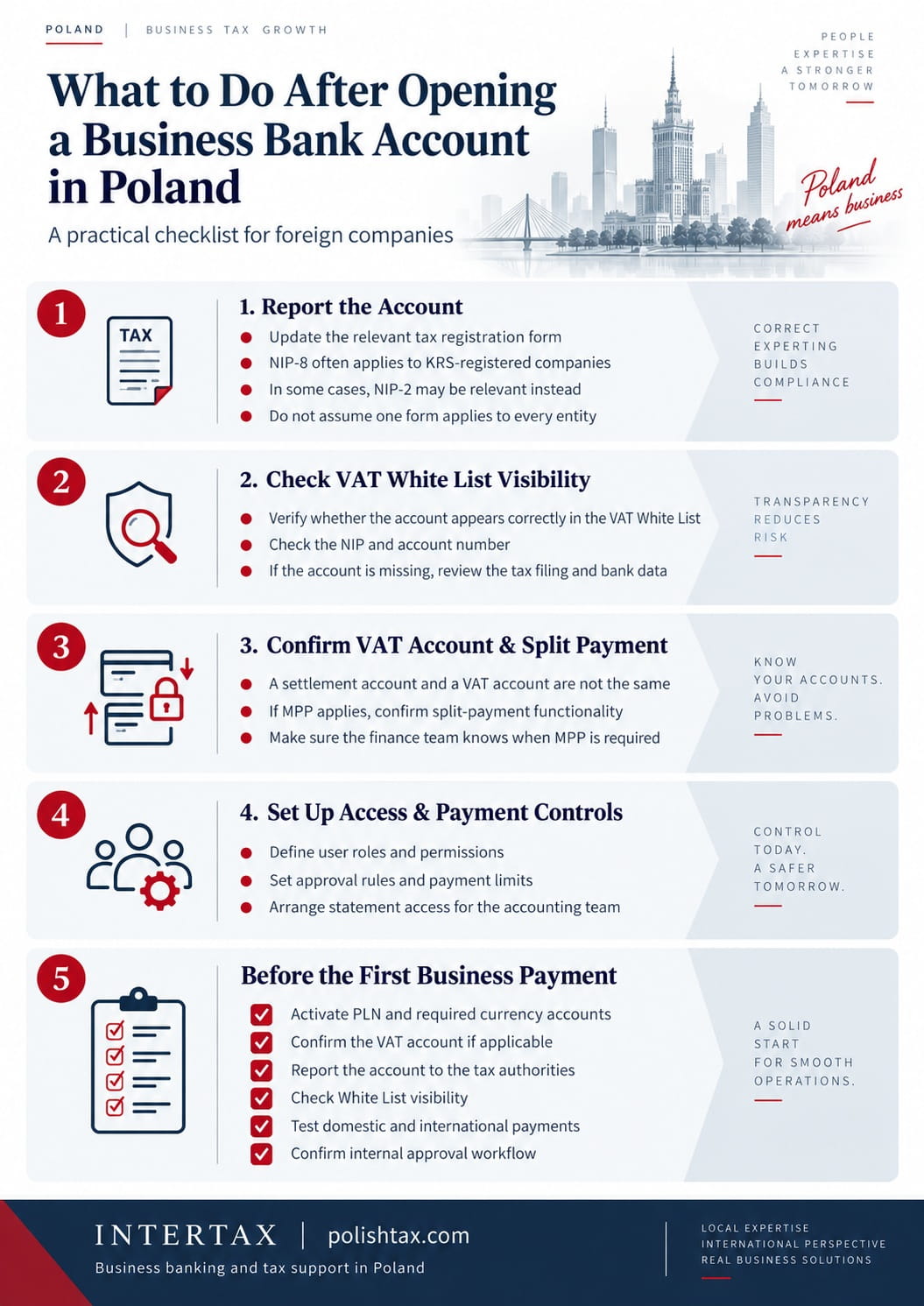
Opening the account is not the end of the process.
For many companies, the tax and operational steps completed after opening are equally important.
Report the Account to the Tax Authorities
The correct reporting procedure depends on the type of taxpayer.
For companies registered in the Polish National Court Register (KRS), bank accounts form part of the supplementary information reported using NIP-8. The official business portal specifically identifies bank-account numbers as information reported or updated on NIP-8.
For other legal persons or organizational entities, NIP-2 may be relevant. Current versions of both NIP-2 and NIP-8 are published by the Ministry of Finance.
Do not assume that one form and one deadline apply to every foreign business.
Check VAT White List Visibility
If the business is registered for Polish VAT and expects its account to be visible in the White List, verify this after the relevant tax data have been updated.
The Ministry of Finance White List system verifies settlement accounts using the taxpayer’s NIP and bank-account number.
If an expected account is missing:
1. verify that the correct account was reported to the tax authorities;
2. confirm the account type with the bank;
3. check that the NIP and account data are correct;
4. allow for the relevant register update;
5. investigate any continuing discrepancy.
Do not simply assume that opening the bank account automatically completes the White List process.
Confirm VAT Account and Split-Payment Functionality
A settlement account and a VAT account serve different purposes.
If your company is involved in transactions subject to MPP, confirm that:
-
the appropriate business settlement account is active;
-
the associated VAT account exists;
-
split-payment transfers can be sent and received correctly;
-
the accounting team knows which transactions require MPP.
The Ministry of Finance confirms that a VAT account is associated with business settlement accounts and cannot be replaced by a personal ROR account.
Set Up Accounting Access and Payment Controls
Before the first payment, configure internal controls.
Consider:
-
who can view the account;
-
who can prepare payments;
-
who approves payments;
-
whether two-person authorization is required;
-
transaction limits;
-
accounting access;
-
automatic statement delivery;
-
storage of bank confirmations;
-
access for external accountants.
The bank setup should reflect your company’s internal control model rather than giving every user unrestricted access.
Before Your First Business Payment — Checklist
-
Confirm the exact company name and account number.
-
Activate PLN and required foreign-currency accounts.
-
Confirm the VAT account if applicable.
-
Report the account to the relevant tax authority.
-
Check White List visibility where relevant.
-
Configure user permissions.
-
Set payment authorization rules.
-
Provide banking details to the accounting team.
-
Update customer and supplier payment instructions.
-
Test domestic and international payments.
-
Confirm MPP functionality where applicable.
-
Arrange statement export or accounting integration.
Common Mistakes and How to Avoid Them
|
Mistake |
Possible consequence |
What to do |
|
Ownership data differ between documents |
Additional KYC questions or delay |
Reconcile KRS, CRBR and corporate documents before applying |
|
Source of financing is not clearly explained |
Extended compliance review |
Prepare supporting financing documentation |
|
Representation rules are unclear |
Agreement cannot be signed correctly |
Confirm representation before onboarding |
|
Personal account is used instead of a company account |
Operational and tax problems |
Use an appropriate business settlement account |
|
Fintech product is selected without checking Polish tax functionality |
No VAT account, MPP or White List compatibility |
Verify the exact legal and functional characteristics |
|
Foreign director assumes the whole process is remote |
Unexpected visit or delay |
Confirm identification and signature requirements first |
|
Bank account is opened but not reported |
Tax-register inconsistencies |
Complete the appropriate tax notification |
|
White List status is not checked |
Customer payment problems and possible tax consequences |
Verify visibility after registration |
|
Company treats account activation as the end of the process |
Payment controls and tax functions remain incomplete |
Complete a post-opening checklist |
Frequently Asked Questions
Can a foreign company open a bank account in Poland without incorporating a Polish subsidiary?
Potentially yes. A foreign-registered company may apply for a Polish business account, but acceptance and documentation requirements are bank-specific. The bank will normally verify the company’s registration, representation, ownership structure, UBOs, business purpose and expected transactions. A Polish subsidiary is therefore not automatically required, but the practical onboarding process may be more extensive.
Do foreign directors need a PESEL number?
Not in every case. PESEL should not be presented as a universal statutory requirement for all banks and all corporate customers. A bank may use different identification methods depending on the applicant, the director’s residence and available identity documents. The requirement should be confirmed with the selected bank before the application is submitted.
Can a Polish company open an account if all board members live abroad?
Potentially yes, but the onboarding route may differ from the standard process used for Polish-resident directors. The bank may require additional identity verification, certified documents or an in-person visit. It is advisable to describe the company’s representation structure to the bank before preparing the full application package.
Is a visit to Poland required?
Not always. Some banks allow substantial parts of corporate onboarding to be completed remotely, but the result depends on the legal form, ownership structure, representatives and identity documents used. Remote application, remote identification and remote signing are separate stages and should be confirmed individually with the chosen bank.
What is the difference between a business account and a VAT account?
A business settlement account is the company’s operational account for receiving and making payments. A VAT account is a special account linked to a business settlement account and used within the Polish split-payment mechanism. It is not a substitute for the company’s ordinary operating account.
Can a foreign bank account be used for Polish VAT refunds?
It depends on the refund procedure and the taxpayer’s situation. Under the EU VAT Refund procedure, an eligible foreign taxpayer may receive the refund to an account in Poland, in its Member State of establishment or in another EU Member State. Other VAT refund situations should be checked separately against the applicable Polish VAT rules.
Why is my new account missing from the VAT White List?
Possible reasons include incomplete tax registration data, an incorrect account type, data that have not yet been updated or discrepancies between the bank and tax records. First verify how the account was reported, whether it is an eligible business settlement account and whether the taxpayer’s NIP and account details are correct.
What can I do if the bank rejects my application?
A rejection by one bank does not automatically determine the outcome at another institution. Ask whether the bank can identify missing information or documentation, review the consistency of your KYC package and consider another bank whose onboarding policy is more suitable for your legal form, ownership structure and transaction profile. Do not attempt to circumvent KYC requirements.
How Intertax Can Help
Opening a business bank account in Poland often involves more than completing a bank application. Foreign-owned companies may also need to coordinate corporate documents, beneficial-owner information, Polish tax registrations and post-opening reporting.
Intertax can assist foreign companies with preparing the information and documents required for the banking process, reviewing Polish tax and VAT implications connected with the account, and completing relevant formalities after the account is opened — within the scope of the services agreed with the client.
Support may include, depending on the case:
-
reviewing the company’s Polish banking and tax requirements;
-
helping prepare corporate and ownership documentation;
-
coordinating information required for KYC and UBO verification;
-
assisting with Polish tax registration and account-reporting formalities;
-
checking VAT White List and split-payment implications;
-
coordinating with the company’s accounting team after account activation.
Because the final account-opening decision remains with the bank, no adviser can guarantee approval.
Discuss your company’s banking and tax requirements in Poland.
Related Intertax Guides
For further guidance on related tax, VAT and company-formation issues, see:
-
Polish LLC (Sp. z o.o.) – How to Register, Costs & Taxes in 2026
-
Mandatory Split Payment Mechanism in Poland Extended Until 2028
Selected Official and Bank Sources
-
Polish Entrepreneurs’ Law / statutory payment-account threshold — https://eli.gov.pl/
-
Ministry of Finance — Split Payment Mechanism (MPP) — https://www.podatki.gov.pl/podatki-firmowe/vat/poradniki-i-informatory/mechanizm-podzielonej-platnosci-mpp
-
Ministry of Finance — VAT White List — https://www.podatki.gov.pl/narzedzia/white-list
-
Business.gov.pl — NIP-8 supplementary information — https://www.biznes.gov.pl/
-
Ministry of Finance — registration forms NIP-2 and NIP-8 — https://www.podatki.gov.pl/formularze-rejestracja
-
Ministry of Finance — VAT refunds to foreign entities — https://www.podatki.gov.pl/pozostale/tax-free-vat-refund-vap-oss-i-ioss/zwrot-vat-podmiotom-zagranicznym
-
CRBR — official information — https://www.gov.pl/web/finanse/centralny-rejestr-beneficjentow-rzeczywistych
-
Bank Pekao — company account onboarding information — https://www.pekao.com.pl/
-
ING Bank Śląski — company account information — https://www.ing.pl/spolki/konta/konto-dla-spolki