


Poland is one of the largest economies in the European Union and offers foreign companies access not only to a substantial domestic market, but also to the EU Single Market.
For an international business, however, entering Poland involves more than choosing a location and registering a company. The legal structure, corporate tax position, VAT model, employment arrangements, accounting system and increasingly digital compliance requirements should ideally be designed before the first transactions take place.
This doing business in Poland guide provides CFOs, founders, expansion directors and in-house legal teams with a practical overview of the main issues they should consider in 2026.
For the broader investment case – including Poland’s location, workforce, investment incentives and market potential – see our Why Invest in Poland: Strategic Advantages for Foreign Businesses (2026 Guide)
Legal Forms of Doing Business in Poland

Choosing the appropriate legal form is one of the first decisions when doing business in Poland.
The right structure depends on factors including liability, planned financing, number and type of investors, expected scale of operations, taxation and whether the investor wants to establish a separate Polish legal entity.
For foreign corporate investors, the most relevant structures usually include a limited liability company (sp. z o.o.), a simple joint-stock company (P.S.A.), a joint-stock company (S.A.), or a branch of a foreign company.
|
Business structure |
Minimum capital |
Liability |
Typical use |
|
Limited liability company – sp. z o.o. |
PLN 5,000 |
Shareholders generally not liable for company debts |
Most foreign subsidiaries, SMEs, trading and service companies |
|
Simple joint-stock company – P.S.A. |
PLN 1 capital fund |
Shareholders generally not liable for company debts |
Startups, technology companies and businesses seeking flexible investor arrangements |
|
Joint-stock company – S.A. |
PLN 100,000 |
Shareholders generally not liable for company debts |
Large investments, regulated businesses and capital-market projects |
|
Branch of a foreign company |
No separate statutory share capital |
Foreign parent remains responsible |
Direct Polish operations of an existing foreign enterprise |
|
Representative office |
No minimum capital |
Part of the foreign enterprise |
Advertising and promotion of the foreign enterprise |
|
Sole proprietorship – JDG |
No minimum capital |
Unlimited personal liability |
Individual entrepreneurs entitled to conduct business in this form in Poland |
Limited Liability Company – sp. z o.o.
The spółka z ograniczoną odpowiedzialnością (sp. z o.o.) is often the first structure considered by a foreign company establishing a subsidiary in Poland.
Its minimum share capital is PLN 5,000 and it has separate legal personality. Shareholders are generally not personally liable for the company’s obligations, although separate liability rules may apply to members of the management board in certain circumstances.
Foreign investors may generally hold 100% of the shares in a Polish sp. z o.o. There is no general requirement to have a Polish shareholder simply because the company operates in Poland.
For formation, governance and taxation details, see our dedicated Polish LLC guide.
Simple Joint-Stock Company – P.S.A.
The prosta spółka akcyjna (P.S.A.) is a flexible capital company particularly relevant to innovative and investment-driven businesses.
Its minimum capital fund is only PLN 1. P.S.A. shares have no nominal value and the corporate structure provides considerable flexibility in organising relationships between founders and investors.
A distinctive feature is that shares may also be issued in return for certain contributions consisting of work or services. Such contributions do not, however, form part of the capital fund itself.
The P.S.A. can therefore be attractive for startups, technology businesses and ventures in which founders contribute know-how, work or intellectual capital.
It should not automatically be treated as preferable to a sp. z o.o. The decision should take into account the financing model, governance arrangements, future investors and planned exit strategy.
Joint-Stock Company – S.A.
A traditional spółka akcyjna (S.A.) requires minimum share capital of PLN 100,000 and has a significantly more formal corporate structure.
It is generally more relevant for larger projects, certain regulated businesses and companies planning to use capital-market financing.
For many foreign SMEs establishing their first Polish subsidiary, an S.A. will therefore be more complex than necessary.
Branch of a Foreign Company
A branch allows a foreign entrepreneur to conduct business in Poland without incorporating a separate Polish subsidiary.
The branch does not have separate legal personality from its foreign parent. Consequently, the foreign enterprise remains responsible for its activities and obligations.
A branch may be attractive where the investor wants Polish operations to remain legally integrated with the foreign company. The decision should nevertheless take into account Polish accounting and tax consequences, including potential permanent establishment in Poland exposure. For the registration rules and limitations, check here : https://polishtax.com/branch-of-a-foreign-taxpayer-in-poland/
Representative Office
A representative office has a much narrower function than a branch.
Its activity in Poland is generally limited to advertising and promotion of the foreign enterprise. It should therefore not be used as a substitute for a subsidiary or branch where ordinary commercial activities are intended.
For the registration rules and limitations, see our Representative Office Registration in Poland guide.
Sole Proprietorship – JDG
A sole proprietorship does not require minimum capital but involves unlimited personal liability.
For foreign individuals, availability of this form depends on nationality and – particularly for third-country nationals – residence status or another legal basis permitting them to conduct business in Poland.
Foreign individuals should therefore verify their eligibility before assuming that a Polish JDG is available to them.
You can find more information here What are the different legal forms of running a business in Poland | Biznes.gov.pl – An information and service website for entrepreneurs
How to Register a Business in Poland
Starting a business in Poland as a foreigner generally involves a combination of corporate, tax and administrative procedures.
For a typical foreign-owned company, the process can be summarised as follows:
-
Choose the appropriate legal structure.
-
Define the shareholders, management and representation rules.
-
Select the registered office and determine the scope of business activities.
-
Prepare the articles of association or other incorporation documents.
-
Contribute the required capital, where applicable.
-
Register the company with the National Court Register (KRS).
-
Complete the required tax and statistical registrations and supplementary notifications.
-
Report beneficial owners to the Central Register of Beneficial Owners (CRBR) where required.
-
Obtain an address for electronic service – e-Doręczenia – where required.
-
Register for VAT and VAT-EU, if required.
-
Set up accounting, invoicing, tax reporting and payroll procedures before operations begin.
Foreign corporate documents may require an apostille or other legalisation, depending on their country of origin and the applicable international rules. Polish sworn translations may also be necessary.
A Polish shareholder is generally not required to establish a Polish capital company. There is also no general rule requiring every management board member of a Polish sp. z o.o. to be a Polish national or resident.
Nevertheless, foreign companies should consider the practical implications of electronic signatures, bank onboarding, e-Doręczenia and access to Polish electronic tax systems.
For the detailed company-entry process, see our Entering the Polish Market: The Ultimate Tax & Legal Compliance Guide for Foreign Investors.
Company registration and tax registration are not the same thing
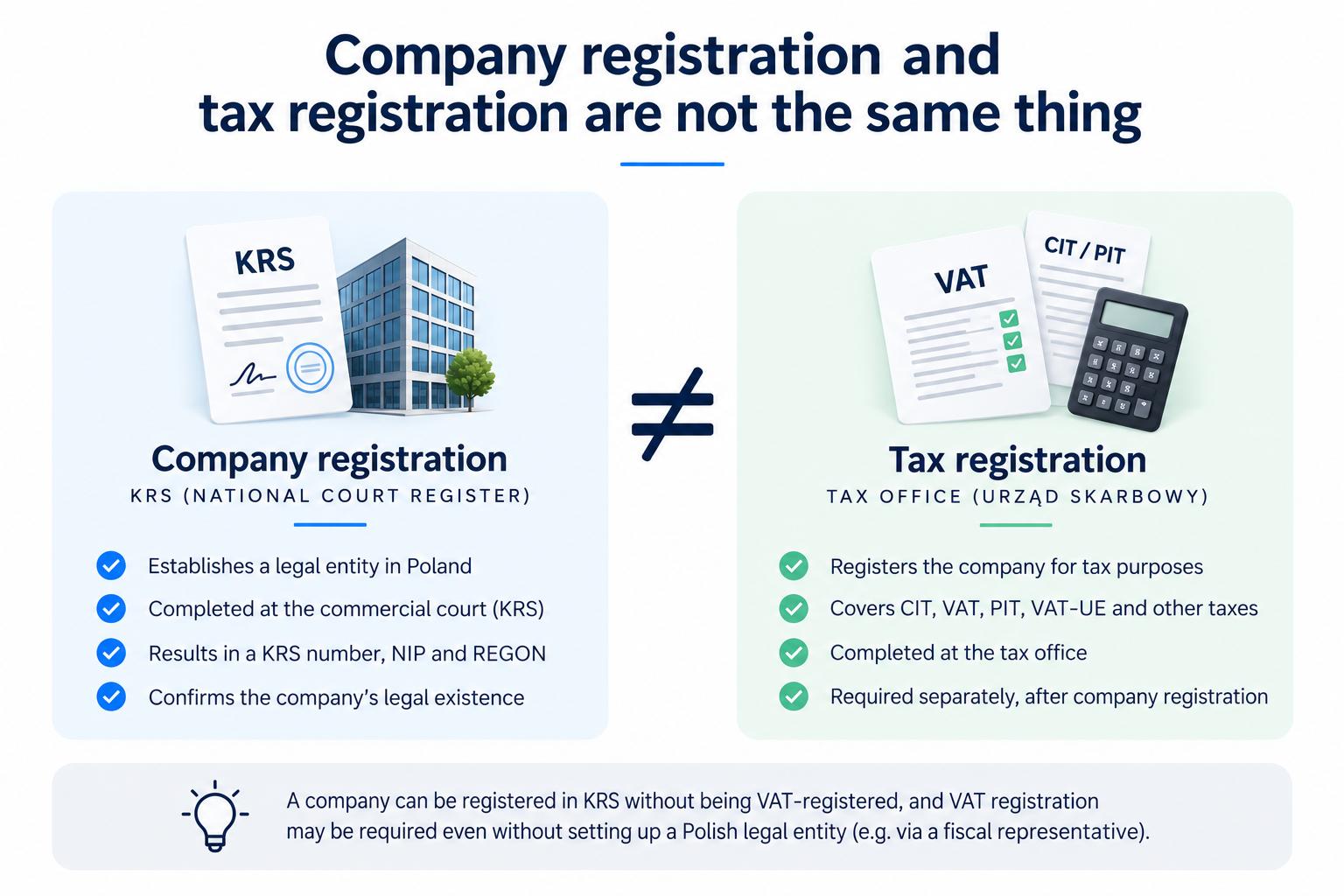
A particularly important distinction for foreign businesses is that incorporating a company in Poland and registering for Polish taxes are separate issues.
Depending on its activities, a foreign enterprise may need a Polish NIP, VAT registration or other tax registrations without establishing a Polish subsidiary at all.
Taxation for Businesses in Poland
Tax should be considered before selecting the operating model rather than after the company has been registered.
Warehouses, employees, management functions, contracts and the movement of goods can all affect Polish corporate taxation, VAT and permanent establishment exposure.
Key Polish tax rates in 2026
|
Tax |
2026 rate |
Key point |
|
Corporate Income Tax – standard CIT |
19% |
Standard corporate tax rate |
|
Reduced CIT |
9% |
May apply to qualifying small/start-up taxpayers and qualifying income |
|
VAT – standard rate |
23% |
Standard VAT rate |
|
VAT – reduced rates |
8% / 5% |
Apply to specified goods and services |
|
PIT – progressive scale |
12% / 32% |
One of the taxation methods relevant to individuals |
|
PIT – flat tax for business income |
19% |
Available subject to applicable conditions |
|
IP Box |
5% |
Preferential rate for qualifying IP income subject to statutory requirements |
Corporate Income Tax
The standard Polish CIT rate is 19%.
A 9% CIT rate may apply to qualifying small taxpayers and businesses commencing activity, subject to statutory conditions and exclusions. The taxpayer’s revenue in the current tax year must generally not exceed the equivalent of EUR 2 million, and the 9% rate does not apply to capital gains. From 2026, where a tax year is shorter or longer than 12 months, the EUR 2 million current-year threshold is adjusted proportionally.
Among other requirements, the taxpayer must generally be a qualifying small taxpayer or a business commencing activity and must comply with statutory revenue limits and exclusions.
International groups should additionally consider:
-
withholding tax,
-
double tax treaties,
-
transfer pricing,
-
permanent establishment exposure,
-
related-party transactions,
-
financing arrangements,
-
minimum corporate income tax where applicable.
For more detail, see our guides to:
-
Corporate Income Tax in Poland
-
Withholding Tax in Poland
-
Capital Gains Tax in Poland
-
Personal Income Tax in Poland
VAT
The standard Polish VAT rate is 23%, with reduced rates including 8% and 5% for specified categories of goods and services.
Foreign companies may be required to register for Polish VAT even without establishing a Polish company.
Situations that frequently require a separate VAT analysis include:
-
storing goods in Poland,
-
domestic supplies of goods,
-
intra-Community acquisitions and supplies,
-
imports,
-
exports,
-
inventory and fulfilment models,
-
e-commerce,
-
installation supplies,
-
certain cross-border services.
Consequently, VAT registration and company incorporation are separate questions.
A foreign company can have Polish VAT obligations without creating a Polish subsidiary.
For non-EU businesses, another issue may arise: depending on the company’s country of establishment and activities, a fiscal representative in Poland may be required under the Polish VAT rules.
E-Invoicing and KSeF Compliance
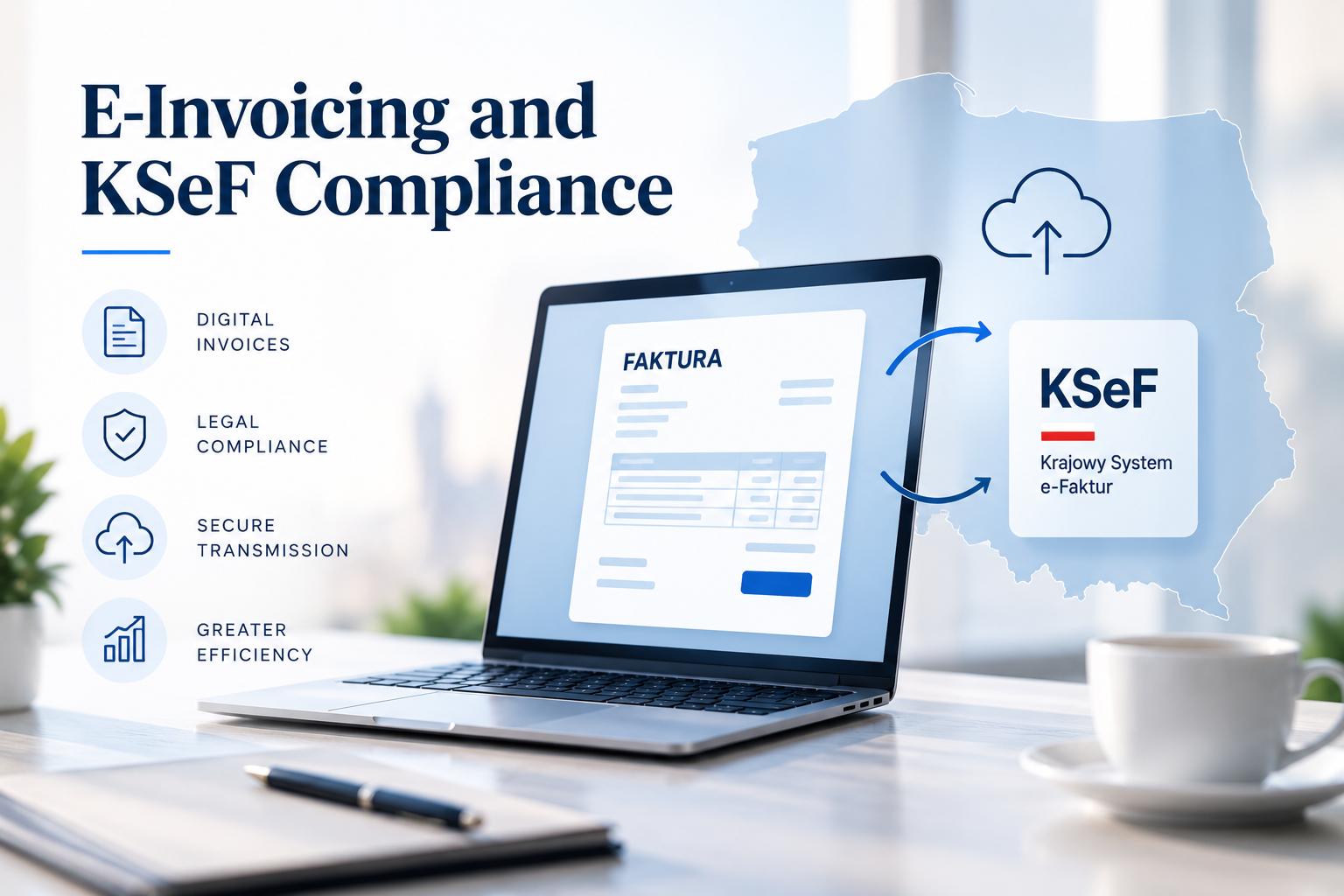
The implementation of mandatory KSeF – Krajowy System e-Faktur (National e-Invoicing System) is one of the most significant Polish compliance developments of 2026.
The obligation to issue invoices through KSeF has been introduced in stages:
-
1 February 2026 – for taxpayers whose 2024 gross sales exceeded PLN 200 million;
-
1 April 2026 – for other taxpayers falling within the mandatory system;
-
until 31 December 2026 – a transitional exemption applies in specified circumstances where monthly sales documented by invoices do not exceed PLN 10,000 gross;
-
1 January 2027 – the transitional exemption for those smallest taxpayers is scheduled to end.
The obligation to receive invoices through KSeF generally applies from 1 February 2026, subject to statutory exceptions, including certain foreign entities and transactions.
KSeF for foreign companies
A key point for international businesses is that Polish VAT registration does not automatically mean that a foreign company has to issue invoices through mandatory KSeF.
A foreign taxpayer is generally outside the mandatory KSeF invoicing requirement where it:
-
has neither its business establishment nor a fixed establishment in Poland, or
-
has a fixed establishment in Poland, but that establishment does not participate in the particular transaction documented by the invoice.
This makes the concept of fixed establishment for VAT purposes particularly important.
VAT registration itself does not create a fixed establishment. The existence of an FE depends on the actual business structure, permanence and human and technical resources available in Poland.
Foreign companies with employees, warehousing arrangements, outsourced resources or other Polish operational infrastructure should therefore determine both their VAT and FE position rather than assuming that one follows automatically from the other.
For a deeper analysis, read:
Cost of Doing Business in Poland
The minimum cost of registering a company is only a small part of the real cost of doing business in Poland.
Foreign investors should separately budget for incorporation, accounting, tax compliance, payroll, employment, premises and technology.
Indicative 2026 cost framework
|
Cost category |
Indicative amount / basis |
Comment |
|
Minimum capital – sp. z o.o. |
PLN 5,000 |
Company capital, not an advisory fee |
|
Minimum capital fund – P.S.A. |
PLN 1 |
Different legal concept from share capital in an sp. z o.o. |
|
Minimum capital – S.A. |
PLN 100,000 |
Statutory minimum |
|
Standard KRS registration court fee |
PLN 500 |
Reduced court fee may apply to eligible S24 registrations |
|
KRS registration via S24 |
PLN 250 |
Applies where an eligible company is incorporated using the standard agreement template in the S24 system |
|
Notary / translations / apostille |
Case-specific |
Particularly relevant for foreign shareholders |
|
Accounting |
Provider and volume dependent |
Transaction volume, VAT, payroll and international transactions strongly affect the price |
|
VAT compliance |
Scope dependent |
VAT-EU, Intrastat and cross-border transactions may increase the workload |
|
Virtual office |
Usually substantially below physical-office cost |
Depends on city and scope |
|
Physical office |
Market-based |
Significant differences between Warsaw and regional cities |
|
2026 minimum gross salary |
PLN 4,806/month |
Statutory minimum |
|
Employer cost at minimum wage |
Approx. PLN 5,790/month under standard assumptions |
Before PPK and additional benefits |
|
Payroll / HR administration |
Usually per employee or package |
Depends on headcount and complexity |
What does an employee really cost in Poland?
From 1 January 2026, the national minimum salary is PLN 4,806 gross per month.
Gross salary is not the same as total employer cost. Employer-funded social security and labour-related contributions are added on top.
Under standard contribution assumptions, including a commonly applicable accident insurance rate, the basic employer cost of the minimum salary is approximately PLN 5,790 per month.
The exact figure may differ depending on the employer’s accident contribution rate. PPK, bonuses, private medical care and other benefits can increase the cost further.
Employment and Labor Law Basics for Employers in Poland
Polish employment law is relatively formal and companies hiring employees in Poland need to consider more than gross salary.
Typical employer responsibilities include:
-
concluding an appropriate employment agreement,
-
registering employees for social insurance,
-
calculating and withholding PIT,
-
calculating employee and employer social security contributions,
-
maintaining payroll and HR documentation,
-
monitoring working time and annual leave,
-
arranging mandatory medical examinations,
-
complying with occupational health and safety rules,
-
applying statutory notice and termination procedures.
Employing foreign nationals may additionally require an analysis of their right to work and stay in Poland.
The statutory national minimum salary from 1 January 2026 is PLN 4,806 gross per month.
For more detail, see:
Ongoing Compliance – What Happens After Registration
Company registration is only the beginning of Polish compliance.
Depending on its legal form and activities, a Polish business may have recurring obligations involving:
-
statutory bookkeeping,
-
VAT records and JPK_V7 reporting,
-
CIT calculations and returns,
-
payroll and social security reporting,
-
annual financial statements,
-
corporate resolutions and KRS filings,
-
beneficial-owner reporting and updates,
-
e-Doręczenia,
-
transfer pricing,
-
Intrastat,
-
statutory audit where applicable,
-
KSeF,
-
structured income-tax accounting reporting.
JPK_PD – Structured Accounting Data
Poland is progressively introducing structured electronic reporting of accounting and tax books for income-tax purposes.
The system includes, among others:
-
JPK_KR_PD – accounting books,
-
JPK_ST_KR – fixed asset and intangible asset records for taxpayers filing JPK_KR_PD.
The rollout is phased.
The first group – including certain large CIT taxpayers and tax capital groups – already reports for financial years beginning after 31 December 2024.
For financial years beginning after 31 December 2025, the next group includes further CIT and PIT taxpayers that are required to submit monthly JPK_VAT.
The reporting obligation expands further for financial years beginning after 31 December 2026.
For foreign-owned companies, this means that accounting software configuration increasingly becomes a tax-compliance issue in its own right.
E-Delivery – e-Doręczenia
Electronic delivery has also become part of the Polish corporate compliance environment.
E-Delivery (e-Doręczenia) is already mandatory for businesses registered in KRS. Companies registered from 1 January 2025 establish an e-Delivery address as part of the registration process, while businesses entered in KRS before that date have been subject to the requirement since 1 April 2025. For entrepreneurs registered in CEIDG before 1 January 2025, the general deadline is 1 October 2026.
Business Culture and Etiquette in Poland
Legal compliance is only one aspect of successfully doing business in Poland.
Foreign executives should also understand several practical characteristics of the local business environment.
Formality
Initial business relationships can be relatively formal. Titles and surnames are commonly used until the relationship develops and the parties move to a first-name basis.
Punctuality
Arriving on time is generally expected, particularly in corporate, finance and professional-services environments.
Decision-making
Organisations can be relatively hierarchical. Operational meetings may involve several employees while significant commercial decisions remain subject to management or board-level approval.
Documentation
Polish businesses and professional advisers often place considerable emphasis on supporting documents, written agreements and clearly defined responsibilities.
For foreign companies this becomes particularly important where documentation determines VAT, customs, employment or corporate-tax treatment.
Language
English is widely used in international business, particularly in larger companies and major cities.
However, official filings and many administrative procedures are conducted in Polish. Corporate, accounting, employment and tax documentation may therefore need to be prepared or maintained in Polish even where the group’s internal working language is English.
Specialized Structures – Permanent Establishment, Family Foundations, Customs and EORI
Not every foreign business entering Poland needs to incorporate a Polish company.
Depending on the operating model, other areas may be equally or more important.
Permanent Establishment in Poland
A foreign company may become subject to Polish corporate taxation even without establishing a Polish subsidiary.
An office, employees, management functions, construction activities, dependent representatives or other forms of presence can potentially create a permanent establishment in Poland, depending on the facts and the applicable double tax treaty.
A PE analysis should therefore be carried out before assuming that operating without a Polish company means operating without Polish corporate-tax exposure.
This corporate income tax concept should also be distinguished from a fixed establishment for VAT purposes. Although the terms can sound similar, they arise under different tax rules and should be analysed separately.
Family Foundation
The Polish family foundation is primarily a succession, asset-holding and family-wealth planning structure.
It should not be treated as the standard vehicle for normal operating activity, but may be relevant to owners of family businesses considering long-term ownership and succession planning.
See our Family Foundation in Poland – 2026 Guide
Customs and Imports
Companies importing goods into Poland from outside the European Union should analyse:
-
customs classification,
-
customs value,
-
origin,
-
importer-of-record arrangements,
-
customs duties,
-
import VAT,
-
available import VAT simplifications,
-
EORI registration.
FAQ – Doing Business in Poland
What is the best legal structure for a foreign company doing business in Poland?
For many foreign SMEs and international groups, a spółka z ograniczoną odpowiedzialnością (sp. z o.o.) is the natural starting point because it combines separate legal personality, limited shareholder liability and a relatively low minimum share capital of PLN 5,000.
A P.S.A. may be worth considering for startups and investor-driven projects requiring greater flexibility, while a branch can be appropriate where the foreign enterprise prefers to operate directly rather than through a separate subsidiary.
There is therefore no single structure that is best for every foreign investor.
How much does it cost to register and run a small business in Poland?
For an sp. z o.o., minimum share capital is PLN 5,000.
Registration involves a court fee, while notarial, translation, apostille and professional fees may apply depending on the structure and registration method.
After incorporation, accounting, tax compliance, payroll, employees and premises generally become much more significant than the original registration cost.
For example, an employee receiving the 2026 statutory minimum salary of PLN 4,806 gross costs the employer approximately PLN 5,790 per month under standard contribution assumptions, before PPK and additional benefits.
Do I need a local partner or director to do business in Poland?
Generally, no.
A foreign investor can normally own a Polish sp. z o.o., P.S.A. or S.A. without a Polish shareholder.
There is also no general nationality requirement under which every management board member of an ordinary Polish sp. z o.o. must be Polish.
Foreign management should nevertheless consider practical issues such as electronic signatures, banking, KRS filings, e-Doręczenia and access to Polish tax systems.
Different eligibility rules apply to foreign individuals wishing to operate a sole proprietorship.
What taxes does a company pay in Poland?
The standard Polish CIT rate is 19%.
A reduced 9% CIT rate can apply to qualifying small and start-up taxpayers subject to statutory requirements and exclusions.
The standard VAT rate is 23%, with reduced rates including 8% and 5% for specified goods and services.
Depending on the operating model, a company may also encounter withholding tax, payroll taxes and social security, customs duties, transfer pricing obligations, minimum CIT and sector-specific taxation.
Is Poland a good place to do business as a foreign investor in 2026?
Poland offers foreign companies access to one of the EU’s largest domestic markets and the wider EU Single Market, together with developed manufacturing, logistics and business-services sectors.
The attractiveness of a Polish investment should nevertheless be assessed against the particular business model.
In 2026, investors should model not only labour and taxation but also digital compliance – particularly KSeF, JPK_PD and e-Doręczenia – as part of the cost and implementation timeline.
For the complete investment case, see our Why Invest in Poland: Strategic Advantages for Foreign Businesses (2026 Guide)
How Intertax Can Help You Do Business in Poland
Doing business in Poland often involves several interconnected areas of compliance.
Intertax supports foreign companies with:
-
company establishment and registration,
-
selection of an appropriate Polish business structure,
-
Polish tax registration,
-
VAT and VAT-EU registration,
-
fiscal representation,
-
CIT and VAT advisory,
-
ongoing accounting,
-
payroll and HR,
-
KSeF implementation,
-
SAF-T and JPK reporting,
-
EORI and customs-related registrations,
-
permanent establishment and fixed establishment analysis,
-
representation before Polish tax authorities.
For foreign CFOs and expansion teams, the most efficient approach is usually to design the entire Polish operating and compliance model before the first transactions take place.
That includes determining:
-
which entity will contract with customers,
-
where goods will be stored,
-
which entity will employ personnel,
-
whether Polish VAT registration is required,
-
whether a permanent establishment or VAT fixed establishment may arise,
-
whether mandatory KSeF applies,
-
how Polish accounting and JPK reporting will be handled.
Considering doing business in Poland in 2026? Contact Intertax to discuss your planned business model. We can identify the registrations, tax obligations and ongoing compliance requirements that should be addressed before operations begin.
This guide provides general information based on Polish law and administrative guidance available as at 14 September 2026. The tax and legal treatment of a particular business depends on its individual circumstances and should be verified before implementation.