


Foreign investment control in Poland (FDI screening) should be checked at the beginning of an acquisition process, not shortly before closing. As of 2026, Poland operates a permanent screening regime for certain investments that may affect public order, public security or public health. For some transactions, signing or completing an acquisition before the required notification can create consequences far more serious than a procedural delay: the transaction may be invalid and criminal sanctions may apply.
For an investor, CFO or in-house counsel, the practical question is therefore not simply whether the target operates in a “strategic” sector. The analysis must combine the identity and location of the investor, the target’s business and turnover, the percentage of rights being acquired, the structure of any indirect acquisition and, in some cases, a separate list-based screening regime that can apply irrespective of the investor’s nationality.
|
2026 key point. Since 24 July 2025, the specialised Polish FDI regime is permanent and the competent authority is the minister responsible for the economy — currently the Minister of Finance and Economy. Proceedings started by the President of UOKiK before that date remain subject to the transitional rule and are completed under the previous framework. |
Legal Framework — Two Parallel Screening Regimes in Poland
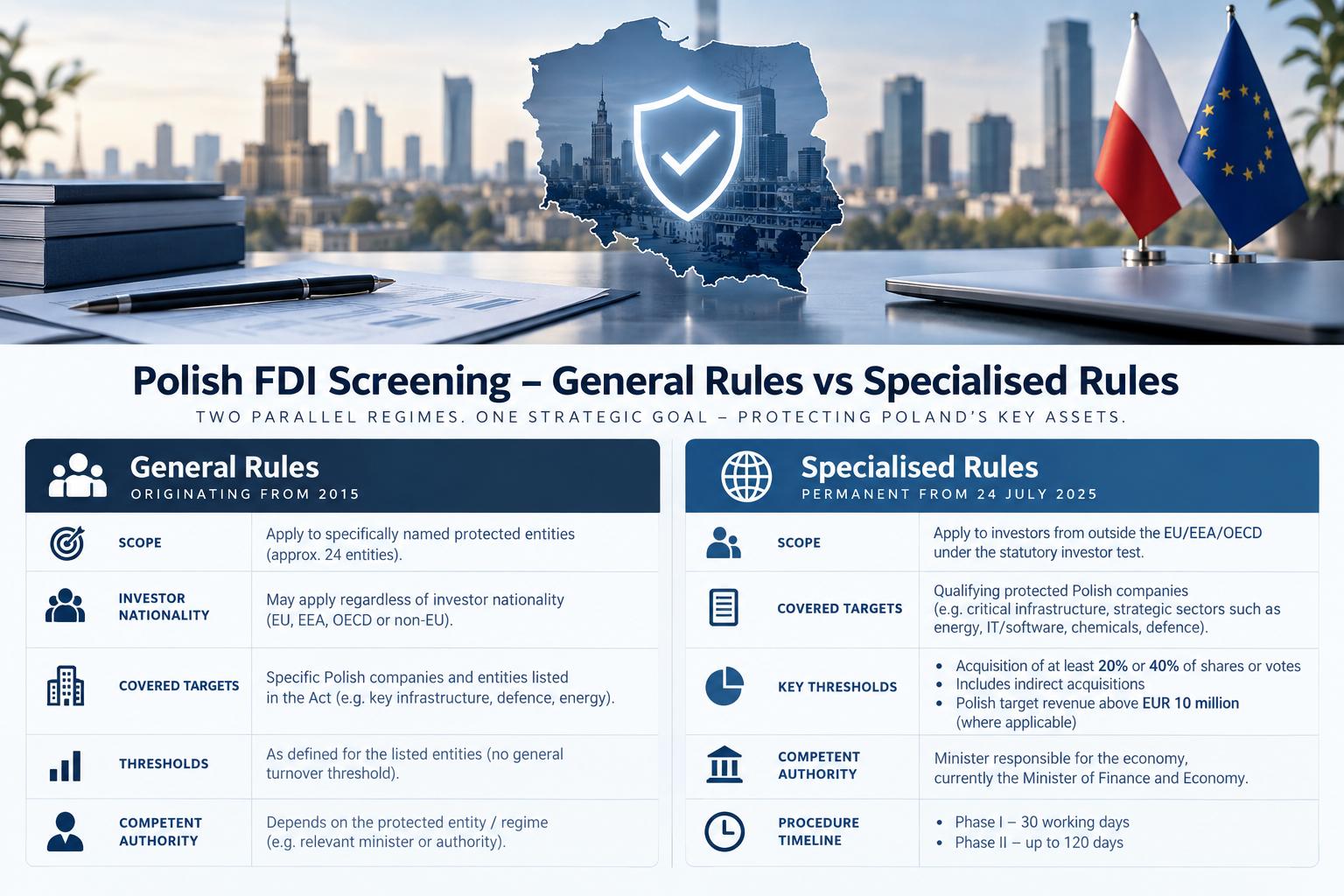
The Polish Act on Control of Certain Investments contains two mechanisms that should be analysed separately. Treating them as one single FDI test can lead to the wrong conclusion about whether a filing is required.
|
Feature |
General Rules |
Specialised Rules |
|
Origin |
2015 regime |
2020 regime, made permanent in 2025 |
|
Investor test |
Can apply regardless of nationality |
Focused on investors outside the EU/EEA/OECD framework defined by the Act |
|
Target test |
Named protected entities on a government list |
Polish targets meeting statutory activity/sector and turnover criteria |
|
Authority |
Authority assigned to the particular protected entity |
Minister responsible for the economy |
|
Core purpose |
Protection of specifically listed strategic entities |
Protection of public order, public security and public health |
General Rules. The original 2015 regime covers entities expressly included in a Council of Ministers regulation. The list is not static. The regulation in force for 2025–2027 was amended again in September 2026. Following that amendment, the numbered list runs to 25 protected entities, with Huta Częstochowa and Advanced Protection Systems added and the former item 9a removed. This regime should therefore be checked against the current regulation at the time of the deal, rather than against an old summary or transaction checklist.
Specialised Rules. Articles 12a–12k create the broader FDI screening mechanism commonly encountered in cross-border M&A. This is the regime in which the investor’s EU/EEA/OECD status, the target’s turnover and business profile, and the 20%/40% participation thresholds are particularly important.
2025/2026 Update — Permanent Regime and New Authority
A major change took effect on 24 July 2025. The specialised screening rules, which had originally been introduced as an emergency mechanism and later extended, ceased to be temporary. The same amendment transferred competence under Articles 12a–12k from the President of the Office of Competition and Consumer Protection (UOKiK) to the minister responsible for the economy.
In 2026, that role is performed by the Minister of Finance and Economy. This is not merely a change of letterhead. Transaction documents, filing strategies and legal opinions that still identify UOKiK as the current authority for the specialised FDI regime should be updated. UOKiK remains highly relevant in Polish M&A because it continues to administer merger control, but merger control and FDI screening are separate procedures with different legal tests.
The transitional rule is narrow but important: proceedings initiated by the President of UOKiK under Articles 12a–12k and not completed before 24 July 2025 continue under the previous wording and are completed by UOKiK.
Who Needs to Notify? Investor Criteria
Under the specialised regime, the investor-side test focuses on whether the acquiring person or entity falls outside a “Member State” as defined for these rules. That statutory definition is broader than the EU alone: it includes EU Member States, EEA states and OECD countries.
-
For an individual, the screening mechanism concerns an investor who does not hold citizenship of a qualifying Member State.
-
For an entity, the legislation examines whether it has — or has had for at least two years before the filing — its registered office in a qualifying Member State.
-
Subsidiaries, branches and representative offices of a non-qualifying investor may be treated as not having their seat in a qualifying Member State for the purposes of the specialised rules.
-
The authority can also act where the structure appears to involve an abuse or circumvention of the rules, for example where an acquisition vehicle lacks genuine economic activity, a permanent business establishment, an office or personnel in the qualifying jurisdiction.
This makes the ultimate ownership and substance analysis important. A transaction should not be classified only by looking at the country printed next to the immediate buyer in the SPA.
Which Transactions and Target Companies Are Covered
A specialised-regime filing may be triggered by an acquisition or achievement of “significant participation” or by acquisition of dominance over a protected Polish target. The statutory concept is intentionally broader than a simple purchase of a majority stake.
-
A 20% threshold can constitute significant participation.
-
Crossing or reaching the 20% or 40% voting, profit-participation or partnership-capital thresholds is specifically relevant.
-
Acquiring or leasing the enterprise or an organised part of the enterprise may also be caught.
-
Indirect acquisitions can be covered, including transactions carried out higher in an international group structure.
-
Certain subsequent corporate events — including redemptions, divisions, mergers or changes to rights attached to shares — can create a “subsequent acquisition” effect.
Target-side conditions. The specialised rules protect Polish-seated businesses falling into the statutory categories. In broad terms, these include public companies, businesses connected with critical infrastructure, specified software and cloud/data services, and a long list of strategic activities such as energy, fuels, chemicals, defence-related goods and technologies, telecommunications, medical products and pharmaceuticals, gas and heat infrastructure, and certain food-processing activities.
A key financial condition is the Polish turnover test. The target must generally have revenue from sales of goods and services in Poland exceeding the equivalent of EUR 10 million in either of the two financial years preceding the filing. For transaction teams, this threshold should be confirmed from reliable financial and management data rather than assumed from the target’s total global revenue.
Tax and M&A Due Diligence Angle
FDI screening should sit in the same pre-signing workstream as tax and financial transaction due diligence. A share deal may simultaneously require analysis of corporate income tax exposure, historic tax risks, financing, withholding tax, transfer pricing and the tax consequences of the seller’s exit. FDI does not replace those checks; it can determine whether the transaction may legally proceed on the planned timetable.
In particular, where the acquisition involves shares in a Polish company, the transaction team should consider the capital gains tax on the sale of shares in a Polish company alongside the FDI analysis. The target’s revenue level may also be relevant to the screening test, so financial data used in the FDI workstream should be reconciled with information reviewed for Corporate Income Tax in Poland.
For investors still deciding between acquiring an existing business and establishing a new vehicle, FDI screening is also one reason to compare an acquisition with greenfield entry. See our guide on Company Registration in Poland before registering a company as a non-EU investor.
The Notification Procedure — Step by Step
The filing timetable should be built into the SPA and signing mechanics. In many cases the notification must be made before a binding commitment to acquire is entered into, and the transaction must not be completed while the standstill obligation applies.
-
Screen the investor and target: Identify the direct and ultimate investor, qualifying jurisdiction, target activities, Polish turnover, public-company/critical-infrastructure status and the rights to be acquired.
-
Map the transaction structure: Check direct and indirect acquisitions, acting-in-concert arrangements, options, staged closings and corporate restructurings.
-
Determine who files: The filing party depends on the transaction type. Direct and certain indirect acquisitions are notified by the relevant acquiring entity; subsequent acquisitions can place the filing obligation on the protected target.
-
File before the statutory trigger: For standard intended acquisitions, the filing is generally made before concluding the agreement that creates the acquisition obligation or before another legal act leading to the acquisition.
-
Phase I — preliminary review: The authority has 30 working days from commencement of the preliminary review to issue a no-objection decision or open the full control proceeding.
-
Phase II — control proceeding: If the case requires further examination, the decision should be issued no later than 120 days from commencement of the control proceeding. Statutory suspensions can extend the practical timetable.
-
Observe standstill: The notifying party must refrain from completing the notified transaction until the applicable review period has passed and the legal conditions for completion are satisfied.
Practical drafting point. The SPA should contain a properly drafted FDI condition precedent where the analysis indicates that clearance may be required. Long-stop dates should reflect not only the headline 30-working-day Phase I period, but also the possibility of a Phase II review and information requests that suspend the statutory clock.
Grounds for Objection and Judicial Review
The Minister may object where the filing is incomplete or required explanations are not provided, but the substantive grounds are wider. The Act allows an objection where the investment creates at least a potential threat to Poland’s public order, public security or public health, where the investor’s qualifying status cannot be established, or where the transaction may negatively affect projects or programmes of Union interest.
A decision of the control authority can be challenged before the administrative court. For deal planning, however, judicial review is a remedy after the administrative decision; it is not a substitute for correctly identifying the filing obligation before signing or closing.
Penalties for Non-Compliance
The consequences of ignoring the FDI regime can be severe and should be treated as a transaction-validity risk, not simply a regulatory fine risk.
-
Under the General Rules, acquiring significant participation or dominance without the required notification can be punishable by a fine of up to PLN 100 million, imprisonment from six months to five years, or both.
-
Under the Specialised Rules, acquiring or achieving significant participation or dominance without the required filing can be punishable by a fine of up to PLN 50 million, imprisonment from six months to five years, or both.
-
Separate sanctions can apply to persons responsible for the affairs of dependent entities and to the exercise of rights from shares in breach of the notification rules.
-
A transaction completed without the required prior notification, or despite an objection, can be invalid by operation of law under the specialised regime, subject to the statutory exceptions for particular indirect-acquisition situations.
For M&A documentation, the invalidity risk is the key reason why the FDI analysis should be completed before the parties lock themselves into closing mechanics that assume unrestricted transfer of shares or voting rights.
Enforcement in Practice — How Strict Is Poland Really?
The statutory sanctions are significant, but the historic enforcement record under the specialised regime provides useful context. According to official government information presented during the 2025 legislative process, 27 notifications had reached the President of UOKiK in 2020–2025 (data as at 29 April 2025). Twelve decisions were issued: eight decisions refusing to open the full control proceeding and raising no objection, three discontinuances as moot and one discontinuance connected with the loss of UOKiK’s competence. The same official material indicates that only two matters had entered the Phase II control proceeding during that period.
That record should not be read as a guarantee that future transactions will be cleared. The regime is designed for national-security and public-order risks, and the authority can focus heavily on the investor, ownership chain, target technology, infrastructure and strategic importance. The practical lesson is different: most filings historically did not result in a prohibition, but the legal exposure for failing to file can still be disproportionate to the cost of carrying out the screening analysis early.
FDI Screening Is Not the Same as Merger Control
An acquisition can require one filing, both filings, or neither. Polish merger control remains administered by the President of UOKiK and is based on competition-law criteria and turnover thresholds. FDI screening under the specialised regime is administered by the Minister responsible for the economy and focuses on public order, public security and public health. The two reviews protect different interests and operate under different statutes.
For example, a deal may fall below merger-control thresholds but still trigger FDI screening because the target is in a protected sector and the investor meets the foreign-investor test. Conversely, a transaction involving an EU investor may require merger clearance while falling outside the specialised FDI investor test. Transaction checklists should therefore contain separate FDI and merger-control questions.
What’s Next — EU-Level FDI Reform Has Now Been Adopted
The EU framework has moved beyond the proposal stage. Regulation (EU) 2026/1386 on the screening of foreign investments in the Union was adopted on 17 June 2026 and published in the Official Journal on 26 June 2026. It entered into force on 16 July 2026, with selected institutional provisions applying from that date, while the main regime will apply from 17 January 2028 and Regulation (EU) 2019/452 will then be repealed.
The new EU framework requires screening mechanisms in all Member States, establishes a common minimum scope covering sensitive areas such as military and dual-use items, critical technologies and critical infrastructure, and also addresses certain investments structured through EU subsidiaries. Poland already has a national screening system, but further alignment with the new EU rules should be expected before 2028. Investors planning multi-jurisdictional acquisitions should therefore treat FDI as a rapidly harmonising European compliance workstream rather than a purely Polish issue.
Practical Pre-Signing Checklist
-
Identify the direct acquirer, ultimate parent and all relevant controlling persons.
-
Confirm whether the investor is established/citizen in the EU, EEA or OECD and whether the two-year seat condition is met where relevant.
-
Check whether any acquisition vehicle has genuine economic substance or could raise circumvention concerns.
-
Confirm the target’s registered office in Poland and its business activities.
-
Check whether the target is a public company, owns critical-infrastructure assets, supplies specified software/cloud services or operates in a strategic sector.
-
Calculate Polish revenue for each of the two preceding financial years and test the EUR 10 million threshold.
-
Map the percentage of voting rights, profit rights and other governance rights before and after the transaction.
-
Check the 20% and 40% thresholds and whether dominance may arise by contract or governance rights.
-
Review indirect acquisitions and upstream group transactions.
-
Check the current General Rules list of named protected entities separately.
-
Run merger-control analysis independently from FDI screening.
-
Build any required FDI clearance into the SPA as a condition precedent and set a realistic long-stop date.
-
Coordinate FDI work with tax, financial and legal due diligence.
FAQ — Foreign Investment Control in Poland
Who is the current authority for FDI screening in Poland?
For the specialised regime in Articles 12a–12k, the competent authority has been the minister responsible for the economy since 24 July 2025. In 2026 this is the Minister of Finance and Economy. Older proceedings started by UOKiK before that date are covered by a transitional rule.
Is the Polish FDI regime still temporary in 2026?
No. The specialised screening rules were made permanent by the amendment effective from 24 July 2025.
Do EU investors need FDI clearance in Poland?
An EU investor will generally not fall within the investor test for the specialised non-EU/EEA/OECD screening mechanism. However, the separate General Rules can apply regardless of nationality where the target is a specifically listed protected entity. Merger control must also be analysed separately.
What happens if a transaction closes without FDI clearance?
Depending on the applicable regime and transaction structure, the acquisition may be invalid, voting rights may be restricted and criminal fines and imprisonment can apply. The specialised regime includes a fine of up to PLN 50 million for an acquisition made without the required notification.
Is FDI screening the same as merger control in Poland?
No. Merger control is a competition-law review administered by the President of UOKiK. The specialised FDI review is administered by the Minister responsible for the economy and protects public order, security and public health. A transaction can require both reviews.
How Intertax Can Support an Acquisition in Poland
FDI screening is only one part of transaction readiness. Intertax can support foreign investors with the tax and compliance workstreams surrounding an acquisition in Poland, including transaction tax review, corporate income tax, VAT and post-acquisition compliance. Where a matter requires specialised legal representation, the FDI analysis should be coordinated with M&A counsel so that regulatory conditions and transaction documents are aligned.
Planning an acquisition or market entry in Poland? Contact Intertax to discuss the tax and compliance aspects of your transaction, or review our tax consultancy services and business consulting services.