

Executive Summary
Excise tax in Poland is an indirect tax imposed on selected categories of goods, including alcohol, tobacco products, energy products, electricity, passenger cars and a growing range of nicotine and vaping products. Businesses producing, importing, acquiring or distributing excise goods in Poland may need to register for excise purposes, use the PUESC platform, file excise declarations and, in certain cases, operate under the duty suspension arrangement.
For foreign businesses, determining whether Polish excise duty applies should therefore be part of the tax analysis before goods are imported, moved to Poland or placed on the Polish market.
What Is Excise Tax in Poland?
Excise duty (podatek akcyzowy) is an indirect tax governed primarily by the Polish Act of 6 December 2008 on Excise Duty and, for harmonised excise goods, by EU legislation, including Council Directive (EU) 2020/262 laying down the general arrangements for excise duty.
Unlike VAT, excise duty applies only to specifically defined goods and transactions.
Whether a product is subject to excise often depends on its classification under the Combined Nomenclature (CN), its technical characteristics and its intended use rather than simply on its commercial description.
Excise is not VAT
Although both VAT and excise are indirect taxes, the two systems operate differently.
|
Excise duty |
VAT |
|
Applies only to specified goods and transactions |
Applies generally to supplies of goods and services |
|
Usually becomes chargeable as a result of a specific event defined by excise legislation |
Generally applies at successive stages of the supply chain |
|
Does not operate through a general input-tax deduction mechanism comparable to VAT |
Input VAT may generally be deducted if statutory conditions are met |
|
Has separate registration, authorisation, movement and reporting rules |
Operates through the VAT registration and JPK/VAT reporting system |
Consequently, VAT registration in Poland does not replace excise registration.
A company may already have a Polish VAT number and still need CRPA registration, PUESC access, an excise authorisation or a specific excise status before carrying out the planned transaction.
What Goods Are Subject to Excise Duty in Poland?
From a business perspective, it is useful to distinguish between EU-harmonised excise goods and products subject to specific Polish excise rules.
EU-harmonised excise goods
The principal categories include:
-
alcohol and alcoholic beverages,
-
tobacco products,
-
energy products,
-
electricity.
Other products subject to Polish excise rules
Polish legislation also covers, among others:
-
passenger cars,
-
raw tobacco,
-
liquids for electronic cigarettes,
-
novel products,
-
vaping devices,
-
sets of parts for vaping devices,
-
nicotine pouches,
-
other nicotine products.
The scope of Polish excise legislation was significantly expanded in 2025 to cover additional nicotine and vaping products. These rules are fully relevant to businesses operating in Poland in 2026.
A crucial point is that excise classification frequently follows CN codes and statutory product definitions, not simply a product’s commercial name.
Where the classification is uncertain, obtaining Binding Excise Information (WIA) may significantly reduce the tax risk.
Excise Duty Rates in Poland 2026
Excise rates depend on the type of product and may be expressed as:
-
a fixed amount per unit,
-
a percentage of the taxable base,
-
a percentage of the maximum retail price,
-
or a combination of a fixed and percentage component.
Selected rates applicable in 2026 include:
|
Product |
Selected 2026 excise rate |
|
Cigarettes |
PLN 414 / 1,000 pcs + 32.05% of the maximum retail price |
|
Smoking tobacco |
PLN 338.18/kg + 32.05% of the maximum retail price |
|
Cigars and cigarillos |
PLN 786/kg |
|
E-cigarette liquid |
PLN 1.44/ml |
|
Vaping devices |
PLN 40 per unit |
|
Sets of parts for vaping devices |
PLN 40 per set |
|
Nicotine pouches |
PLN 200/kg |
|
Other nicotine products |
PLN 200/kg |
|
Petrol |
PLN 1,529/1,000 litres |
|
Diesel |
PLN 1,160/1,000 litres |
|
LPG used as motor fuel |
PLN 659/1,000 kg |
|
Electricity |
PLN 5/MWh |
|
Ethyl alcohol |
PLN 8,391/hl of 100% vol. alcohol |
|
Beer |
PLN 11.47/hl for each degree Plato |
|
Wine |
PLN 233/hl |
|
Coal and coke |
generally PLN 1.38/GJ, subject to applicable exemptions and use rules |
|
Passenger cars – engine ≤2,000 cm³ |
generally 3.1% |
|
Passenger cars – engine >2,000 cm³ |
generally 18.6% |
|
Certain non-plug-in hybrids ≤2,000 cm³ |
1.55% |
|
Certain hybrids >2,000 cm³ and ≤3,500 cm³ |
9.3% |
The 2026 rates for cigarettes, smoking tobacco and e-cigarette liquids result from Poland’s multi-year excise roadmap.
For nicotine pouches and other nicotine products, a transitional rate of PLN 200/kg applies throughout 2026.
Excise on electric and hybrid vehicles
Qualifying electric vehicles and hydrogen-powered vehicles may benefit from an excise exemption.
A special exemption also applies until the end of 2029 to qualifying plug-in hybrid passenger cars with an internal combustion engine capacity of no more than 2,000 cm³.
Other qualifying hybrid vehicles may benefit from reduced rates of 1.55% or 9.3%, depending on their technical characteristics and engine capacity.
The exact vehicle category should therefore always be verified before applying an exemption or reduced rate.
The excise roadmap
Poland has used an excise roadmap to schedule increases in taxation of tobacco, nicotine and related products over several years.
For businesses, the roadmap is particularly relevant for pricing, budgeting and margin forecasting. Excise should therefore be considered not merely a compliance cost, but also a factor affecting commercial strategy and working capital.
Important: the applicable rate should always be checked against the precise product classification and the rules in force on the date when the taxable event occurs.
When Does the Excise Duty Obligation Arise?
The taxable event depends on the type of excise goods and the transaction involved.
Depending on the circumstances, excise liability may arise in connection with:
-
production of excise goods,
-
importation from outside the EU,
-
intra-EU acquisition,
-
release of goods for consumption from a duty suspension arrangement,
-
possession or acquisition of goods on which excise has not been properly paid,
-
use of exempt goods contrary to the conditions of the exemption,
-
certain losses or shortages,
-
other events specifically identified in the Excise Duty Act.
The moment at which excise becomes chargeable is particularly important because it determines the applicable rate, reporting period and payment deadline.
Special Rules for Passenger Cars
Passenger cars are subject to a separate excise regime.
Excise may arise, in particular, upon:
-
importation of a passenger car into Poland,
-
intra-Community acquisition of a passenger car,
-
the first sale in Poland of a passenger car manufactured in Poland where excise has not previously been paid,
-
certain structural modifications resulting in another registered vehicle becoming classified as a passenger car.
The rules generally concern vehicles that have not previously been registered in Poland, although specific provisions also apply to certain vehicle conversions.
For an intra-Community acquisition, the taxpayer generally files the AKC-U/S declaration electronically within 14 days from the date on which the tax obligation arises, but no later than on the date of registration of the car in Poland.
Excise must also be settled in accordance with the specific statutory payment rules before the vehicle registration procedure is completed.
Duty Suspension Arrangement and Excise Warehouses
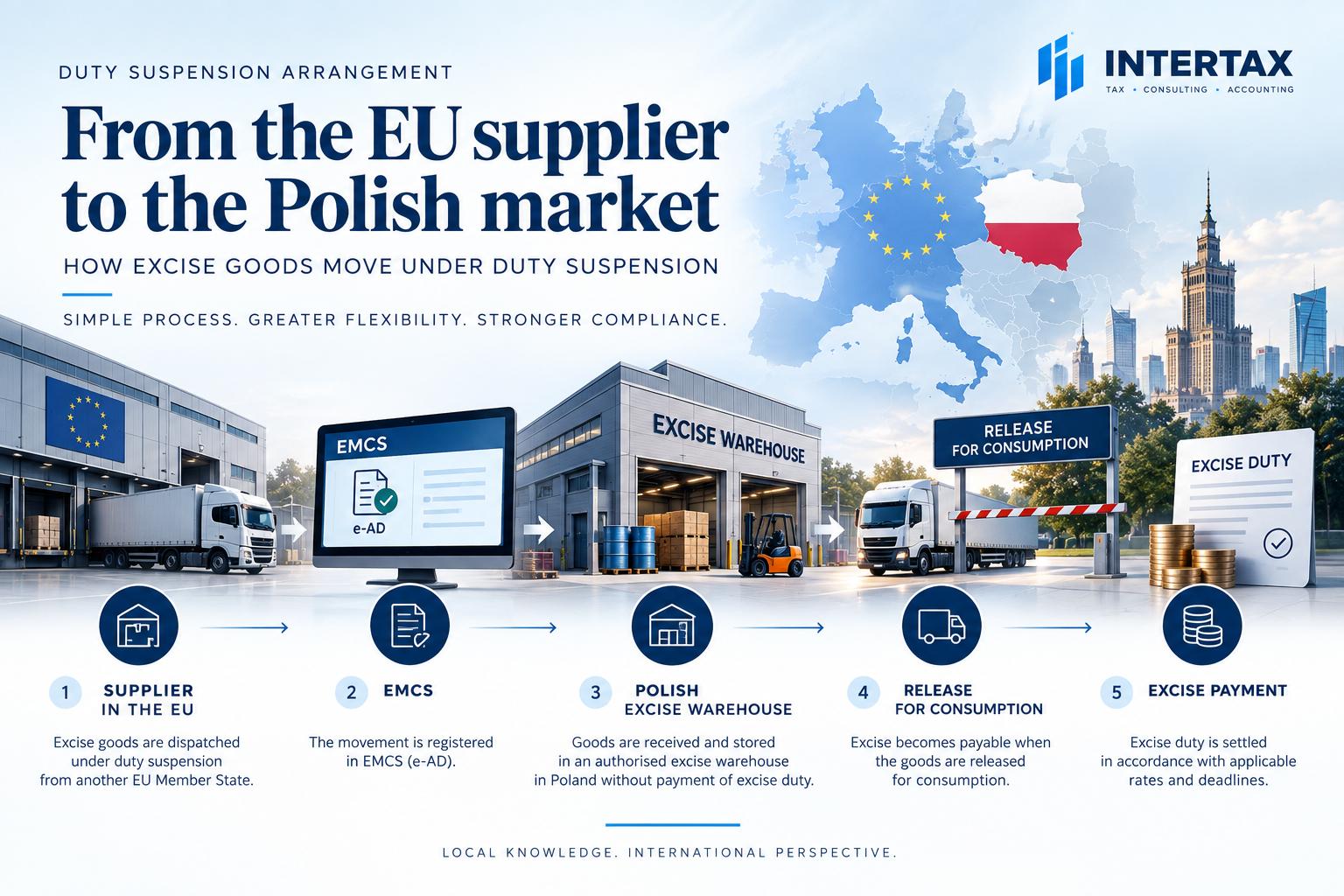
For businesses dealing with alcohol, tobacco products, energy products or certain other excise goods, one of the most important concepts is the duty suspension arrangement (procedura zawieszenia poboru akcyzy).
Under this procedure, qualifying excise goods can, subject to statutory conditions, be produced, stored or moved without immediate payment of excise duty.
Excise generally becomes payable when the goods are released for consumption.
This can provide a significant cash-flow advantage.
Three common operating models in Poland
A foreign company entering the Polish market will typically consider one of the following models:
|
Model |
Main characteristic |
Excise guarantee |
Best suited for |
|
Own excise warehouse |
Company operates its own authorised excise warehouse |
Generally required, subject to statutory exceptions |
Large, regular volumes and long-term Polish operations |
|
Third-party excise warehouse |
Goods are handled in an excise warehouse operated by another entity |
Depends on the structure and authorisation |
Foreign businesses entering Poland without their own infrastructure |
|
Registered consignee |
Entity receives qualifying excise goods from another EU country under duty suspension |
Generally required |
Businesses mainly receiving goods from other EU Member States |
An excise warehouse (skład podatkowy) requires an authorisation and compliance with detailed organisational, record-keeping and security requirements.
For many foreign businesses, using an existing third-party excise warehouse can be considerably simpler than establishing their own warehouse.
Excise guarantees
A business operating under certain excise procedures may be required to provide an excise guarantee (zabezpieczenie akcyzowe).
Depending on the taxpayer’s status and the applicable procedure, statutory exemptions from or special rules concerning the guarantee may apply.
The guarantee requirement should therefore be analysed together with the planned supply chain and excise status.
EMCS PL2 and Electronic Movement of Excise Goods
Movements of harmonised excise goods under duty suspension are monitored electronically through the Excise Movement and Control System (EMCS).
In Poland, relevant electronic procedures operate through EMCS PL2.
For movements under duty suspension, the system uses an electronic administrative document (e-AD).
Since 2023, EMCS has also been used for qualifying intra-EU commercial movements of harmonised excise goods released for consumption, using the electronic simplified administrative document (e-SAD).
Specific rules apply to non-harmonised Polish excise goods and to domestic movements involving exempt goods or goods subject to a zero rate depending on their intended use.
For a company planning regular cross-border movements of alcohol, tobacco or energy products, the excise logistics model should therefore be established before the first shipment takes place.
Registration in the Central Register of Excise Entities (CRPA)
Many businesses carrying out activities involving excise goods must register in the Central Register of Excise Entities (Centralny Rejestr Podmiotów Akcyzowych – CRPA).
Registration is handled electronically through PUESC – the Polish Electronic Tax and Customs Services Platform.
Depending on the activity, registration requirements may concern, among others:
-
producers of excise goods,
-
importers and businesses performing taxable excise activities,
-
entities making certain intra-EU acquisitions,
-
entities using excise goods covered by exemptions based on their intended use,
-
intermediary entities,
-
certain coal and gas market participants,
-
entities operating with regulated nicotine and vaping products,
-
certain foreign distance sellers or their representatives.
Where registration is required, it must generally be completed before the first activity covered by the registration requirement is performed.
Changes to data included in the registration must generally be reported within 7 days from the date of the change.
If an entity ceases the relevant excise activity, the cessation must also generally be notified within 7 days.
Who manages CRPA?
The authority currently responsible for CRPA registration is the Director of the Tax Administration Chamber in Poznań (Dyrektor Izby Administracji Skarbowej w Poznaniu).
Important for foreign companies
Polish VAT registration and Polish excise registration are two separate procedures.
A foreign company may already have a Polish NIP and VAT number and still need CRPA registration, PUESC access, excise authorisations or other registrations before it can lawfully carry out the planned excise activity.
This distinction should be checked during the planning stage rather than after the first shipment arrives in Poland.
You can check the information about VAT registration here https://polishtax.com/vat-registration-in-poland-is-it-mandatory-for-our-company/
Excise Declarations, Payment Deadlines and Reporting
Registration is only the first step.
Depending on the business model and type of goods, taxpayers may also have to submit excise declarations and maintain detailed records.
Examples of forms used in the Polish excise system include:
|
Form |
Typical application |
|
AKC-4 and relevant attachments |
Periodic settlement of specified excise goods |
|
AKC-U/A |
Certain intra-Community acquisitions of excise goods |
|
AKC-U/S |
Intra-Community acquisition of passenger cars |
|
AKC-WW |
Reporting relating to coal products |
|
AKC-EN |
Reporting relating to electricity |
For many standard monthly excise settlements, the declaration and payment deadline is the 25th day of the month following the relevant settlement period.
However, special deadlines apply to particular transactions, products and procedures.
Polish excise law also imposes extensive record-keeping requirements.
The exact scope depends on the taxpayer’s status, product and procedure.
Businesses should therefore determine in advance:
-
which declarations must be submitted,
-
how often they must be submitted,
-
which excise records must be maintained,
-
whether EMCS or other PUESC systems must be used,
-
whether excise guarantees are required,
-
who will be authorised to submit electronic documents on behalf of the company.
Excise Stamps – Banderole
Certain products intended for sale in Poland are subject to an obligation to carry Polish excise stamps (znaki akcyzy, commonly referred to as banderole).
The obligation applies, depending on the product and circumstances, to various tobacco, nicotine and vaping products.
From 2025, the system was extended to new categories including:
-
vaping devices,
-
nicotine pouches,
-
other nicotine products,
-
certain tobacco-free novel products.
A transitional period allowed certain unmarked nicotine pouches, other nicotine products and tobacco-free novel products already on the market to continue to be sold until 30 April 2026.
After that date, qualifying products intended for further sale in Poland must comply with the applicable excise-stamp rules.
Importers and distributors should therefore analyse excise-stamp obligations before products are shipped to Poland, as correcting the marking after importation can create significant practical difficulties.
Exemptions and Excise Refunds
Polish excise legislation provides numerous exemptions and preferential treatments, but they are usually conditional.
Depending on the goods and their intended use, exemptions may apply, for example, to:
-
certain electricity used in industrial processes,
-
certain energy products used for qualifying purposes,
-
certain railway or navigation uses,
-
combined heat and power generation,
-
certain agricultural uses,
-
qualifying losses or destruction of goods,
-
particular categories of passenger cars,
-
electric and hydrogen-powered vehicles,
-
qualifying plug-in hybrid vehicles.
The key practical issue is that an exemption often depends not only on what the product is, but also on:
-
who acquires it,
-
how it is transported,
-
its intended use,
-
the documentation held,
-
registration status,
-
record-keeping requirements.
Using exempt goods for a purpose other than the one permitted by the legislation may result in excise becoming payable and may also lead to interest and fiscal penal consequences.
Excise refunds
Refund mechanisms may be available where excise previously paid in Poland relates to goods subsequently exported or supplied to another EU Member State.
A refund is subject to detailed statutory conditions, documentary evidence and procedural deadlines.
For this reason, the possibility of obtaining a refund should ideally be analysed before the goods leave Poland, so that the required evidence can be collected correctly.
Binding Excise Information (WIA)
Where there is uncertainty regarding classification, businesses may apply for Binding Excise Information (Wiążąca Informacja Akcyzowa – WIA)
A WIA is an administrative decision issued by the Director of the National Tax Information (Dyrektor Krajowej Informacji Skarbowej) determining, depending on the application:
-
the relevant CN classification for excise goods or passenger cars, or
-
the appropriate statutory category of an excise product.
A WIA is generally issued for five years and is valid from the day following the day on which it becomes final.
Its validity may be extended, upon application, for further periods of up to five years.
This makes WIA particularly valuable where a product is innovative, technically complex or difficult to classify.
WIA vs WIS vs individual tax ruling
|
Instrument |
Main purpose |
|
WIA |
Excise classification or determination of the type of excise product |
|
WIS |
VAT classification and/or VAT rate |
|
Individual tax ruling |
Interpretation of tax law in relation to a described factual situation or future event |
Choosing the correct instrument matters.
An individual tax ruling should not be treated as a substitute for WIA where the real issue is the excise classification of a product.
What Changed in 2026 – and What Is Coming?
The excise environment in Poland continues to evolve rapidly, particularly for tobacco alternatives, nicotine products and vaping devices.
1. Higher tobacco and vaping rates in 2026
The excise roadmap introduced further increases from 1 January 2026.
Among the most significant changes:
-
the fixed component of cigarette excise increased to PLN 414 per 1,000 cigarettes,
-
smoking tobacco increased to PLN 338.18/kg plus 32.05% of the maximum retail price,
-
cigars and cigarillos increased to PLN 786/kg,
-
e-cigarette liquid increased to PLN 1.44/ml,
-
nicotine pouches and other nicotine products are taxed at PLN 200/kg during 2026.
2. End of the transitional excise-stamp period
The transitional period for selling certain unmarked nicotine pouches, other nicotine products and tobacco-free novel products ended on 30 April 2026.
Products intended for further sale after that date are subject to the applicable Polish excise-stamp requirements.
3. Vaping devices – further changes are proposed
As at 14 September 2026, the Polish Parliament is still considering a government bill that would further change the taxation of electronic cigarettes and vaping devices.
The proposal includes, among other measures:
-
increasing the excise rate on vaping devices from PLN 40 to PLN 50 per unit,
-
increasing the corresponding amount for sets of parts,
-
changing the taxation of certain electronic cigarettes,
-
increasing the e-liquid rate to PLN 2.20/ml from 1 January 2027.
These are proposed rules, not the current PLN 40 rate applicable to vaping devices as at the date of this guide.
Businesses in this sector should therefore monitor the legislative process closely.
4. EU tobacco taxation reform
Excise taxation is also evolving at EU level.
The European Commission has proposed changes to the EU tobacco taxation framework that would extend the harmonised regime to additional products, including new nicotine and vaping categories.
Any final reform will depend on the EU legislative process, including the requirement for agreement among Member States in the field of taxation.
For businesses operating across several EU countries, both Polish legislation and EU-level developments should therefore be monitored.
Penalties and Common Compliance Mistakes
Excise is a highly formalised area of Polish tax law.
For foreign businesses, the most common problems include:
-
starting excise activity before completing CRPA registration,
-
assuming that Polish VAT registration is sufficient,
-
using an incorrect CN classification,
-
importing or selling products without required excise stamps,
-
failing to maintain the required excise records,
-
incorrectly applying an exemption,
-
incorrectly applying the duty suspension arrangement,
-
failing to provide or maintain a required excise guarantee,
-
incorrectly documenting movements through EMCS.
Breaches may result not only in tax arrears and interest but also in liability under the Polish Fiscal Penal Code.
Depending on the infringement and individual responsibility, fiscal penal exposure may also arise for persons responsible for the company’s tax and financial affairs.
This makes preventive excise compliance particularly important.
Correcting an excise structure after goods have already been imported, received or released onto the Polish market is usually substantially more difficult than designing the correct procedure before the first transaction.
FAQ
How much is excise duty in Poland?
There is no single Polish excise rate. The amount depends on the product. In 2026, for example, e-cigarette liquid is taxed at PLN 1.44/ml, nicotine pouches at PLN 200/kg, while passenger cars are generally taxed at 3.1% or 18.6%, subject to exemptions and reduced rates.
Who has to register for excise duty in Poland?
Businesses producing, importing, acquiring or dealing with specified excise goods may have to register in the Central Register of Excise Entities (CRPA). The requirement depends on the goods and activity performed. Registration should generally be completed before the first activity for which excise registration is required.
Is excise duty the same as VAT in Poland?
No. Excise and VAT are separate taxes with separate registration and reporting systems. A company registered for Polish VAT may still need CRPA registration, PUESC access, excise declarations, guarantees or specific authorisations before importing, producing, storing or moving excise goods in Poland.
Do I need an excise warehouse to import alcohol into Poland?
Not necessarily. The correct structure depends on where the alcohol comes from and how it will be moved, stored and released for consumption. Businesses may use their own excise warehouse, a third-party warehouse or another authorised excise arrangement. The structure should be determined before the shipment.
How much is excise duty on a car imported to Poland?
The standard Polish excise rates for passenger cars are generally 3.1% of the taxable base for cars with engines up to 2,000 cm³ and 18.6% for larger engines. Reduced rates apply to certain hybrids, while qualifying electric, hydrogen and certain plug-in hybrid vehicles may benefit from an exemption.
Are electric vehicles subject to excise duty in Poland?
Qualifying electric passenger cars and hydrogen-powered vehicles are exempt from Polish excise. Certain plug-in hybrid passenger cars with engines up to 2,000 cm³ are also covered by a temporary exemption applicable until the end of 2029, subject to the statutory conditions.
Can excise duty paid in Poland be refunded?
Yes, in certain circumstances. Polish legislation provides refund mechanisms, including for some excise goods on which Polish excise has been paid and which are subsequently exported or moved to another EU Member State. Refunds are conditional and require appropriate evidence and compliance with statutory procedures.
What is the deadline for filing an excise declaration in Poland?
The deadline depends on the declaration and transaction. For many periodic excise settlements, the standard deadline is the 25th day of the following month. Special declarations, including those relating to intra-Community acquisitions of passenger cars, are subject to different deadlines.
How Intertax Can Help
Polish excise compliance can require significantly more than filing a tax declaration.
Before starting operations, foreign businesses often need to determine the correct CN classification, identify the taxable event, choose the appropriate logistics model and establish whether CRPA registration, an excise warehouse, registered consignee status or another authorisation is required.
If your company plans to manufacture, import, acquire, store or distribute excise goods in Poland, it is advisable to determine the Polish excise obligations before the first shipment or transaction takes place.
Contact Intertax to discuss the appropriate excise registration and compliance model for your business.
Sources
-
Polish Act of 6 December 2008 on Excise Duty Excise Duty Act
-
Council Directive (EU) 2020/262 laying down the general arrangements for excise duty Council Directive (EU) 2020/262
-
Polish Ministry of Finance –https://www.podatki.gov.pl/akcyza
-
PUESC – Electronic Tax and Customs Services Platform PUESC; PUESC FAQ, https://puesc.gov.pl/en