

Executive Summary
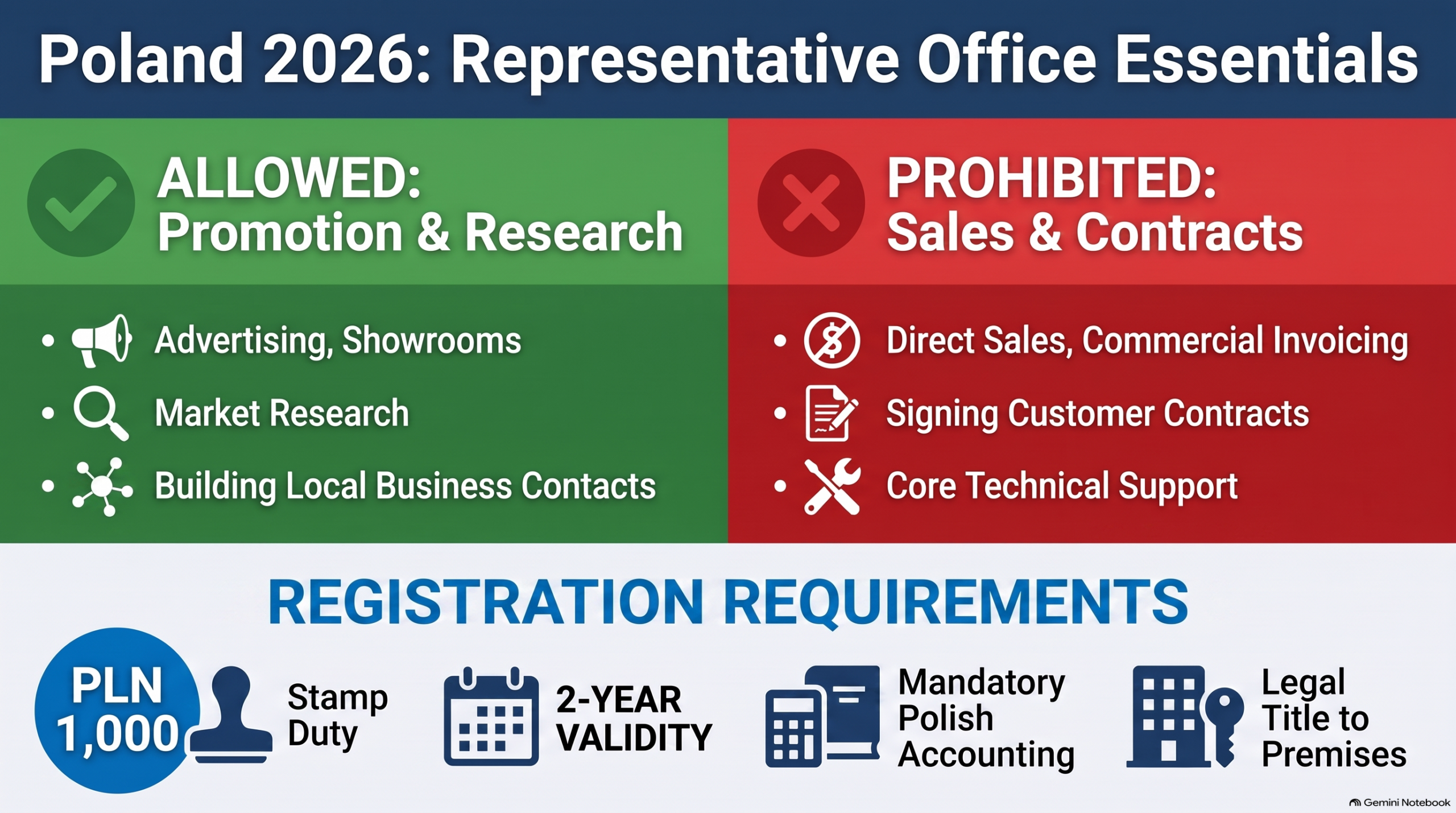
A representative office (przedstawicielstwo) is the lightest formal presence a foreign company can establish in Poland. Its activity must be limited to advertising and promoting the foreign entrepreneur: it cannot sell, issue commercial invoices, accept orders or conclude contracts with customers. The entry is made in the Register of Representative Offices of Foreign Entrepreneurs kept by the Minister of Development and Technology, normally after a formal review of Polish-language documents. The statutory stamp duty is PLN 1,000, and the entry is valid for two years, with renewal available during the final 90 days. The structure is simple, but tax, payroll and accounting risks arise quickly if the Polish team moves beyond genuinely preparatory or auxiliary activity.
|
Aspect |
Representative office |
|
Registration time |
Usually up to one month; longer if documents are incomplete |
|
Scope of activity |
Advertising and promotion of the foreign entrepreneur only |
|
Validity of entry |
2 years, renewable for further 2-year periods |
|
Register |
Register of Representative Offices of Foreign Entrepreneurs, kept by the Minister of Development and Technology |
|
Legal personality |
None; it is part of the foreign entrepreneur |
|
Who may apply |
Any foreign entrepreneur; no reciprocity requirement for a representative office |
|
Stamp duty |
PLN 1,000 |
|
CIT |
No separate CIT taxpayer; the foreign entrepreneur must still pass the permanent establishment test |
|
VAT |
No automatic Polish VAT registration merely because the office exists; input VAT may be recoverable under the foreign-business refund procedure |
|
Accounting |
Separate Polish-language accounting is mandatory |
|
Employment |
Allowed; Polish PIT withholding and ZUS duties may arise |
|
Name |
Original company name plus “przedstawicielstwo w Polsce” |
What Is a Representative Office in Poland?
A representative office in Poland is an organisational unit of a foreign entrepreneur without separate legal personality. It remains an integral part of the foreign company, which bears full responsibility for the office, its employees, its premises and all obligations incurred in Poland. The office is not incorporated in the National Court Register (KRS). Instead, it is entered in a dedicated administrative register kept by the minister responsible for the economy.
The governing legislation is the Act of 6 March 2018 on the Rules of Participation of Foreign Entrepreneurs and Other Foreign Persons in Economic Trade in the Territory of the Republic of Poland. The consolidated text was published in Journal of Laws 2025, item 89, but the Act has since been amended, including by legislation published in 2026. For a 2026 registration, the current consolidated wording and subsequent amendments should therefore be checked rather than citing Dz.U. 2025 poz. 89 as if it were the complete current legal state.
The decisive limitation is statutory: the representative office may act only in the field of advertising and promotion of the foreign entrepreneur. Its real activities, not merely its registered description, determine whether that limitation is respected.
What a representative office CAN do
-
Operate a showroom that presents products without taking orders or completing sales.
-
Attend trade fairs, conferences and industry events and distribute promotional materials.
-
Conduct market research and collect non-binding information about customer preferences and competitors.
-
Build business contacts and identify potential distributors, agents or commercial partners.
-
Arrange introductory meetings between prospects and the foreign company’s commercial team.
-
Run public relations, brand-awareness and communication campaigns.
-
Maintain a liaison function between the foreign head office and the Polish market, provided the liaison remains promotional or informational.
What a representative office CANNOT do
-
Sell goods or services in Poland in its own name or on behalf of the foreign entrepreneur.
-
Issue commercial invoices to Polish customers or collect sales proceeds.
-
Conclude sales, service, distribution or supply contracts with customers.
-
Negotiate binding prices, discounts, payment terms, delivery conditions or warranties.
-
Accept orders or confirm that an order has been accepted by the foreign company.
-
Hold stock for customer fulfilment or release goods to customers as part of a sales process.
-
Provide routine after-sales service, complaint handling or technical support that forms part of the foreign company’s core customer offering.
-
Present local personnel as a Polish sales office when, in practice, they perform a commercial function.
Practical warning
A disclaimer in an email signature stating “for promotional purposes only” will not protect the foreign company if the Polish team actually agrees commercial terms, coordinates orders or plays the decisive role in closing contracts.
Who Can Open a Representative Office in Poland?
Any foreign entrepreneur may create a representative office in Poland. Unlike the rules governing a branch, the legislation on representative offices does not make access for a non-EU or non-EFTA entrepreneur dependent on reciprocity. This is particularly important for businesses from Asia, Africa, South America, the Middle East, the United States and the United Kingdom that want a limited, non-commercial presence before making a larger investment.
The Act also allows a foreign person established by an act of the competent authority of its home state to create an office promoting that state’s economy. That is a narrower public-promotion model: its permitted activity is limited to promotion and advertising of the economy of the relevant country.
Foreign banks and credit institutions are subject to special rules. Under the Act, establishing and operating their representative offices does not require entry in the general register discussed in this guide, although sector-specific financial regulations may apply.
obrazek
How to Register a Representative Office in Poland – Step by Step
-
Confirm the internal decision and permitted scope: The foreign company should formally approve the creation of the Polish representative office under its home-country corporate rules. A corporate resolution is good evidence of authority and is often useful in practice, but it is not listed in the Polish Act as a universal mandatory attachment in every case. The internal decision should clearly state that the office is limited to promotion and advertising.
-
Appoint an authorised person in Poland: The foreign entrepreneur must designate a natural person authorised in the representative office to represent it. The application states that person’s first name and surname, and an authorisation document should define the scope of authority. The appointment must not be drafted so broadly that it appears to empower the person to conduct commercial operations prohibited to the office.
-
Secure a Polish address and legal title to the premises: The application must identify the representative office’s address in Poland. The foreign entrepreneur must hold a valid legal title to the property, such as a lease, sublease or qualifying virtual-office agreement. Lack of legal title to the registered premises is a statutory ground for removal from the register.
-
Collect foreign corporate documents and Polish translations: The core attachment is an official extract or other official document confirming the foreign entrepreneur’s registration. If that document does not show the registered office, representation rules and authorised representatives, an additional officially certified document is needed. Foreign-language documents must be submitted with a Polish translation prepared or certified by an eligible sworn translator (tłumacz przysięgły).
-
Obtain apostille or legalisation and pay the fee: The official registration document must be authenticated. If it comes from a state party to the Hague Apostille Convention, it should generally bear an apostille. Otherwise, consular legalisation is required, subject to any applicable treaty exception. The statutory stamp duty for the entry is PLN 1,000; attach proof of payment.
-
File with the Minister of Development and Technology: The Polish-language application is filed with the Minister of Development and Technology, whose Department of SMEs handles the register. Filing is available by post or at the office under the official procedure. Following a positive formal and substantive review, the minister enters the office in the register and issues an official certificate ex officio.
Required documents – checklist
-
Polish-language application containing the foreign entrepreneur’s name, registered office, legal form, principal business activity, authorised person and Polish representative-office address.
-
Official extract or document confirming registration of the foreign entrepreneur.
-
Additional official document showing the foreign entrepreneur’s registered office, representation rules and authorised representatives, if the registry extract does not contain those details.
-
Document authorising the named person to represent the foreign entrepreneur in the representative office.
-
Polish sworn translations of foreign-language documents.
-
Apostille under the Hague Apostille Convention or consular legalisation, as applicable, for the official registration document.
-
Proof of payment of the PLN 1,000 stamp duty.
-
Evidence of legal title to the Polish premises should be retained and may be requested; it is an ongoing statutory requirement.
What happens if the application is incomplete?
If the application has formal defects, the minister requests completion within a period of at least seven days. The deadline may be extended on a justified request submitted before it expires. Failure to cure the defects results in the application being left without examination. This is not a substantive refusal: in practice, the entrepreneur may need to submit a new application, and the treatment of the earlier fee should be checked with the authority rather than assuming that it automatically transfers.
Grounds for refusal
The minister may refuse entry if creation of the office would threaten national security or defence, the security of classified information marked ‘confidential’ or above, or another overriding public interest. Refusal also applies if the proposed activity extends beyond advertising and promotion. In security-related cases, the authority is not required to provide the factual justification normally expected in an administrative decision.
|
Step |
Main document or action |
Key risk |
|
1 |
Internal approval and scope definition |
Commercial wording may contradict the statutory promotional purpose |
|
2 |
Appointment of authorised person |
Authority drafted too broadly |
|
3 |
Polish premises |
No valid legal title or address service unsuitable for actual use |
|
4 |
Registry documents and translations |
Outdated extract, missing representation details, improper translation |
|
5 |
Apostille/legalisation and PLN 1,000 fee |
Authentication route depends on the issuing country |
|
6 |
Application to the minister |
Incomplete Polish-language filing causes delay or non-examination |
Costs of a Representative Office in Poland (2026)
Only the registration stamp duty is fixed by law. The remaining amounts depend on the issuing country, number of documents, translation volume, premises and level of ongoing compliance support. The ranges below are market-oriented planning estimates, not statutory tariffs or a binding Intertax quotation.
|
Cost item |
Indicative 2026 range |
Comment |
|
Stamp duty – registration |
PLN 1,000 |
Statutory fee for entry in the register |
|
Sworn translations |
Often PLN 50–120 per standard translation page |
Varies by language, urgency and document complexity |
|
Apostille / consular legalisation |
Country-specific |
May include authority, embassy, courier and intermediary fees |
|
Virtual office / registered address |
Often PLN 100–500 per month |
Agreement must provide a genuine legal title suitable for the registered address |
|
Monthly bookkeeping |
Often from PLN 800–2,500+ per month |
Depends on document volume, payroll, reporting and foreign-currency transactions |
|
Payroll support |
Usually priced per employee per month |
Employer registrations and recurring PIT/ZUS compliance may be separate |
|
Renewal every 2 years |
Professional fees plus any applicable official charges |
Confirm the official fee position at the time of renewal |
Validity, Renewal and Reporting Obligations
The entry is valid for two years from the date it is made. It may be extended for another two years on an application submitted during the final 90 days of the current entry. The safest operational approach is to calculate the renewal window from the exact final validity date shown in the register and certificate, not from the date on which documents were prepared or filed.
Missing the statutory window means the existing entry cannot simply be renewed retroactively. The representative office loses the legal basis for continued operation under that entry and is removed from the register; a fresh registration process may then be necessary.
Changes to the foreign entrepreneur’s name, registered office, legal form, principal business activity, authorised person or other reportable circumstances must be notified to the minister within 14 days. The register is public, maintained electronically and made available through Poland’s open-data system.
Compliance calendar
Day 0: entry made and two-year validity starts. Month 21: the 90-day renewal window begins approximately. Month 24: entry expires. Separately, report relevant changes within 14 days of occurrence.
Grounds for Removal from the Register
The minister removes a representative office from the register in the circumstances specified by the Act. These include serious breach of Polish law, loss of legal title to the registered premises, liquidation of the foreign entrepreneur, loss of its right to conduct business, removal from the home-country register, failure to renew the entry and activity extending beyond promotion and advertising. The exact statutory ground and procedure should be checked against the current Act because amendments may change cross-references or procedural details.
For a voluntary closure, the foreign entrepreneur should notify the ministry and organise an orderly wind-down of leases, employees, payroll, ZUS, taxes, accounting records and other liabilities. Removal from the administrative register does not itself extinguish contractual or public-law obligations.
Tax Treatment of a Representative Office
Corporate income tax (CIT)
A representative office is not a separate legal person and is not a separate Polish CIT taxpayer merely because it is entered in the register. The relevant taxpayer is the foreign entrepreneur. If the Polish presence is genuinely limited to promotion and advertising and does not create a permanent establishment under the applicable double tax treaty and Polish law, the foreign entrepreneur should not have Polish CIT liability attributable to the office.
This conclusion is factual, not automatic. Registration as a representative office does not provide a tax safe harbour. Tax authorities may disregard the label and examine what the Polish personnel actually do, what authority they exercise and how they participate in the foreign company’s revenue-generating operations.
When a representative office becomes a permanent establishment
Article 5 of the OECD Model Tax Convention and many Polish tax treaties exclude a fixed place used solely for activities of a preparatory or auxiliary character. Advertising, market reconnaissance and limited promotional activity can fall within that exception when they support, rather than constitute, an essential part of the foreign enterprise’s business.
The risk rises where the Polish office performs functions that are commercially significant or closely connected with sales. A permanent establishment may arise through a fixed place of business or through a dependent-agent pattern. Under the modern treaty approach, risk is not limited to a person formally signing contracts: it may also arise where the Polish representative habitually plays the principal role leading to contracts that the foreign enterprise routinely concludes without material modification.
-
The Polish representative has price lists and discretion to grant discounts.
-
Customer emails handled in Poland end with agreement on price, quantity, delivery and payment terms.
-
The office’s ‘promotion’ includes routine after-sales support, complaint resolution or warranty coordination.
-
Polish staff coordinate order fulfilment or logistics and communicate acceptance to customers.
-
Sales personnel abroad merely rubber-stamp terms negotiated by the Polish team.
-
The office stores goods and releases them to customers as part of the normal sales process.
For a broader analysis, see permanent establishment in Poland and the guide to a dependent or independent agent.
VAT
The existence of a representative office does not, by itself, mean that the office is a separate VAT taxpayer or that the foreign entrepreneur must register for Polish VAT. However, the foreign entrepreneur’s overall Polish transactions must still be reviewed. Any taxable supplies, intra-Community transactions, imports, domestic acquisitions or fixed-establishment issues may create separate VAT obligations regardless of the representative-office registration.
Input VAT on rent, telecommunications, professional services and promotional materials may be recoverable by the foreign business if the statutory refund conditions are met. EU-established taxable persons generally use the electronic foreign-VAT refund procedure through the tax administration of their home Member State. Businesses established outside the EU may qualify under the Polish third-country refund procedure, generally subject to reciprocity, with exceptions for certain special VAT schemes. The application commonly called VAT-REF on the Polish portal is the Polish outbound form for Polish taxpayers reclaiming VAT from another Member State; foreign applicants reclaiming Polish VAT follow the procedure applicable to their country of establishment.
See also: VAT refund in Poland.
Employment: PIT and ZUS
A representative office may hire employees in Poland. The employer remains the foreign entrepreneur, acting through the Polish office. Depending on the employment structure, it may need Polish tax and social-security registrations, monthly payroll calculations, PIT advance withholding, ZUS contributions, annual employee information and labour-law documentation. The fact that the office does not sell does not remove employer obligations.
Operational support: payroll services.
Mandatory accounting
The foreign entrepreneur must maintain separate accounting for the representative office in Polish and in accordance with Polish accounting rules. This obligation follows directly from the 2018 Act and is reinforced by the Accounting Act (Ustawa o rachunkowości), which applies to branches and representative offices of foreign entrepreneurs. In practice, the books record funding from the head office, payroll, rent, professional fees, travel, promotional expenditure, fixed assets, foreign-currency settlements and other office costs.
Whether a full statutory financial statement, filing or audit obligation arises in a particular case should be assessed in light of the current Accounting Act, the office’s facts and administrative practice. The safe operational assumption is that proper books, source documents, year-end closing procedures and statutory retention are required even when the office earns no sales revenue.
Operational support: accounting services in Poland.
obrazek
Representative Office vs Branch vs Sp. z o.o.
|
Criterion |
Representative office |
Branch (oddział) |
Sp. z o.o. |
|
Scope of activity |
Promotion and advertising only |
Business activity generally corresponding to the parent company’s activity |
Unrestricted within its corporate objects and licensing rules |
|
Register |
Minister of Development and Technology |
KRS |
KRS |
|
Validity |
2 years, renewable |
Indefinite |
Indefinite |
|
Availability |
Any foreign entrepreneur |
EU/EFTA entrepreneurs and others where reciprocity or treaty rules allow |
Generally available to foreign founders |
|
Legal personality |
No |
No |
Yes |
|
CIT |
No separate taxpayer; PE test applies to parent |
Foreign entrepreneur normally taxed in Poland through a PE |
Polish company is a CIT taxpayer |
|
VAT |
No automatic registration solely due to office |
Registration may be required depending on transactions |
Registration may be required depending on transactions |
|
Liability |
Foreign entrepreneur bears full liability |
Foreign entrepreneur bears full liability |
Shareholder liability generally limited |
|
Official registration cost |
PLN 1,000 stamp duty |
KRS and publication fees depend on filing route and current tariffs |
S24 or notarial route; current fees depend on method |
A branch is intended for actual business activity and is not a substitute for a representative office. A Polish subsidiary provides separate legal personality and broader operational flexibility. Compare branch vs subsidiary in Poland and the guide to a Polish LLC (sp. z o.o.).
When Is a Representative Office the Right Choice?
Choose a representative office if the foreign company wants to test the Polish market, build brand visibility, attend events, conduct market research and create contacts without selling locally. It is particularly useful where the planned Polish team is small, the budget is limited and all commercial decisions remain genuinely outside Poland.
Choose a branch or a Polish company if Polish personnel will negotiate commercial terms, accept orders, invoice, hold operational stock, provide core services or manage customer contracts. The more closely the Polish function is tied to revenue generation, the less suitable the representative-office model becomes.
A common expansion path is representative office → branch → subsidiary. There is no statutory conversion of a representative office into a branch or company. The new structure must be established separately, assets and employees transferred lawfully, and the representative office then removed from its register after liabilities are settled.
For a wider market-entry overview, see entering the Polish market and corporate income tax in Poland.
FAQ – Frequently Asked Questions
Can a representative office in Poland issue invoices?
No. A representative office may only promote and advertise the foreign entrepreneur. Issuing commercial invoices would normally indicate business activity outside the permitted scope. Suppliers may issue invoices for the office’s costs, but sales invoices to customers should not be issued by the office as a commercial seller.
How much does it cost to register a representative office in Poland?
The statutory stamp duty for entry is PLN 1,000. Additional costs usually include sworn translations, apostille or legalisation, address services, professional assistance and bookkeeping. These costs vary by country, language and document volume, so the total budget should be based on the specific corporate documents.
Can a representative office hire employees in Poland?
Yes. It may hire employees for lawful promotional, administrative and liaison functions. The foreign entrepreneur may then have Polish employer obligations, including ZUS registration and contributions, PIT advance withholding, payroll records and annual employee reporting. Job descriptions should not assign prohibited sales or contract-negotiation functions.
Does a representative office have to pay CIT in Poland?
Not automatically. The office is not a separate CIT taxpayer, and the foreign entrepreneur may remain outside Polish CIT if the Polish activity is only preparatory or auxiliary. A permanent establishment can nevertheless arise if the office performs core business functions or plays a principal role in concluding contracts.
How long does representative office registration take?
A complete application is commonly processed within about one month, but the timing is not guaranteed. Apostille, legalisation and sworn translations often take longer than the ministerial review. If the application is incomplete, the authority requests corrections and the process is extended.
Can a representative office use a virtual office address?
Potentially yes, provided the agreement gives the foreign entrepreneur a genuine legal title to use the address and the arrangement is suitable for receiving official correspondence. A purely nominal address without a valid legal basis creates compliance risk because loss of title to the premises is a removal ground.
What happens if I miss the 2-year renewal deadline?
The existing entry cannot be renewed after the statutory window has expired. The office loses the right to continue operating under that entry and may be removed from the register. The foreign entrepreneur may need to submit a fresh registration application and suspend representative-office activity until a new entry is made.
Can a non-EU company open a representative office in Poland?
Yes. The representative-office regime is available to any foreign entrepreneur and does not impose the reciprocity condition applicable to certain non-EU branch registrations. The same promotional-only scope, document authentication, Polish translation, accounting and compliance rules apply regardless of whether the parent company is established inside or outside the EU.
Can a representative office sign contracts in Poland?
It should not sign commercial customer contracts. The authorised person may sign documents necessary to operate the office itself, such as a lease, employment paperwork or service agreements, if properly authorised. Signing sales or service contracts for the foreign entrepreneur would create both registration-compliance and permanent-establishment risk.
Does a representative office need a Polish bank account?
There is no general rule in the representative-office registration provisions requiring a Polish bank account. A local account may nevertheless be operationally useful for payroll, ZUS, taxes, rent and supplier payments. Banks will conduct their own KYC review, and some public payments may be easier from a Polish account.
Who keeps the register of representative offices in Poland?
The register is kept by the Minister of Development and Technology as the minister responsible for the economy. The Department of SMEs handles the register within the ministry. The register is public, electronic and available through the Polish open-data system.
Is a representative office a permanent establishment?
Not necessarily. A genuinely promotional office may fall within the preparatory or auxiliary exception under Article 5 of the applicable tax treaty. The office can become a permanent establishment if its real functions are commercially significant or if Polish personnel habitually play the principal role in concluding contracts.
Intertax Support
Intertax handles the complete representative office registration process: review of the proposed activity, corporate document checklist, coordination of sworn translations and apostille or legalisation, preparation and filing of the application with the Ministry, and ongoing bookkeeping and payroll support. We also assess whether the planned Polish functions create permanent establishment, CIT or VAT exposure. Request a fixed-fee quote before committing to premises or hiring staff in Poland.
Legal Verification and Official Sources
Legal status reviewed for this article: 27 July 2026. The principal conclusions were checked against current official Polish sources. Because legislation and administrative pages may change, registration and tax positions should be reconfirmed for the specific filing date and facts.