

Thinking of buying a ready-made (shelf) company in Poland? Discover the 2026 acquisition process, costs, hidden risks, and VAT-active vs. dormant options.
Foreign investors entering the Polish market are often offered a shelf company in Poland as the fastest way to start doing business. A ready-made company can indeed save time in certain situations – particularly if it already has an active VAT status, a business history, or licences that would otherwise take time to obtain.
However, buying an existing company is not automatically the fastest or safest solution.
In 2026, a new Polish limited liability company (sp. z o.o.) can often be registered quickly through the S24 online system. For many investors, setting up a new company from scratch may therefore be simpler and less risky than acquiring an existing entity.
The right choice depends on what you actually need: speed, VAT registration, corporate history, licences, banking access or simply a clean legal structure.
What Is a Shelf Company in Poland?
A shelf company is a company that has already been incorporated and entered in the National Court Register (KRS) but was created primarily for later sale to an investor.
In Poland, shelf companies are most commonly established as spółka z ograniczoną odpowiedzialnością (sp. z o.o.), the Polish equivalent of a limited liability company.
-
has already been registered in the KRS,
-
has its articles of association and share capital,
-
has a Polish tax identification number (NIP) and statistical number (REGON),
-
has had little or no previous commercial activity,
-
has no employees or business contracts,
-
should have no outstanding liabilities.
Some shelf companies are also registered for Polish VAT and VAT-EU purposes.
That distinction may be important. A company with an active VAT status can potentially start certain transactions sooner than a newly incorporated entity that still has to complete VAT registration.
A shelf company should not be confused with a shell company with an operating history. An entity that has previously traded may have tax, contractual or financial liabilities that are not immediately apparent from the KRS.
Shelf Company vs. New Company Registration (S24) in 2026
One of the most persistent myths about doing business in Poland is that buying a ready-made company is always much faster than incorporating a new one.
This is no longer necessarily true.
Poland has an electronic company-registration system known as S24, which allows a standard sp. z o.o. to be incorporated online using predefined articles of association. In straightforward cases, a newly established company can often be entered in the KRS very quickly.
Buying an existing company, on the other hand, also involves documentation, identification of the purchaser, transfer of shares, changes to the management board, KYC/AML procedures and subsequent corporate filings.
The practical comparison therefore looks different from what many shelf-company advertisements suggest.
|
Criterion |
Shelf Company |
New Company via S24 |
|
Initial availability |
Existing legal entity can be acquired immediately |
New entity must first be incorporated |
|
KRS registration |
Already registered |
Often very fast through S24 |
|
Acquisition / incorporation cost |
Usually higher because seller charges a premium |
Usually lower |
|
Notary involvement |
Often required for notarised signatures on share-transfer documents |
Normally not required for standard S24 incorporation |
|
VAT status |
May already have active VAT/VAT-EU registration |
VAT registration may still be required |
|
Corporate history |
May have an existing registration history |
Starts from zero |
|
Historical liability risk |
Must be verified |
Very limited because company is newly created |
|
Due diligence |
Strongly recommended |
Usually much simpler |
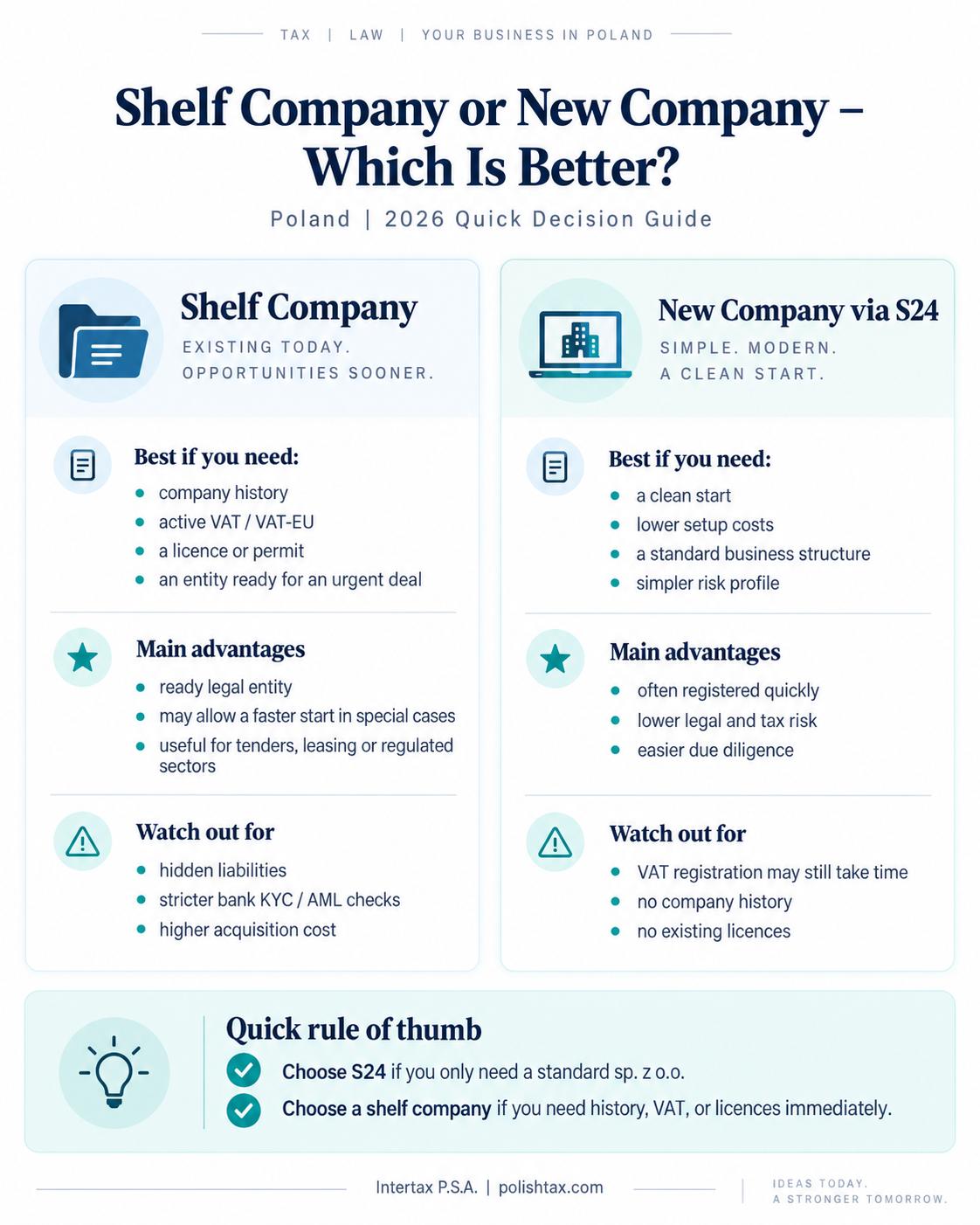
For many foreign investors who simply want a standard Polish limited liability company with no special licences or VAT urgency, incorporating a new company through S24 may therefore be the more rational option.
When Does Buying a Ready-Made Company Make Sense?
Despite the efficiency of S24, there are situations where a ready made company in Poland can still provide a genuine commercial advantage.
1. You need an older corporate history
Certain counterparties, leasing companies, financial institutions or tender procedures may take the company’s age or operating history into account. Buying a company incorporated one or several years earlier may therefore be useful where the date of incorporation has commercial significance. However, investors should distinguish carefully between corporate age and actual trading history. An older dormant company does not automatically have turnover, creditworthiness or financial references.
2. You need an existing VAT or VAT-EU registration
VAT registration can involve verification by the Polish tax authorities. A company that has already been confirmed as an active Polish VAT taxpayer – and, where required, as a VAT-EU taxpayer – may therefore allow an investor to start certain transactions faster.
3. You need a company holding a particular licence or permit
Some ready-made companies are marketed together with licences or authorisations, for example in transport, employment services or regulated sectors. This can potentially save substantial time. However, this requires particularly careful legal verification. A licence should never be assumed to remain valid automatically after a change of shareholders, management or beneficial ownership. Depending on the regulated activity, notification, approval or a new application may be required.
4. You have a transaction that requires an existing legal entity immediately
Occasionally an investor needs a Polish entity immediately to enter into a contract, acquire assets or participate in a transaction. In such cases, buying a clean shelf company may be commercially justified even if establishing a new company would only take a few additional days.
Active VAT vs. Dormant Shelf Companies
Shelf companies are often offered in two broad categories.
The first is a dormant company that has never conducted significant commercial operations. It may already have NIP and REGON numbers but may not be registered as an active VAT or VAT-EU taxpayer.
The second is a VAT-registered shelf company with an active Polish VAT status and, where applicable, VAT-EU registration.
The second option is normally more expensive because the seller has already gone through the registration and maintenance process.
For an investor planning immediate B2B transactions within the European Union, an existing VAT-EU status may be commercially valuable.
However, the status should always be independently verified before acquisition. Most importantly, buying a VAT-active company does not guarantee that its status will remain unaffected after acquisition.
A sudden change of shareholders, directors, registered office or business profile may trigger additional questions from the tax authorities or the company’s bank.
Hidden Risks: What to Watch Out for Before Buying
The greatest risk when you buy a company in Poland is not the purchase price. It is acquiring a legal entity together with its past.
Even if the seller describes the company as “clean”, proper due diligence should be carried out.
Tax liabilities
Check whether the company has outstanding obligations relating to:
-
VAT,
-
corporate income tax,
-
payroll taxes,
-
social security contributions,
-
other public-law liabilities.
Where appropriate, certificates confirming the absence of tax and social-security arrears should be obtained.
Previous commercial activity
Verify bank statements, accounting records and financial statements. If the company has previously issued invoices, entered into contracts or employed staff, it should no longer be treated as a simple shelf company. Its history needs to be analysed as part of a normal corporate acquisition.
KRS and corporate documents
The company’s entries in the National Court Register (KRS) should be compared with its articles of association, shareholder records and corporate resolutions. Restrictions on transferring shares should also be checked before signing the purchase agreement.
KYC and AML issues
Foreign investors sometimes assume that acquiring an existing company means they can automatically use its existing bank account. That assumption can be costly. Polish banks apply Know Your Customer (KYC) and Anti-Money Laundering (AML) procedures. A change from Polish shareholders and directors to foreign beneficial owners may therefore result in renewed verification.
-
the new shareholders,
-
ultimate beneficial owners,
-
source of funds,
-
expected turnover,
-
countries involved in transactions,
-
the company’s actual business activities.
Consequently, an existing bank account should not be treated as guaranteed banking access after the acquisition.
The Step-by-Step Process of Acquiring a Company
The precise procedure depends on the company and the transaction, but acquisition of a Polish shelf company usually involves the following stages.
Step 1: Select and verify the company
Before signing anything, obtain at least:
-
current KRS extract,
-
articles of association,
-
shareholder information,
-
financial statements or confirmation of inactivity,
-
tax and accounting records,
-
VAT/VAT-EU status,
-
information on bank accounts,
-
confirmation of licences, where relevant.
For companies with any meaningful operating history, a proper legal and tax due diligence review is advisable.
Step 2: Transfer the shares
For a standard Polish sp. z o.o., Article 180 of the Polish Commercial Companies Code provides that the transfer of shares should generally be made in writing with signatures certified by a notary. This is an important distinction: a full notarial deed is not normally required merely to transfer shares. For companies whose articles were concluded using the S24 template, Polish law also permits share transfers using the appropriate electronic template, with the parties signing electronically. Foreign investors may also acquire shares through a properly authorised representative. Depending on the country where the power of attorney is issued and the specific transaction structure, notarisation, an apostille or legalisation and a sworn Polish translation may be required.
Step 3: Change the management board and corporate details
The existing management board will usually resign or be removed and new directors will be appointed. Other changes may include:
-
registered office or address,
-
business activity,
-
company name,
-
representation rules.
Some changes may also require amendment of the articles of association.
Step 4: Update the National Court Register
Changes requiring disclosure must be reported to the National Court Register (KRS).
Step 5: Update the Beneficial Owner Register
The new ownership structure must also be analysed for CRBR – the Central Register of Beneficial Owners. Changes concerning beneficial owners generally have to be reported within the statutory deadline. Bank, tax and other registrations should also be reviewed after completion.
Shelf Company or New Company – Which Is Better?
There is no universal answer.
If your goal is simply to establish a standard Polish sp. z o.o., with no special licences and no urgent need for an existing VAT status, a new S24 company may be cheaper, cleaner and almost as fast as buying a shelf company.
A ready-made company becomes more attractive where you specifically need:
-
an older incorporation date,
-
an active VAT/VAT-EU status,
-
a licence or permit,
-
or an existing legal entity for an urgent transaction.
The key principle is simple: do not buy a shelf company merely because someone tells you it is the fastest way to enter Poland. Buy one when the characteristics of that particular company provide a real commercial advantage.
At Intertax, we can assess both options before you commit to an acquisition: incorporation of a new company or purchase of an existing entity. This allows the decision to be based on tax, legal and operational considerations rather than on the seller’s marketing.
Frequently Asked Questions
How much does a shelf company cost in Poland?
Prices vary considerably depending on the age of the company, VAT status, licences, banking arrangements and corporate history. Basic shelf companies may be offered from approximately EUR 1,500, while companies with VAT registration, licences or other valuable characteristics can cost EUR 3,000 or substantially more. The purchase price should never be the only criterion. The cost of due diligence and the risk associated with the company’s history may be much more important.
Can I buy a shelf company in Poland remotely?
Yes. A foreign investor can generally acquire a Polish company through an authorised representative without travelling to Poland. The power of attorney and supporting documents must meet Polish formal requirements. Depending on where they are issued, they may require notarisation, an apostille or legalisation, and a certified Polish translation.
Is buying a shelf company legal in Poland?
Yes. Buying and selling shares in a Polish limited liability company is completely legal. The key issue is not whether the transaction is permitted, but whether the company being acquired has been properly verified. A genuinely dormant, debt-free company presents a very different risk profile from a company with previous commercial activity, tax liabilities or undisclosed contracts.
Need Help Choosing the Right Option?
Not sure whether a shelf company or a newly incorporated Polish company is the better solution for your business? Intertax can review your plans and recommend the most practical route, taking into account registration time, VAT status, corporate risks and your intended activity in Poland.
We can also assist with the full incorporation process, including company registration, VAT registration, documentation, representation before Polish authorities and related compliance matters.
Useful links:
-
E-mail:office@intertax.pl
-
Phone: +48 14 626 29 88
Planning to start a business in Poland? Contact Intertax before deciding whether to incorporate a new company or acquire an existing one.