

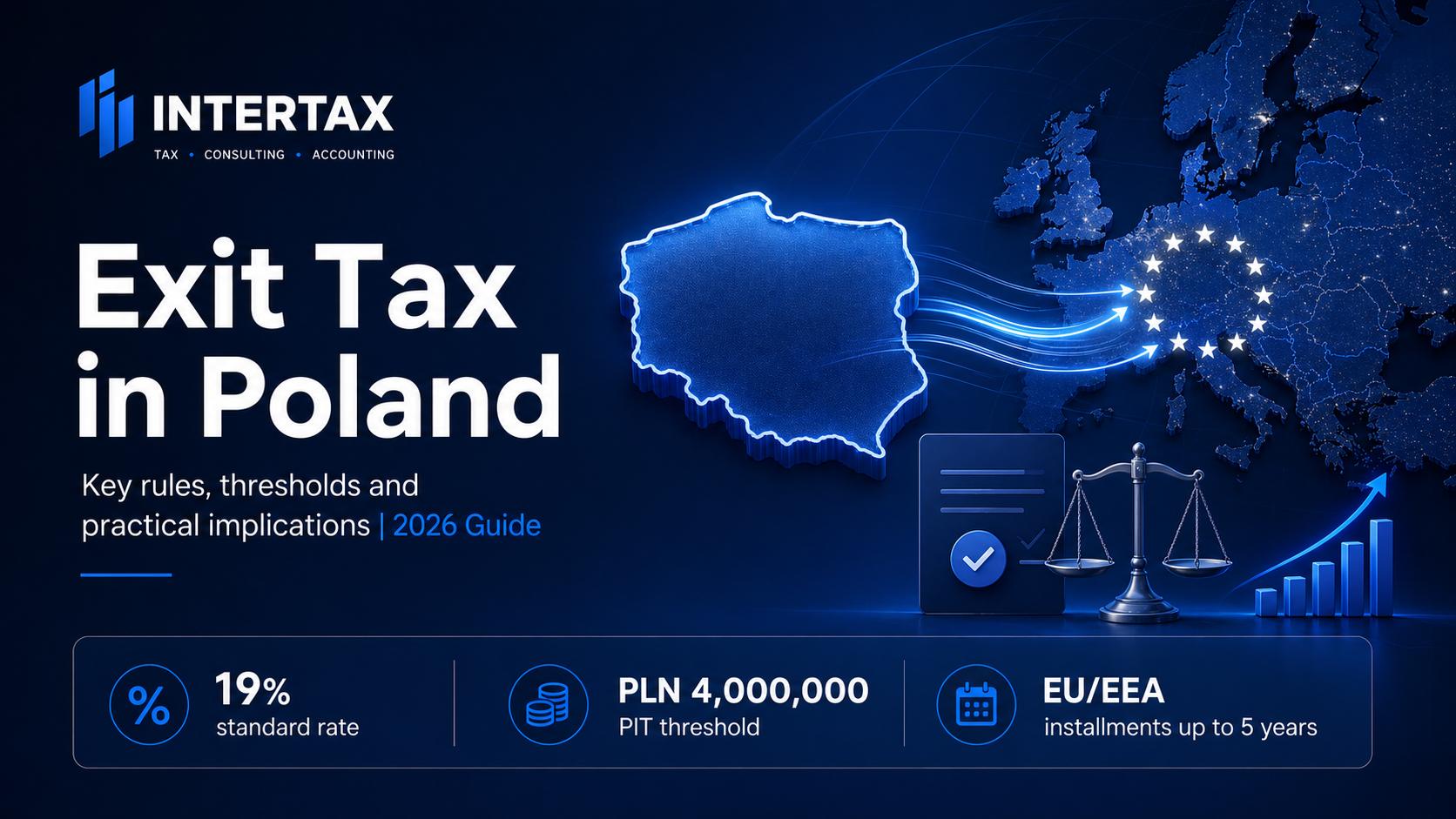
Exit tax in Poland is a tax on unrealized gains. It applies when Poland loses the right to tax a gain that arose while an asset was within the Polish tax net, even though the asset has not yet been sold.
|
Main rate
19%
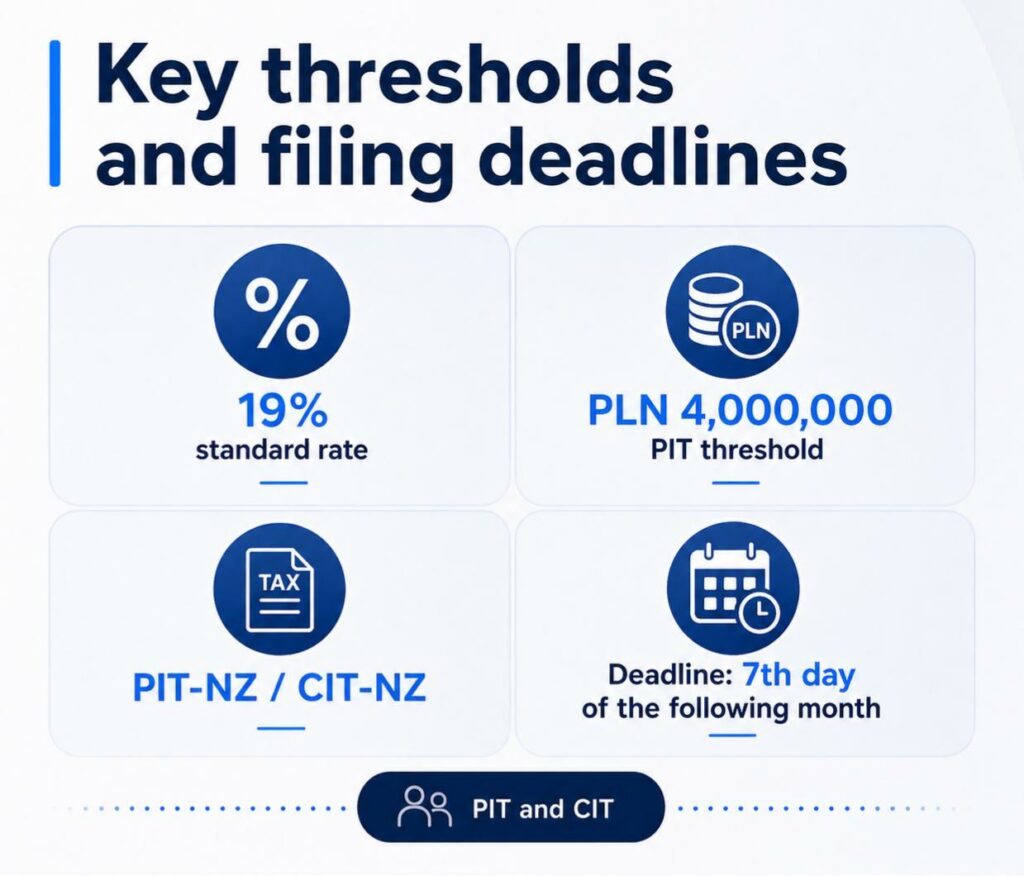
Under CIT, the standard exit-tax rate is 19%. Under PIT, the main rate is also 19%, with a 3% rate in specific cases where no tax value is established.
|
PIT threshold
PLN 4M
For individuals, the threshold concerns the aggregate market value of covered assets.
|
|
CIT threshold
No general threshold
If the exit-tax event occurs and Poland loses taxing rights, taxation may arise immediately.
|
Core forms
PIT-NZ / CIT-NZ
Individuals use PIT-NZ. Companies use CIT-NZ, and in some cases also CIT/NZI.
|
What Is Exit Tax in Poland?
Exit tax in Poland is a tax on unrealized gains. If an asset increased in value while it was within Poland’s taxing jurisdiction, Poland may tax that increase when the asset or the taxpayer leaves that jurisdiction, even if no sale has taken place yet.
Poland introduced the modern exit-tax regime in 2019 as part of the implementation of the EU Anti-Tax Avoidance Directive (ATAD), especially Article 5 of Directive (EU) 2016/1164.
For companies under the CIT rules, the exit-tax rate is 19%. For individuals under the PIT rules, the main rate is also 19%, but the statute additionally provides a 3% rate where the tax value of the asset is not established.
Who Is Subject to Exit Tax? PIT vs CIT Rules
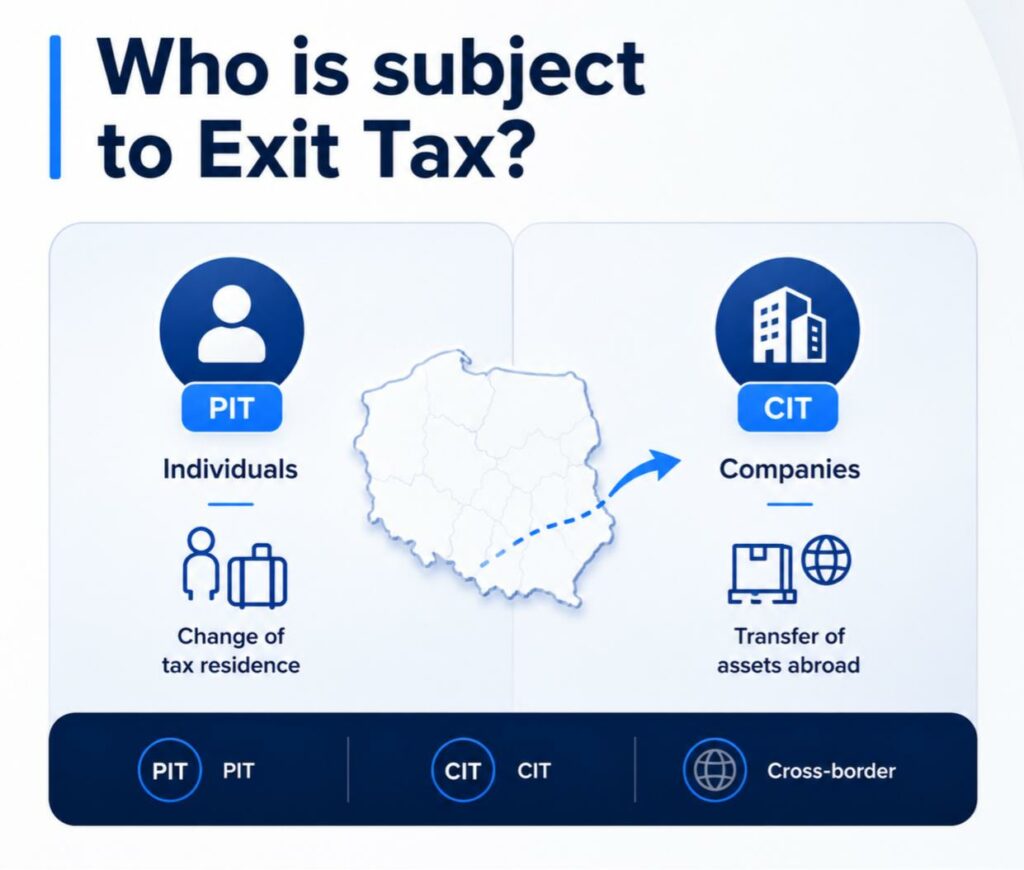
The rules differ materially between individuals and companies. For a practical analysis, it is worth separating the two from the start.
Exit Tax for Individuals (PIT)
Under the PIT rules, exit tax may arise when Poland loses its right to tax the future sale of an asset because the asset or the taxpayer moves abroad.
- A common trigger is a change of tax residence from Poland to another country.
- Another trigger is a transfer of business assets from Poland to a foreign permanent establishment.
- For personal assets, the regime mainly covers shares, stock, securities, derivatives, fund units, and similar rights, provided the individual had Polish tax residence for at least 5 years within the previous 10-year period.
The current statutory threshold for individuals is PLN 4,000,000 in aggregate market value of the transferred assets covered by the regime. If that threshold is not exceeded, the PIT exit-tax provisions do not apply.
Exit Tax for Companies (CIT)
Under the CIT rules, exit tax may arise when a company or a foreign taxpayer operating through a Polish permanent establishment moves assets or business functions in a way that causes Poland to lose its taxing rights.
- A Polish company transfers assets to its foreign permanent establishment while keeping ownership of those assets.
- A foreign tax resident transfers assets from its Polish permanent establishment to its head office or another foreign permanent establishment.
- A foreign tax resident moves all or part of the business previously carried on through its Polish permanent establishment to another country.
- A company transfers its seat or place of management abroad, so Poland loses the right to tax gains on the relevant assets.
For CIT taxpayers, there is no general statutory threshold equivalent to the PIT threshold. If the statutory exit-tax event occurs and Poland loses the right to tax the future gain, the transfer may be taxed immediately under the CIT exit-tax rules.
How Is Exit Tax Calculated in Poland?
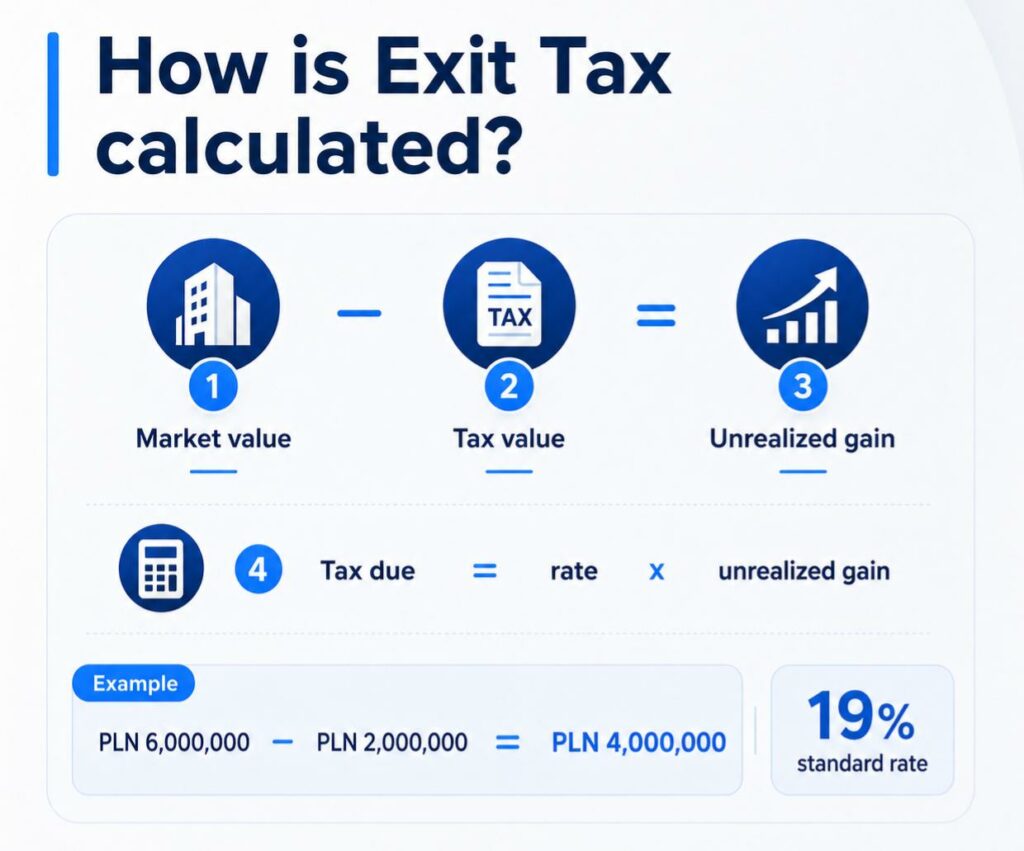
At a high level, the calculation starts with the unrealized gain embedded in the asset on the exit date.
| Core formula Exit tax base = fair market value – tax value The tax due is then the applicable rate multiplied by that base. |
The tax due is then the applicable rate multiplied by that base.
How market value is determined
- For securities and assets whose transfer does not involve a change in economically significant functions, assets, or risks, the law refers to the general market-value rules in the PIT or CIT Act.
- In other cases, Poland applies transfer-pricing valuation logic.
- Where an entire enterprise or an organized part of it is transferred under the CIT rules, the base is calculated for the business as a whole, not asset by asset in isolation.
Worked example
| Scenario | Market value | Tax value | Unrealized gain | Rate | Indicative tax |
| Individual moves shares abroad after changing Polish tax residence | PLN 6,000,000 | PLN 2,000,000 | PLN 4,000,000 | 19% | PLN 760,000 |
| Company transfers an asset to a foreign permanent establishment | PLN 10,000,000 | PLN 7,500,000 | PLN 2,500,000 | 19% | PLN 475,000 |
In the first example, the individual also exceeds the PLN 4,000,000 PIT threshold, so the Polish exit-tax regime can apply. In the second example, the company analysis focuses on whether the transfer caused Poland to lose taxing rights over the asset’s future disposal gain.
Worked example explained step by step
Example 1: individual moving shares abroad after changing Polish tax residence
1. Identify the asset covered by the exit-tax rules: in this example, shares.
2. Determine the market value on the exit date: PLN 6,000,000.
3. Determine the tax value, meaning the amount that would generally be relevant for Polish tax purposes if the shares were sold: PLN 2,000,000.
4. Calculate the unrealized gain: PLN 6,000,000 minus PLN 2,000,000 equals PLN 4,000,000.
5. Check the PIT threshold: the aggregate market value is PLN 6,000,000, so it exceeds the PLN 4,000,000 threshold.
6. Apply the rate used in this example: 19% of PLN 4,000,000 equals PLN 760,000.
7. Result: the indicative Polish exit tax is PLN 760,000.
Example 2: company transferring an asset to a foreign permanent establishment
1. Identify the exit-tax event: a company transfers an asset to a foreign permanent establishment and Poland loses the right to tax the future gain on that asset.
2. Determine the market value on the transfer date: PLN 10,000,000.
3. Determine the tax value of the asset: PLN 7,500,000.
4. Calculate the unrealized gain: PLN 10,000,000 minus PLN 7,500,000 equals PLN 2,500,000.
5. Confirm the rate: for CIT exit tax, the standard rate is 19%.
6. Calculate the tax: 19% of PLN 2,500,000 equals PLN 475,000.
7. Result: the indicative Polish exit tax is PLN 475,000.
Filing Obligations and Payment Deadlines
Individuals (PIT)
Individuals report exit tax using the PIT-NZ declaration. As a rule, the declaration must be filed by the 7th day of the month following the month in which the relevant trigger occurred. The same deadline normally applies to payment.
There is also an important timing rule for historical PIT periods. Under the Minister of Finance regulation on deferred payment dates, the payment deadline for PIT exit tax arising from monthly declarations covering periods from 1 January 2019 to 30 November 2025 was extended, in effect, to 31 December 2025 in the cases covered by that regulation. For periods from 1 December 2025 onward, the standard monthly timing applies again.
Companies (CIT)
Under the CIT rules, taxpayers file the exit-tax declaration on CIT-NZ. In cases involving the market value of an asset determined in another EU member state for equivalent exit-tax purposes, the compliance package may also include CIT/NZI information. The CIT filing deadline is the 7th day of the month following the month in which the exit-tax income arose, and the tax is generally payable within the same period.
For tax capital groups, exit-tax income is determined as the sum of the amounts calculated for all companies forming the group.
Installment Payment Option: EU and EEA Transfers
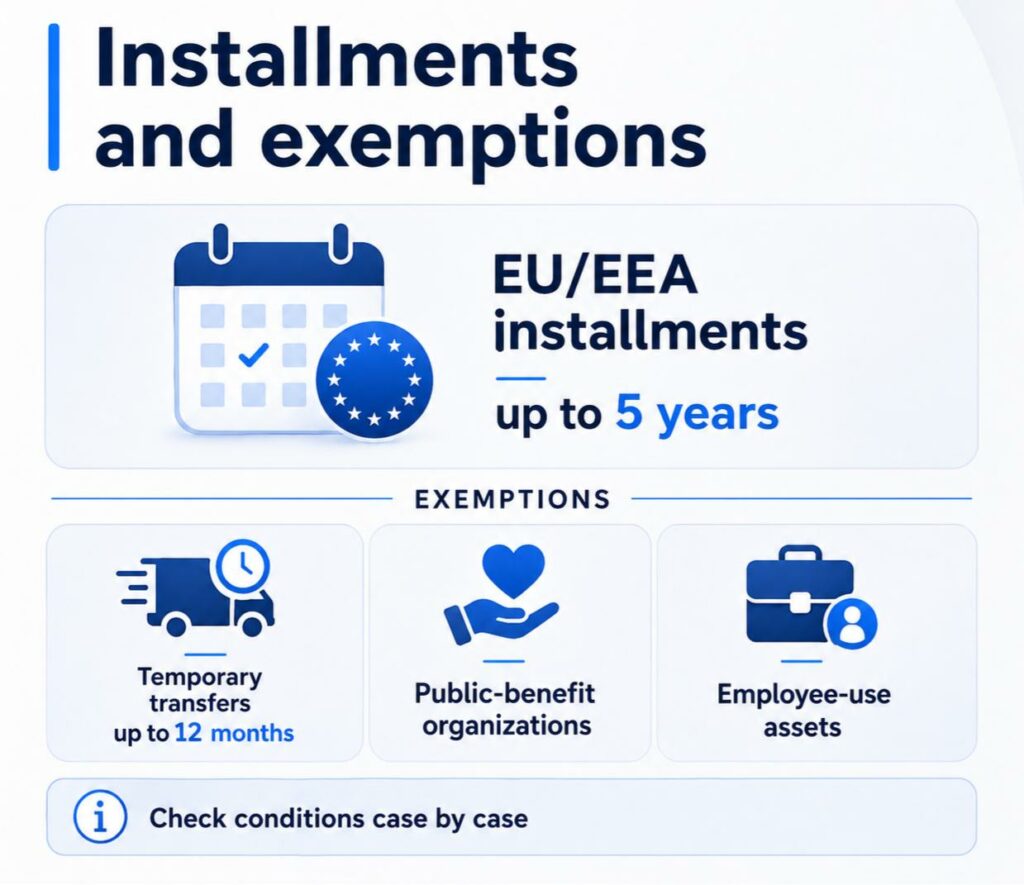
Polish law allows exit tax to be paid in installments, but only in a limited cross-border setting. The transfer must be to an EU or EEA state that meets the statutory mutual-assistance condition for recovery of tax claims.
| Destination | Installments | Maximum period | Key point |
| EU member state | Usually yes | Up to 5 years | Application required; security may be requested if there is a real risk of non-recovery. |
| EEA state meeting mutual-assistance conditions | Usually yes | Up to 5 years | The same general logic applies as for EU transfers. |
| Non-EU / non-EEA state | No | Not applicable | The tax is generally payable under the standard deadline without the special installment regime. |
The installment decision may expire, for example, if the assets are sold, moved onward to a non-qualifying jurisdiction, or the taxpayer misses an installment payment.
Exemptions and Exclusions from Exit Tax
Polish law contains several important exclusions and exemptions that should always be checked before anyone assumes exit tax is due.
Temporary transfers of up to 12 months
- Transfers directly connected with liquidity management between the Polish business and business activity in another state.
- Security transfers, including title transfer as collateral.
Transfers to qualifying public-benefit organizations
Certain transfers to qualifying public-benefit organizations in the EU or EEA fall outside the exit-tax charge, provided the taxpayer does not retain a right to participate in that organization’s profits or assets.
Certain employee-use assets
Assets intended for employees’ business use, directly connected with their work, and not treated as fixed or current assets for accounting purposes, may be excluded.
Family Foundation and Exit Tax
A Polish family foundation can materially reduce the practical exposure of a founder’s later change of tax residence to PIT exit tax, because after a valid contribution the relevant assets are no longer owned by the founder personally. That said, a family foundation does not automatically eliminate exit-tax risk.
The key legal question remains the same: at the time of the transfer, contribution, or residence change, does Poland lose the right to tax income from a later disposal of the relevant asset? If the answer is yes, exit-tax analysis is still required.
At the level of the family foundation itself, the current CIT position is more favorable than the 2025 draft changes would have been. In October 2025, the government announced a CIT amendment project that expressly intended to bring family foundations within the scope of both CFC rules and exit-tax rules. However, that amendment did not enter into force, because the President refused to sign the CIT bill on 27 November 2025.
As of 30 April 2026, the safer and more accurate position is that family foundations may still affect exit-tax analysis in practice, but the specific 2025 draft extension of CIT exit tax to family foundations did not become binding law.
Exit Tax and Double Taxation Treaties
Poland has a broad network of double taxation treaties. Even so, treaties do not automatically eliminate Polish exit tax. The reason is that exit tax is generally charged on a deemed disposal or equivalent domestic-law event that occurs when Poland loses taxing rights.
- Does the relevant treaty materially limit Poland’s taxing rights in the specific exit-tax scenario?
- Will the destination jurisdiction recognize Polish exit tax as a credit or otherwise take it into account?
That is why a treaty review should be part of the relocation or restructuring analysis, especially when the destination country applies its own departure-tax or basis step-up rules.
Practical Planning Considerations
- Timing of the transfer: the transfer date determines the market value used for the calculation, so valuation timing can materially affect the tax base.
- Evidence of tax value: good records of acquisition cost and tax basis can significantly reduce the taxable amount.
- Asset qualification: not every asset falls into the same regime, and some assets may be outside scope or below the relevant PIT threshold.
- Installment analysis: if the move is to an EU or EEA country, the cash-flow impact of using the installment regime should be modeled early.
- Internal coordination: for companies, finance, tax, and legal teams should review cross-border restructurings before execution, especially where permanent establishments are involved.
FAQ
What is exit tax in Poland and when does it apply?
It is a tax on unrealized gains. It applies when Poland loses the right to tax a future gain on an asset because the asset or the taxpayer moves outside the Polish tax net.
What is the exit tax threshold in Poland?
For individuals under the PIT rules, the threshold is PLN 4,000,000 of aggregate market value of the covered assets. For companies under the CIT rules, there is no general statutory threshold: if the exit-tax event occurs, taxation may arise immediately.
Can exit tax in Poland be paid in installments?
Yes, potentially for up to 5 years, but only for qualifying transfers to EU or EEA states that meet the statutory mutual-assistance condition.
Are there any exemptions from Polish exit tax?
Yes. The key statutory categories are temporary transfers of up to 12 months, certain transfers to public-benefit organizations, and certain employee-use assets.
How is exit tax reported in Poland?
Individuals use PIT-NZ. Companies follow the CIT exit-tax filing rules. In both systems, the standard filing deadline is generally the 7th day of the month following the month in which the taxable event occurred.
Does exit tax apply when moving from Poland to Dubai (UAE)?
It can. The fact pattern still needs to be analyzed, but the move is outside the EU and EEA installment framework, so the special 5-year installment regime is not available. Poland also has a tax treaty with the UAE, but treaty relief must be checked case by case.
What changed in Polish exit tax practice in 2025 and 2026?
A key practical point is the end of the deferred PIT payment regime for covered historical periods after 30 November 2025, with standard monthly timing applying again from 1 December 2025 onward. Also, although a 2025 government draft would have extended CIT exit-tax rules to family foundations, that amendment did not enter into force because the President vetoed the bill on 27 November 2025.
Does using a Polish family foundation automatically eliminate exit tax?
No. A family foundation can reduce a founder’s direct PIT exit-tax exposure because contributed assets are no longer owned by the founder, but the decisive question remains whether Poland loses the right to tax a later disposal of the asset at the relevant moment.
Related Links
- Polish tax law overview
- Tax consultation in Poland
- Tax and accounting services
- Entering the Polish market
- Transfer pricing in Poland
Sources
- Council Directive (EU) 2016/1164, Article 5: https://eur-lex.europa.eu/legal-content/EN/TXT/?uri=CELEX%3A32016L1164
- Polish PIT Act consolidated text, Articles 30da-30de: https://eli.gov.pl/api/acts/DU/2024/226/text.html
- Polish CIT Act consolidated text, Articles 24f-24h: https://eli.gov.pl/api/acts/DU/2026/554/text/T/D20260554L.pdf
- Minister of Finance regulation on deferred PIT exit-tax payment deadlines: https://eli.gov.pl/api/acts/DU/2023/1611/text.html
- Official PIT-NZ form information: https://www.podatki.gov.pl/pit/zmiany-w-prawie-pit/nowe-wzory-pit-nz-exit-tax/
- Official CIT-NZ and CIT/NZI form information: https://www.podatki.gov.pl/cit/zmiany-w-prawie-cit/nowe-formularze-podatkowe-cit-nz/
- Current CIT forms list, including CIT-NZ: https://www.podatki.gov.pl/cit/e-deklaracje-cit/formularze-cit/
- Ministry of Finance announcement on 2025 family-foundation draft changes: https://www.gov.pl/web/finanse/rzad-przyjal-dwa-projekty-ustaw-ktore-uszczelniaja-przepisy-podatkowe-dotyczace-fundacji-rodzinnych-oraz-podwyzszaja-cit-dla-bankow
- President of Poland veto message on the 17 October 2025 CIT amendment bill: https://www.prezydent.pl/storage/file/core_files/2025/11/28/64d9a6aa7aa5980bcb537e592521f3ca/Weto%20-%20ustawa%20o%20podatku%20dochodowym%20od%20os%C3%B3b%20prawnych.pdf
- Poland’s official list of double taxation treaties: https://www.podatki.gov.pl/podatkowa-wspolpraca-miedzynarodowa/wykaz-umow-o-unikaniu-podwojnego-opodatkowania/