

What Is a VAT Number in Poland?
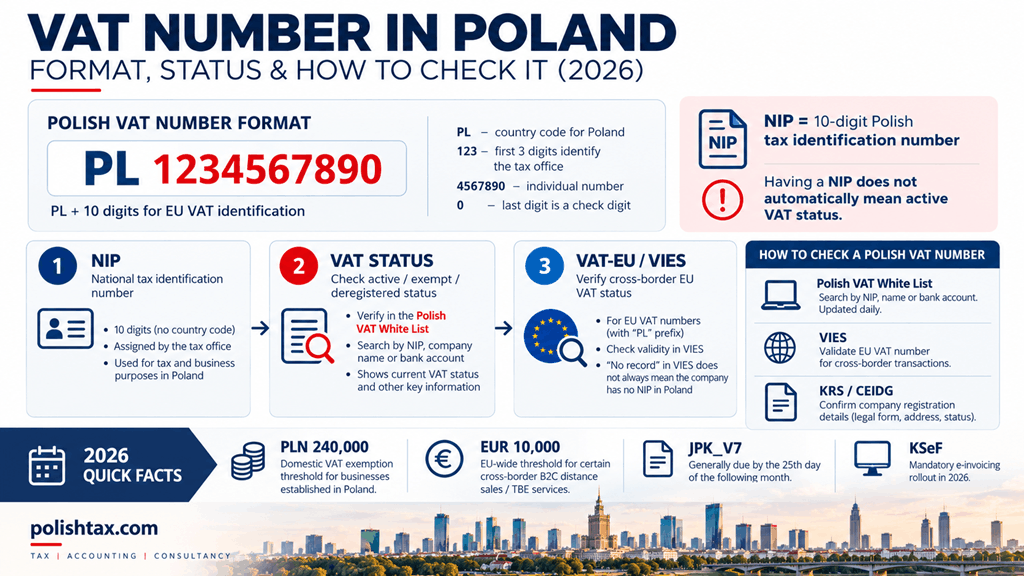
A VAT number in Poland is the tax identification number used to identify a business for Polish VAT purposes. For Polish entities this number is based on the 10-digit NIP (Numer Identyfikacji Podatkowej). In domestic Polish documents the NIP is normally shown as 10 digits. For EU VAT purposes, the country prefix “PL” is added, producing a format such as PL1234567890.
The key practical point is that having a Polish NIP does not by itself prove that a business is an active VAT payer. A company can have a NIP for general tax identification while being VAT-exempt, not registered for VAT, removed from the VAT register, or not registered for intra-EU transactions. This is why finance teams should verify status rather than relying on the number alone.
Polish VAT Number Format and Example
A Polish NIP contains 10 digits. When used as a VAT-EU identification number, it is preceded by the country code PL. The final digit is a checksum used to validate the numerical structure. Older descriptions of the NIP format often explain the first three digits as an identifying code associated with the tax office that originally issued the number; for operational purposes today, however, the safest approach is to treat the NIP as a unique 10-digit identifier and verify the entity in official registers.
|
Element |
Example |
Meaning |
|
Domestic NIP |
1234567890 |
10 digits; illustrative format only |
|
EU VAT number |
PL1234567890 |
PL + 10-digit NIP |
|
Country prefix |
PL |
Poland in EU VAT identification |
|
Last digit |
0 |
Checksum digit in this illustrative example |
Important: the sample number above is illustrative and should not be used as evidence that a real business or valid VAT registration exists.
NIP vs VAT Number vs VAT-EU: What’s the Difference?
Foreign businesses often use the terms NIP, VAT number and VAT-EU interchangeably, but they describe different layers of identification and tax status. The distinction matters when onboarding a supplier, issuing an invoice, applying a zero rate to an intra-Community supply, or checking whether reverse-charge rules can be used.
|
Identifier |
Who issues / maintains it |
Main purpose |
Typical format |
Does it prove active VAT? |
|
NIP |
Polish tax administration |
General tax identification in Poland |
10 digits |
No |
|
VAT status |
Polish VAT register |
Shows active / exempt / deregistered status |
Linked to NIP |
Yes, if verified |
|
VAT-EU |
Polish tax administration + VIES |
Intra-EU VAT transactions |
PL + 10 digits |
Shows EU VAT validity |
|
REGON |
Statistics Poland (GUS) |
Statistical/business identifier |
9 or 14 digits |
No |
|
PESEL |
Polish public administration |
Personal identifier for individuals |
11 digits |
No |
For more on the underlying identification process, see tax registration in Poland (NIP).
How to Check a Polish VAT Number
A Poland VAT number check should match the purpose of the transaction. For domestic Polish VAT status, use the Polish VAT White List. For cross-border EU VAT validity, use VIES. KRS and CEIDG are useful supplementary registers for confirming that the legal entity or sole trader exists and that the identifying details are consistent.
1. The Polish VAT White List
The official White List (Wykaz podatników VAT) is the primary Polish tool for checking domestic VAT status. You can search by NIP, company name or bank account. The result can show whether a taxpayer is registered as active or exempt, has been refused registration, removed from the register or restored, and may also show business bank accounts reported for VAT purposes.
-
Open the official VAT taxpayers search engine.
-
Enter the NIP, company name, REGON or bank account number.
-
Choose the date for which you want to verify the status.
-
Save or document the result when the verification supports a payment or VAT position.
The Ministry of Finance also publishes data used for mass verification and updates the underlying White List data daily. For payment-risk rules and the PLN 15,000 threshold, see the detailed guide to the Polish VAT White List.
2. VIES – for EU cross-border checks
VIES is the European Commission system used to validate VAT numbers for intra-EU transactions. For a Polish business, choose Poland and enter the 10-digit NIP; VIES effectively validates the EU VAT number with the PL prefix. A valid result is important evidence when applying EU VAT rules to B2B transactions, including intra-Community supplies of goods.
A “no record” or invalid VIES result does not necessarily mean that the company has no Polish NIP. It may mean that the entity is not registered for VAT-EU, that its VAT-EU status is inactive, or that the data have not yet been reflected. In that situation, also check the Polish White List and confirm the transaction facts with the counterparty.
3. KRS and CEIDG
KRS is useful for companies and other entities entered in the National Court Register, while CEIDG is relevant mainly for sole traders. These registers help confirm the legal name, address, representatives and registration data, but they should not replace a VAT-status check in the White List or VIES.
Who Needs a VAT Number in Poland? Registration Thresholds
The answer depends on where the business is established and what it does in Poland. A single turnover threshold should not be used as a universal registration test for foreign companies.
-
PLN 240,000 domestic exemption threshold (2026): businesses established in Poland may generally use the subjective VAT exemption if their sales stay within the statutory limit and no exclusion applies.
-
EU businesses and the SME scheme: an EU-established business may in some cases use the cross-border SME exemption procedure, subject to the EU-wide turnover condition and Polish domestic conditions. This is a separate mechanism, not an automatic extension of the domestic exemption.
-
EUR 10,000 EU B2C threshold: this EU-wide threshold applies to specific intra-EU distance sales of goods and certain TBE services. It is not a general Polish VAT registration threshold.
-
No general turnover threshold for many foreign-business scenarios: if a foreign company holds stock in Poland, makes domestic taxable supplies, imports goods, or carries out other transactions that create Polish VAT obligations, registration may be required from the first relevant transaction unless a special rule or simplification applies.
Because foreign-business registration is transaction-driven, a logistics or e-commerce model should be reviewed before goods are moved into Poland. In particular, storing own goods in a Polish warehouse can create Polish VAT obligations even when sales revenue in Poland is still low.
How to Get a VAT Number in Poland – Overview
Registration normally requires an identification filing and a VAT registration filing. For a foreign legal entity, the documentation commonly includes the NIP-2 identification form and VAT-R, together with corporate documents and supporting information requested by the tax office. The exact document package depends on legal form, place of establishment, activities in Poland and whether the business has a fixed establishment.
Foreign entities without a registered office or fixed establishment in Poland are generally handled by the Second Tax Office Warszawa-Śródmieście for VAT registration matters. Registration itself is free; an optional formal confirmation of registration may be subject to stamp duty. Processing time varies because the authority may verify the company, its representatives, business model and supporting documents before confirming active VAT status.
For a full procedural checklist, documents and practical timing, read how to register for VAT in Poland. If you prefer assistance with the filing, see our VAT registration services.
VAT Rates and Filing in Poland – Quick Facts
|
Topic |
2026 quick fact |
|
Standard VAT rate |
23% |
|
Reduced rates |
8% and 5% for specified goods/services; 0% applies in defined cases |
|
JPK_V7 |
Active VAT taxpayers file the electronic VAT record/declaration structure |
|
General filing deadline |
25th day of the following month, subject to weekend/holiday rules |
|
KSeF |
Mandatory e-invoicing rollout applies in stages in 2026, with further extension to the smallest exempted businesses in 2027 |
|
EU transactions |
VAT-EU registration and VIES validation may be required in addition to domestic VAT registration |
For implementation support, see KSeF e-invoicing.
FAQ – VAT Number in Poland
Is NIP the same as a VAT number in Poland?
Not exactly. NIP is the Polish tax identification number. A VAT-active business uses that NIP for VAT purposes, and for EU VAT identification the prefix PL is added. However, having a NIP does not automatically prove active VAT or VAT-EU status.
How do I check if a Polish VAT number is valid?
Use the Polish VAT White List to verify domestic VAT status and VIES to check VAT-EU validity for intra-EU transactions. For due diligence, also compare the legal name and registration details in KRS or CEIDG.
What does a Polish VAT number look like?
A domestic Polish NIP contains 10 digits. For EU VAT purposes the format is PL followed by those 10 digits, for example PL1234567890 as an illustrative format.
Is a VAT number public information in Poland?
Yes, core VAT-registration information is publicly searchable in the official VAT taxpayers register. Other public business registers may also show company identification data.
How long does it take to get a VAT number in Poland?
There is no single guaranteed practical processing time for every foreign-business case. The tax office may verify the entity, business model, representatives and documents before registration. Straightforward applications can be processed relatively quickly, but incomplete or high-risk files take longer.
How Intertax Can Help
A Polish VAT number is easy to recognise but the registration and compliance consequences behind it can be complex, especially for foreign companies operating e-commerce, warehousing, distribution or cross-border service models. Intertax can review whether registration is required, prepare the NIP/VAT-R package, communicate with the tax office and support ongoing Polish VAT compliance.
For non-EU businesses, we can also assess whether fiscal representation in Poland is required. To discuss your case, contact Intertax.