
VAT in Poland: Comprehensive 2026 Guide to Polish VAT Regulation
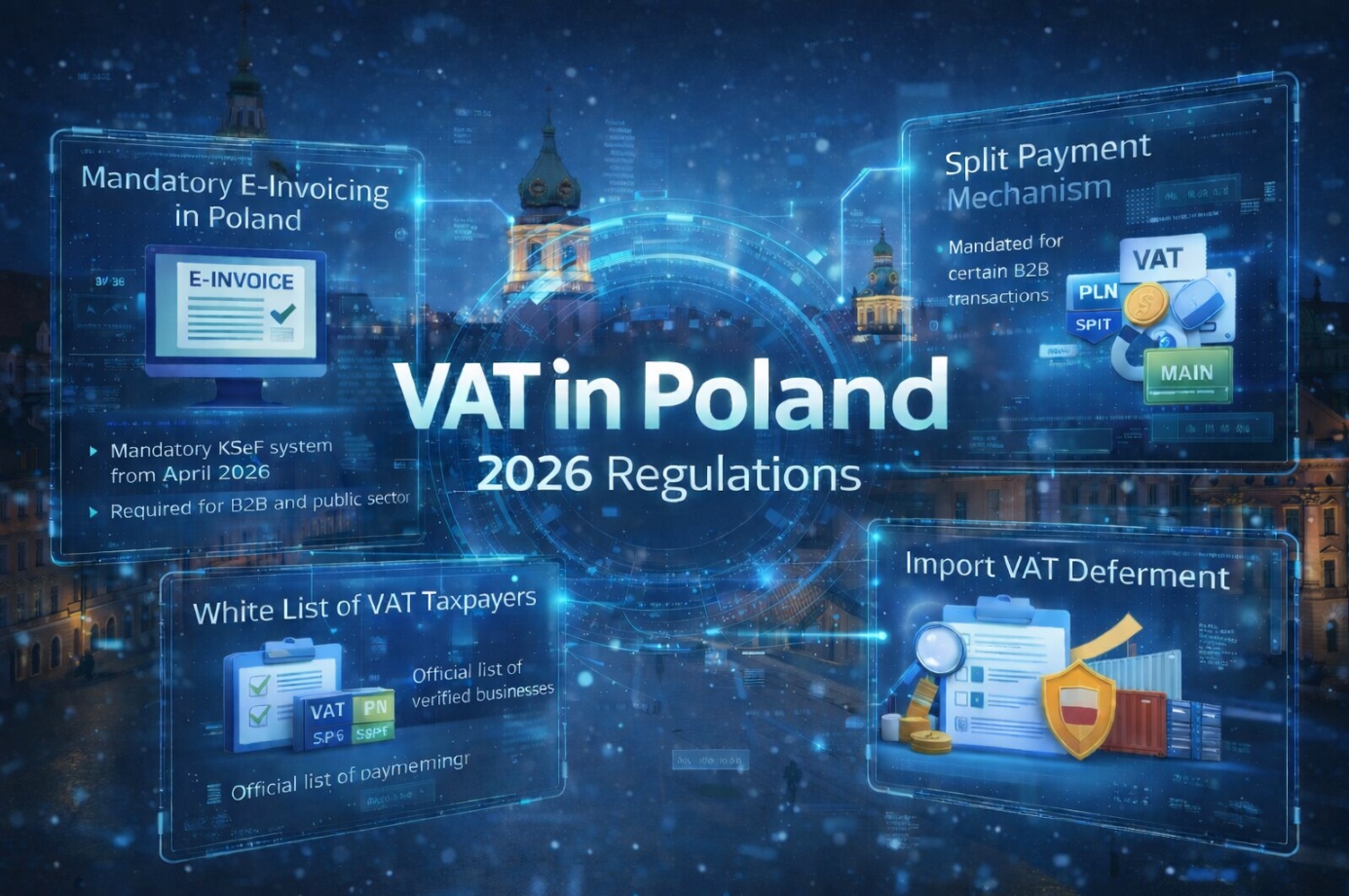
Value Added Tax (VAT) in Poland is a crucial component of the country’s tax system and directly affects all businesses engaged in the sale of goods or services. Whether you’re planning to register for VAT in Poland, claim a VAT refund, or understand VAT compliance rules, this guide provides everything you need to know about Polish VAT in 2026.
What Is VAT in Poland?
Value Added Tax (VAT) is an indirect tax levied on the sale of goods and services. In Poland, VAT is governed by the Polish VAT Act, aligned with EU VAT directives https://www.podatki.gov.pl/en/value-added-tax/
https://taxation-customs.ec.europa.eu/taxation/vat/vat-directive_en
The Polish tax authorities—the Ministry of Finance—administer the VAT system. All businesses exceeding certain turnover thresholds or conducting taxable activities must register for VAT in Poland and comply with local VAT obligations.
Who Must Register for VAT in Poland?
You are required to register for VAT in Poland if:
- Your business is established in Poland and your annual turnover exceeds PLN 240,000.
- You import or export goods or services within the European Union.
- You conduct remote sales to Polish consumers and exceed the EU-wide threshold of EUR 10,000.
- You are not established in Poland but carry out taxable transactions here.
Special Note for Non-EU Companies
Non-EU businesses (with the exception of those from the United Kingdom and Norway) must appoint a fiscal representative in Poland to handle their VAT obligations. This representative shares liability for VAT payments and filings.
Learn more about how to register for VAT in Poland and obtain a Polish VAT number.
VAT Rates in Poland (2026)
Understanding the applicable VAT rate in Poland is essential for correct invoicing and VAT return filing. Polish VAT is levied at different rates:
| VAT Rate | Description | Applies To |
| 23% | Standard VAT rate | Most goods and services |
| 8% | Reduced VAT rate | Certain foodstuffs, medical equipment, healthcare products (pharmaceutical products; medical devices; certain disinfectants applied in health protection), accommodation provided in hotels and similar establishments, food and beverages serving services (excluding the supply of beverages and goods unprocessed by the taxpayer – other than those that are subject to a reduced rate, as well as seafood) |
| 5% | Super reduced VAT rate | Books, newspapers, selected foods, products for children and hygiene products (food for infants and toddlers, pacifiers, nappies, car seats, sanitary pads and tampons and), printed books, books on disks, tapes and other media and e-books (other than publications wholly or predominantly consisting of video content or audible music) as well as regional or local periodicals (printed or on disks, tapes and other media) |
| 0% | Zero rate | Intra-community and international transport, the export of goods, the intra-European Union supply of goods, services provided in maritime ports related to the handling of means of maritime transport or aimed at meeting the direct needs of their cargo, the supply of means of air transport, replacement parts and onboard equipment for air carriers operating primarily international air services |
| Exempt | VAT exemption | Financial, insurance, education services |
For full clarity on appropriate VAT rates, always refer to the official list published by the Polish Ministry of Finance on gov.pl
https://www.podatki.gov.pl/en/value-added-tax/general-vat-rules-and-rates/list-of-vat-rates
Polish VAT Registration: How to Register for VAT in Poland
To register for VAT in Poland, follow these key steps:
- Submit VAT-R and NIP-2 form to the relevant Polish tax office.
- Provide supporting documents (extract from companies register, description of activities).
- Appoint a fiscal representative in Poland if you are a non-EU entity (does not apply to Great Britain and Norway).
- Receive a Polish VAT number and certificate of registration.
Once registered, a company receives a Polish VAT number in the following format:
- PL + 10-digit NIP (e.g., PL1234567890)
This number must be included on all VAT invoices, tax returns, and correspondence with the Polish tax authorities. It can be verified in the VIES system for intra-EU transactions.
The entire process typically takes between 2 to 4 weeks, depending on the quality and completeness of the submitted documents.
VAT Compliance and VAT Reporting in Poland
Maintaining VAT compliance in Poland includes:
- Issuing compliant VAT invoices via KSEF – a centralized government platform for the real-time exchange of invoices.
- Submitting electronic VAT returns in Poland (JPK-V7).
- Paying VAT due to the Polish tax authorities.
- Keeping accurate VAT records.
Invoice formal requirements: Date, number, Tax Identification Number (NIP), description of goods or services, VAT rate. Issuance deadline: by the 15th of the month following delivery
VAT reporting is typically done monthly, though small businesses may opt for quarterly VAT returns. All returns must be filed electronically using Poland’s JPK (Standard Audit File) format.
In Poland, “VAT errors” (a VAT “sanction” ) can trigger Tax arrears + interest, Additional tax liability up to 30%, 20%, or 15% depending on circumstances. If the head of the tax office identifies errors in the JPK_V7 that prevent verification, and you don’t correct or explain, they may impose a PLN 500 fine per error. If an error involves untrue statements / concealment in a tax return that exposes tax to loss, KKS (Fiscal Penal Code) liability can arise.
What Is JPK-V7?
Poland uses the JPK (Jednolity Plik Kontrolny) or Standard Audit File for Tax (SAF-T) format for reporting. The JPK-V7 file combines two previous reports: VAT returns and detailed invoice records.
Businesses must submit JPK-V7 files monthly or quarterly, depending on their size and VAT status. These files must be submitted by the 25th day of the month following the reporting period.
KSeF – Mandatory E-Invoicing in Poland
Starting in February 2026, Poland implemented the mandatory National e-Invoice System (KSeF), a centralized government platform for the real-time exchange of invoices. This reform marks a significant shift from traditional PDF or paper documents to a mandatory structured XML format.
Mandatory Implementation Schedule
The rollout is divided into two primary stages based on company size:
- February 1, 2026: Mandatory for large enterprises whose 2024 gross sales exceeded PLN 200 million.
- April 1, 2026: Mandatory for all other VAT taxpayers, including small and medium-sized enterprises (SMEs).
- Foreign Entities: The April 1, 2026 deadline also applies to foreign entities with a Polish VAT registration that have a fixed establishment in Poland.
Impact on VAT Refunds
One of the primary incentives for adopting the system is the significant reduction in wait times for tax recovery. For taxpayers who exclusively use structured e-invoices via KSeF, the standard VAT refund period will be shortened by one-third—dropping from the current 60 days to just 40 days. This change is designed to improve business liquidity and cash flow by providing faster access to overpaid tax.
A Centralized Government Platform
Invoices will no longer be sent directly between parties via email. Instead, they must be transmitted to the government’s KSeF platform, which assigns a unique identification number and archives the data for 10 years. This centralized storage eliminates the risk of lost or destroyed documents and streamlines future tax audits.
Split Payment Mechanism
The Split Payment (MPP) mechanism is a key tool for tightening the tax system in Poland. Here are the most important information about its functioning:
- Principle of operation: The payment for the invoice is divided into two parts: the net amount goes to the supplier’s current account, and the VAT amount goes to a dedicated, blocked VAT account, from which you can pay mainly tax liabilities and social security contributions.
- Mandatory scope: MPP is mandatory in B2B relations when two conditions are met:
- The gross value of the invoice exceeds PLN 15,000.
- At least one item on the invoice includes goods or services listed in Appendix 15 to the VAT Act (e.g. electronics, steel, scrap, construction works, car parts).
- New deadline: The European Commission has agreed to continue to apply this mechanism in Poland. By an executive decision, the deadline for the mandatory MPP has been extended to 28 February 2028.
- Sanctions: Failure to mark the invoice with the annotation “split payment mechanism” or making a payment bypassing the MPP may result in a sanction of 30% of the VAT amount shown on the invoice and the inability to include the expense in tax-deductible costs (KUP).
The use of split payment also allows you to avoid joint and several liability with the supplier and allows you to take advantage of the 25-day VAT refund period.
White List of VAT Taxpayers
Here’s the gist of the VAT White List:
What is it: A public register of the Ministry of Finance containing taxpayer statuses and their bank account numbers.
When to check: For payments exceeding PLN 15,000 gross.
Biggest risk: Paying to an account not on the list will result in the expense not being included in the costs (KUP) and risking joint and several liability for VAT for the seller.
How to avoid it: If you transfer money to the wrong account, you have 7 days to report it to the tax office (ZAW-NR form).
Always check the Tax Identification Number (NIP) on the government website before making a transfer to avoid tax losses.
Deadlines and VAT Payment in Poland
VAT must be paid to a designated VAT account maintained by the Polish tax office. Deadlines are critical:
- Payment and reporting due: by the 25th of the following month.
- Failure to comply may result in interest charges or administrative penalties.
To stay on track:
- Monitor VAT payment schedules.
- Keep updated on currency conversion if issuing foreign invoices.
- Track your input and output VAT to optimize cash flow.
VAT Refund in Poland for Foreign Businesses
Foreign businesses can apply for a VAT refund in Poland if they:
- Are not established in Poland.
- Do not make taxable supplies here.
- Incurred Polish input VAT on business-related expenses.
Application Process
VAT Refund in Poland – Summary for EU and Non-EU Companies
| Company Type | Method of Submitting VAT Refund Application in Poland |
| EU Companies | Apply via your home country’s VAT refund portal. |
| Non-EU Companies | Submit applications directly to the Polish tax office through a fiscal representative. |
Refund applications must be submitted by September 30th of the year following the year the VAT was incurred.
VAT Exemption in Poland
Certain goods and services are exempt from VAT under Polish VAT law, including:
- Financial and insurance services
- Health care and medical services
- Education and cultural activities
- Real estate leases (under specific conditions)
To benefit from a VAT exemption in Poland, proper documentation and transaction classification are essential.
SME VAT Exemption – Domestic and Cross-Border (Effective January 1, 2025)
Starting January 1, 2025, the EU introduced a unified VAT exemption scheme for small and medium-sized enterprises (SMEs). This scheme allows eligible SMEs to benefit from VAT exemptions both domestically and across EU Member States.
Domestic SME Exemption in Poland:
- SMEs established in Poland with an annual turnover not exceeding PLN 240,000 can opt for VAT exemption.
- Exempt businesses cannot charge VAT on their invoices or reclaim input VAT on business expenses.
- To apply, businesses must notify the Polish tax authorities and indicate “zwolniony z VAT” (exempt from VAT) on invoices.
Cross-Border SME Exemption:
- SMEs established in one EU Member State can apply for VAT exemption in other Member States where they operate, provided:
- Their total annual turnover across the EU does not exceed EUR 100,000.
- Their turnover in each Member State where they seek exemption does not exceed that country’s national VAT exemption threshold .
- Eligible SMEs must submit a prior notification in their Member State of establishment to obtain an ‘EX’ VAT identification number.
- Once granted, the SME can apply the VAT exemption in other Member States from the date of confirmation.
- SMEs under this scheme are required to submit a single quarterly report detailing their turnover in all Member States
This new scheme simplifies VAT compliance for SMEs operating across the EU by reducing the need for multiple VAT registrations and filing
https://single-market-economy.ec.europa.eu/smes_en
VAT for Foreign Businesses Selling in Poland
If you are selling goods or services in Poland without a local entity, you may still be subject to Polish VAT. This applies to:
- Cross-border e-commerce.
- Dropshipping and fulfillment models.
- Digital services to Polish consumers.
- Such businesses must register for VAT in Poland, appoint a representative in Poland, and comply with Polish VAT reporting rules.
Import VAT Deferment
In Poland, “import VAT deferment” is most commonly done via the simplified procedure under Article 33a of the Polish VAT Act (often called “procedure 33a”). It lets you settle import VAT in your JPK_V7 (VAT return) instead of paying VAT at customs clearance.
A taxpayer registered as an active Polish VAT payer may settle import VAT in the VAT return for the period when the import obligation arises—provided the import is covered by the simplified procedure and statutory conditions are met.
Key Takeaways: Polish VAT Compliance in 2026
- Standard VAT rate in Poland remains at 23%.
- VAT registration is required for both local and foreign companies crossing thresholds.
- Non-EU businesses must appoint a fiscal representative (excluding UK and Norway).
- Electronic VAT reporting using JPK-V7 is mandatory.
- VAT refunds are possible but must follow strict application procedures.
- Penalties for non-compliance can include fines and interest charges.
- Professional advisory can help avoid costly mistakes.
Intrastat Reporting in Poland in 2026
Basic thresholds
The obligation to submit a declaration arises after exceeding the following values: Import: PLN 6,000,000 Export: PLN 2,800,000
Specific thresholds
Exceeding them imposes the obligation to fill in additional fields in the declaration (e.g. statistical value, delivery conditions):
Import: PLN 105,000,000
Exports: PLN 148,000,000 (change from PLN 158 million in 2025)
Key information
Most of the limits remained at the 2025 level, with the exception of the specific threshold for exports, which was lowered.
From July 2025, a higher simplification limit (up to EUR 1000) is also in force, allowing for collective reporting of small transactions under one code.
Need Help with Polish VAT Registration or Compliance?
Our tax experts at Intertax specialize in:
- Assisting international clients with VAT registration in Poland
- Representing foreign businesses as fiscal representatives
- Ensuring full VAT compliance, reporting, and refunds