

Executive Summary
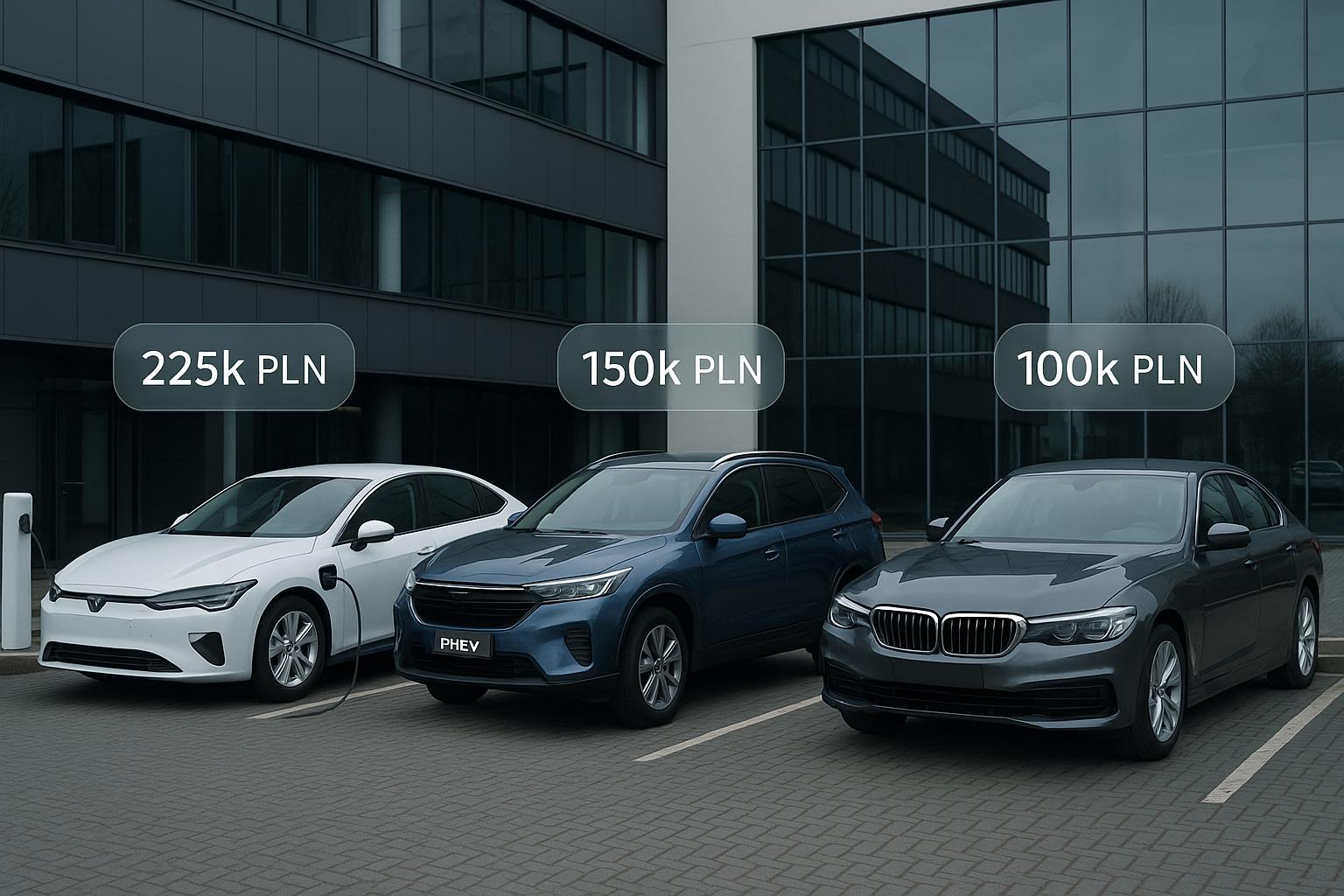
From 2026 the tax‑deductible value for passenger car depreciation in Poland depends on CO₂ emissions: PLN 225,000 for battery‑electric/hydrogen vehicles; PLN 150,000 for low‑emission cars below 50 g CO₂/km (few PHEV models); and PLN 100,000 for cars at or above 50 g CO₂/km (most ICE and hybrids). The same thresholds apply proportionally to operating lease and rental payments. Effective for vehicles recognized from 1 January 2026.
Car depreciation limits Poland 2026 – the new framework
Beginning 1 January 2026, Poland replaces the current two‑tier caps (PLN 150k / 225k) with a three‑tier system linked to the vehicle’s type of propulsion and certified CO₂ emissions. These depreciation thresholds for cars also drive the tax‑deductible vehicle costs for leasing, rental and certain insurance costs.
Depreciation thresholds for passenger cars (from 2026)
| Vehicle category | CO₂ criterion | Maximum tax‑deductible input for depreciation / proportional lease cost |
| Electric / hydrogen | N/A (no tailpipe CO₂) | PLN 225,000 |
| Low‑emission (mostly selected PHEV) | < 50 g CO₂/km | PLN 150,000 |
| Other ICE & hybrids | ≥ 50 g CO₂/km | PLN 100,000 |
Notes:
- The CO₂ value is determined from the Central Vehicle Register (CEPiK) type‑approval data.
- In practice, few plug‑in hybrids qualify below 50 g/km; mild/full hybrids and ICE exceed it and fall to PLN 100k.
- The electric car depreciation cap of PLN 225k remains unchanged.
New vehicle tax rules interacting with depreciation
The 2026 regime does not change the nominal depreciation rates for passenger cars (e.g., standard 20% per year, minimum 5‑year period), but it caps the input value eligible for tax costs. For operating leases, long‑term rental and car‑sharing, businesses must apply the same caps proportionally to periodic payments when the car’s catalog value exceeds the applicable threshold.

Calculating depreciation in Poland – step‑by‑step example
Example 1 – ICE company car (CO₂ 120 g/km) bought in March 2026
- Purchase price (gross for simplicity): PLN 200,000
- Applicable cap (≥ 50 g/km): PLN 100,000
- Proportional factor: 100,000 / 200,000 = 50%
- Accounting depreciation (20% p.a.): PLN 40,000/yr → Tax‑deductible: 50% × 40,000 = PLN 20,000/yr
Example 2 – PHEV under 50 g/km bought in 2026
- Price: PLN 240,000; CO₂: 38 g/km → Cap PLN 150,000
- Factor: 150,000 / 240,000 = 62.5%
- Annual depreciation (20%): PLN 48,000 → Tax cost: 62.5% × 48,000 = PLN 30,000/yr
Example 3 – Electric car (BEV) recognized in 2026
- Price: PLN 260,000; Cap PLN 225,000
- Factor: 225,000 / 260,000 ≈ 86.54%
- Annual depreciation (20%): PLN 52,000 → Tax cost: ≈ PLN 45,000/yr
Car leasing and depreciation rules – proportional limit on payments
For operating lease and long‑term rental, the same thresholds apply to each invoice:
- Determine the car’s initial value (catalog/configured price).
- Compute the limit ratio (cap ÷ initial value).
- Multiply each lease/rental invoice by that ratio to obtain the tax‑deductible portion.
Example – operating lease signed in 2026 (ICE, value 180,000 PLN)
- Cap: PLN 100,000 → Ratio 55.56%
- Monthly invoice PLN 3,600 → Tax‑deductible: PLN 2,000; the rest is non‑deductible for income tax.
Updated amortization rules – effective date and transition
- Effective date: The new business vehicle tax changes start on 1 January 2026.
- Fixed assets recognized by 31 Dec 2025: Vehicles entered into the fixed asset register (or purchased and put into use) by 31 December 2025 continue with the previous caps (PLN 150k for ICE/hybrids; PLN 225k for BEV/H₂) for the remaining depreciation period.
- Leasing and rental contracts: Contracts concluded and cars delivered/put into use from 1 January 2026 apply the new limits. Contracts from before 2026 typically keep the old cap, but carefully verify your dates (order/acceptance/first use) and check for specific anti‑avoidance or MDR risks.
Important: Given the 50 g/km cliff, model selection (e.g., choosing a PHEV that stays under 50 g/km) can preserve the PLN 150k cap. Always confirm the official type‑approval CO₂ figure for the exact version and wheel‑tyre combo.
Luxury car depreciation limit vs. practical thresholds
Polish law does not use the word “luxury,” but effectively any vehicle value above the relevant threshold (225k/150k/100k) becomes partly non‑deductible for income tax via proportioning. For high‑spec SUVs with CO₂ ≥ 50 g/km, the effective luxury car depreciation limit is PLN 100,000 from 2026.
Impact on businesses – who pays more?
- SMEs and service companies relying on ICE fleets will see higher taxable income due to lower deductible depreciation/lease costs.
- Sales teams and field service using compact PHEV models may still access the PLN 150k tier if emissions are < 50 g/km.
- Corporate sustainability/ESG goals align with taxation: BEV/H₂ retain PLN 225k, often improving TCO when combined with lower operating costs and parking/toll privileges.
- Used cars: thresholds apply to the input value at recognition, not the age—older ICE cars above the cap remain proportioned.
How to calculate car depreciation in Poland under the 2026 rules – checklist
- Identify propulsion & certified CO₂ (CEPiK/type‑approval).
- Pick the correct threshold: 225k / 150k / 100k.
- Compute the ratio: cap ÷ vehicle initial value.
- Apply the ratio to each depreciation charge (or each lease/rental invoice).
- Track non‑deductible portions off‑ledger for CIT/PIT adjustments.
- Reassess insurance and operating costs subject to analogous caps.
Planning tips before and after 2026
- Before 31 Dec 2025: If you intend to buy/recognize an ICE or hybrid ≥ 50 g/km, doing so before year‑end 2025 may lock in the PLN 150k cap for the whole depreciation life (subject to anti‑avoidance/MDR considerations).
- From 2026: Consider BEV (cap 225k) or qualifying PHEV < 50 g/km (cap 150k). Verify real CO₂ for the specific trim.
- Leasing strategy: Compare operating lease vs. finance purchase using the same cap ratio; optimize advance payments and residuals to smooth the deductible portion.
- Fleet policy: Update car policy to reference the new depreciation thresholds for cars, procurement CO₂ limits, and total‑cost‑of‑ownership gates.
Frequently asked questions (FAQ)
Are van/pick‑up vehicles affected?
The thresholds target passenger cars; vehicles classified as trucks/special vehicles follow different rules. Verify type approval (M1/N1) when in doubt.
Does VAT change anything?
The income‑tax cap and the VAT 50%/100% deduction rules are separate regimes. Apply each independently.
What about imported cars?
The cap applies based on the input value at recognition in Poland and CO₂ for the model/version; documentation must be auditable.
Do the caps index with inflation?
No automatic indexation in 2026; the nominal thresholds are fixed at 225k/150k/100k.
Sources (Poland, official and expert)
- Prawo.pl: Ministry of Finance confirms lower limits from 2026 and the three‑tier 225k/150k/100k structure. (30‑09‑2025)
- Dz.U. 2021, poz. 2269: Act amending the Electromobility and Alternative Fuels Act and other acts (basis for staged changes effective 2026).
Last updated: 2025‑11‑28
Always verify model‑specific CO₂ data and contract dates against your company’s facts and current law.