


In Brief
-
PCC (Podatek od Czynności Cywilnoprawnych) is a Polish transaction tax imposed on selected civil law transactions, including sales of assets, share transfers, loans, mortgages, and company formation documents. Sejm API
-
In many cases, PCC is calculated on the market value of the asset or right rather than the contractual price.
-
Unless a notary acts as tax remitter, taxpayers generally must file a PCC return and pay the tax within 14 days.
-
Key rates include 2% for real estate and movable property, 1% for shares and other property rights, 0.5% for loans, 0.5% for company agreements and capital increases, 0.1% for mortgages securing a fixed claim, and PLN 19 for mortgages securing an undefined claim.
-
Special rules introduced in recent years include a possible PCC exemption for qualifying first-home purchases and a 6% PCC rate on certain acquisitions of multiple residential units.
What Is PCC Tax in Poland?
PCC (Podatek od Czynności Cywilnoprawnych) is a Polish transaction tax imposed on selected civil law transactions, including sales of assets, share transfers, loans, mortgages, and company formation documents. Sejm API
In many cases, PCC is calculated on the market value of the asset or right rather than the contractual price.
Unless a notary acts as tax remitter, taxpayers generally must file a PCC return and pay the tax within 14 days.
Key rates include 2% for real estate and movable property, 1% for shares and other property rights, 0.5% for loans, 0.5% for company agreements and capital increases, 0.1% for mortgages securing a fixed claim, and PLN 19 for mortgages securing an undefined claim.
Special rules introduced in recent years include a possible PCC exemption for qualifying first-home purchases and a 6% PCC rate on certain acquisitions of multiple residential units.
PCC (Podatek od Czynności Cywilnoprawnych) is a transaction tax imposed under the Polish Act of 9 September 2000 on Tax on Civil Law Transactions. PCC Act
Unlike VAT, PCC applies only to transactions specifically listed in the statute. The tax generally falls on the party acquiring a benefit under the transaction, such as:
-
the buyer,
-
the borrower,
-
the company receiving contributions,
-
or another party specified by law.
For international investors, PCC is often comparable to a transfer tax or stamp duty, although the Polish system operates under its own statutory rules.
Which Transactions Are Subject to PCC?
The PCC Act contains a closed list of taxable transactions.
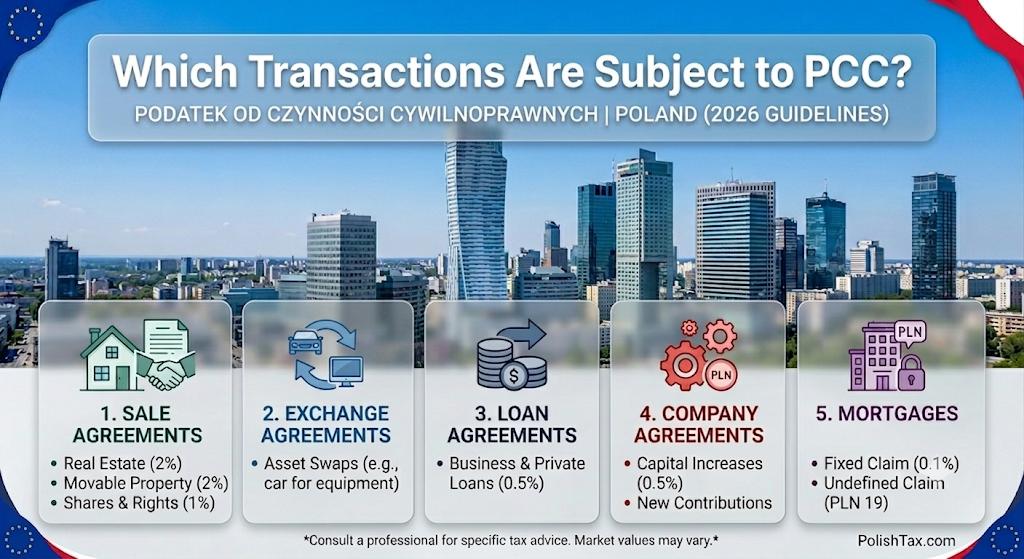
Sale Agreements
PCC commonly applies to sales of:
-
real estate,
-
movable property,
-
shares,
-
partnership interests,
-
receivables and other property rights.
Exchange Agreements
Asset swaps and exchanges may also trigger PCC.
The tax base is generally determined by reference to the property or right that results in the higher tax liability.
Loan Agreements
Loan agreements are expressly taxable under the PCC Act.
Unless a statutory exemption applies, PCC is generally calculated on the amount of the loan.
Company Agreements and Capital Increases
PCC may apply to:
-
incorporation of companies,
-
increases of share capital,
-
increases of partnership contributions,
-
additional payments made by shareholders,
-
certain restructuring events.
Mortgages
PCC also applies to the establishment of a mortgage:
-
mortgages securing a fixed claim,
-
mortgages securing an undefined claim.
Other Taxable Transactions
The Act additionally covers selected transactions such as:
-
life annuity agreements,
-
partition of inheritance involving equalisation payments,
-
division of co-ownership involving compensation,
-
paid usufruct rights,
-
paid easements,
-
irregular deposits.
Cross-Border Transactions
PCC can apply even where a transaction is executed outside Poland.
The tax may arise when:
-
the asset is located in Poland,
-
the property right is exercised in Poland,
-
or, in certain situations, the purchaser is resident or established in Poland and the transaction is concluded in Poland.
Cross-border share transactions therefore require a dedicated PCC analysis.
PCC Tax Rates in Poland (2026)
|
Transaction |
PCC Rate |
Tax Base |
|
Sale of real estate |
2% |
Market value |
|
Sale of movable property |
2% |
Market value |
|
Sale of shares and other property rights |
1% |
Market value |
|
Loan agreement |
0.5% |
Loan amount |
|
Company agreement / capital increase |
0.5% |
Contribution or capital value |
|
Mortgage securing a fixed claim |
0.1% |
Secured amount |
|
Mortgage securing an undefined claim |
PLN 19 |
Flat fee |
A critical point is that the tax authority may challenge an undervalued tax base and determine market value using an expert valuation.
The PCC vs VAT Rule
General Principle
As a general rule, PCC does not apply where at least one party is subject to VAT or VAT exemption in relation to the specific transaction.
However, this rule is frequently misunderstood.
The question is not whether a seller is generally a VAT taxpayer. The relevant issue is whether the particular transaction falls within the VAT regime in a way that triggers the PCC exclusion.
Real Estate Transactions
A purchase of a newly developed property from a developer is typically subject to VAT.
As a result, PCC usually does not arise.
A purchase of residential property from a private individual is generally not subject to VAT and therefore may trigger PCC at 2%.
For a broader overview of property taxes in Poland, including real estate tax (RET) and income from rentals, see our guide: https://polishtax.com/information/property-taxes-poland/
Share Transactions
Sales of shares and stock are generally subject to PCC at 1%.
The VAT exclusion should never be assumed automatically in M&A transactions.
Large share acquisitions should always include a separate PCC review.
PCC Exemptions
The PCC Act contains numerous exemptions.
The most relevant include the following.
Sale of Movable Property up to PLN 1,000
No PCC applies where the tax base does not exceed PLN 1,000.
Family Loans
Various exemptions apply to loans granted between close family members.
Many of these exemptions require compliance with formal reporting and documentation requirements.
Certain Company-Related Transactions
The Act provides several exemptions for selected corporate transactions.
For example, loans granted to capital companies by their shareholders are generally exempt from PCC.
Transactions Covered by VAT Exclusion
Where a transaction qualifies for the statutory VAT-based exclusion, PCC is generally not payable.
First Home Exemption and 6% Residential Property Tax
First Home PCC Exemption
Individuals purchasing their first residential property on the secondary market may qualify for a full PCC exemption under Article 9(17) of the PCC Act. The exemption applies to qualifying acquisitions of residential apartments, single-family houses and certain cooperative housing rights, provided the statutory ownership conditions are satisfied. The exemption may apply to:
-
residential apartments,
-
single-family houses,
-
certain cooperative ownership rights.
The statutory conditions should be reviewed carefully before relying on the exemption.
6% PCC on Certain Multiple Residential Purchases
Polish law introduced a special 6% PCC rate in selected situations involving acquisitions of multiple residential units.
The rule may apply where a purchaser acquires the sixth and subsequent residential units in the same development under conditions specified by the PCC Act.
Because these provisions are highly technical, developers, investment funds and institutional investors should obtain transaction-specific advice.
Who Pays PCC and When?
Taxpayer
In practice, PCC is usually paid by:
-
the buyer in a sale transaction,
-
the borrower in a loan transaction,
-
the company in certain capital transactions,
-
both parties in selected transactions specified by law.
Filing Deadline
The taxpayer generally must:
-
file the PCC return,
-
pay the tax,
within 14 days from the date the tax obligation arises.
PCC-3 Form
Most filings are made using:
-
PCC-3,
-
PCC-3/A (where additional parties must be reported).
Notary as Tax Remitter
Where a transaction is executed in the form of a notarial deed, the notary generally collects and remits PCC.
This commonly occurs in real estate transactions.
PCC for Foreign Investors
Foreign investors often assume that residence determines whether PCC applies.
This is not correct.
The key factor is the Polish connection of the asset or property right.
Examples include:
-
Polish real estate,
-
shares in Polish companies,
-
rights exercised in Poland.
Double tax treaties generally do not eliminate PCC because PCC is not an income tax.
Practical Examples
Example 1 – Purchase of a Used Apartment
Purchase price: PLN 800,000
PCC:
2% × PLN 800,000 = PLN 16,000
If the purchaser qualifies for the statutory first-home exemption, no PCC may be payable.
Example 2 – Private Loan
Loan amount: PLN 200,000
PCC:
0.5% × PLN 200,000 = PLN 1,000
The result may differ if a statutory exemption applies.
Example 3 – Share Acquisition
Market value of shares:
PLN 5,000,000
PCC:
1% × PLN 5,000,000 = PLN 50,000
FAQ
Is PCC tax deductible in Poland?
It depends on the nature of the acquired asset and the applicable CIT or PIT rules. In many cases PCC becomes part of the tax basis of the acquired asset rather than an immediately deductible expense.
Does PCC apply if a transaction is subject to VAT?
Generally no, although important statutory exceptions exist. A transaction-specific review should always be performed.
Who pays PCC when purchasing shares?
The purchaser is generally responsible for paying PCC.
Can the tax authority challenge the declared value?
Yes. If the declared value differs from market value, the tax authority may appoint an independent expert.
Is PCC paid by the buyer or by the notary?
In notarised transactions the notary generally acts as tax remitter. In other cases the taxpayer usually files and pays directly.
Conclusion
Although PCC is often viewed as a relatively simple transfer tax, the practical rules are far more nuanced.
The tax consequences frequently depend on:
-
the exact transaction structure,
-
the VAT treatment,
-
statutory exemptions,
-
valuation issues,
-
and special rules applicable to residential real estate.
For foreign investors, M&A teams, CFOs and real estate buyers, PCC should be reviewed early in the transaction process to avoid unexpected tax costs and compliance risks.
If you need support with PCC compliance in Poland, our tax advisors are available to assist: Tax consultancy services.