

Executive Summary
To be valid in Poland (and KSeF-ready from 1 February/1 April 2026 only for taxpayers established in Poland—seat in Poland or a Polish fixed establishment; non-established VAT registrants are outside the mandate), an invoice must meet Article 106e VAT Act requirements (date, sequential/unique number, seller & buyer details incl. NIP where applicable, description/quantity, unit price, net, VAT rate, VAT amount in PLN, gross, dates, payment method, etc.). If you bill in EUR/USD, convert VAT to PLN using the NBP/ECB average rate from the business day before the tax point—or the day before the invoice date if issued earlier. Add required annotations such as “MPP” (Split Payment) and “reverse charge” where legally needed. Mismatches between date of supply and invoice date, missing NIP, wrong exchange rate or no PLN VAT amount are the most frequent errors causing deductions to be challenged.
Invoicing in foreign currency rules
Polish invoices may show invoice total in EUR/USD or any currency, but VAT must be expressed in PLN. You can use the NBP average exchange rate or the ECB rate (converted via EUR) per statute.
VAT amount in PLN calculation
- If the tax point already occurred: use the average rate from the day preceding the tax point.
- If you issue the invoice before the tax point: use the average rate from the day preceding the invoice date.
- For advance invoices (prepayments), the same rule applies to the advance tax point.
Tip: Store the exchange rate table printout (NBP or ECB) used for conversion in your audit file.
Date of supply vs invoice date
These two dates often differ. Always show the date of supply/performance when it does not match the invoice issue date. For continuous supplies (e.g., monthly services), the tax point may be the end of the settlement period; align your exchange rate accordingly.
Reverse charge mechanism annotation
Use “reverse charge” where the buyer accounts for VAT (e.g., import of services into Poland under the general B2B place‑of‑supply rule; selected cross‑border goods/services). Do not apply domestic reverse charge for standard Polish‑to‑Polish supplies (it was broadly phased out). Your invoice should then omit Polish VAT and include the buyer’s VAT ID plus the “reverse charge” notation and legal basis.
Split Payment Mechanism (MPP) obligations
If your invoice includes items from Annex 15 and the gross total ≥ PLN 15,000 (or foreign‑currency equivalent), the invoice must carry the “mechanizm podzielonej płatności” (MPP) annotation. Buyers will pay via bank split payment, sending the VAT portion to the supplier’s VAT sub‑account. For other invoices, MPP is voluntary but often used as a risk‑mitigation tool.
Practical inclusions on the invoice: “Payment method: bank transfer (MPP)” + supplier’s Polish bank account number registered on the White List.
KSeF for foreign vendors explained
KSeF is Poland’s structured e-invoicing platform using an XML FA schema. Key points for foreign vendors:
- Scope: From 1 Feb/April 2026, the KSeF mandate applies to taxpayers established in Poland—entities with their registered seat in Poland or a Polish fixed establishment (FE) that participates in the supply. VAT-registered entities without a Polish FE are outside the mandate (they may use KSeF voluntarily).
- Foreign counterparties:
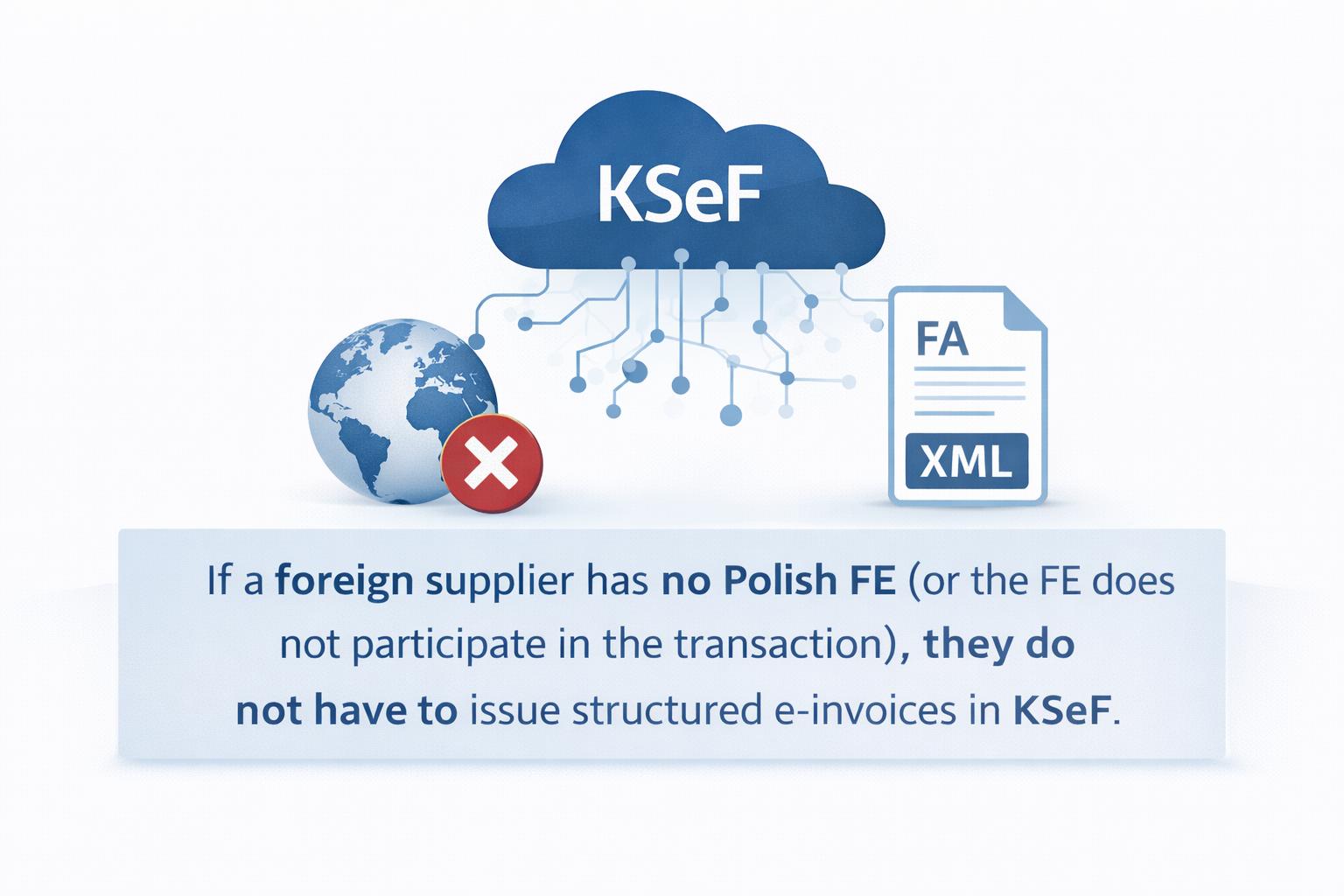
- No mandate for non-established suppliers. If a foreign supplier has no Polish FE (or the FE does not participate in the transaction), they do not have to issue structured e-invoices in KSeF.
- Imports of goods/services (invoices from abroad) do not go to KSeF.Polish businesses book such invoices outside KSeF, as before.
- Invoices to foreign customers (exports). Polish companies generate invoices in KSeF, but deliver them to foreign buyers in the agreed form (e.g., PDF/EDI), not via KSeF’s delivery mechanism.
- Voluntary access. Foreign entities may opt in to KSeF (e.g., for process standardisation), but it is not mandatory if they are not established in Poland.
- Access & authorization: authentication with qualified e-signature/seal, trusted profile or KSeF token; rights can be delegated to staff/advisors.
- Numbering: KSeF assigns a unique identification number (in addition to your internal sequential number).
- Fallback: documented outage procedures apply—retain the XML/PDF and submit once access is restored.
Correcting invoice vs credit note in Poland
- Corrective invoice (faktura korygująca): issued by the seller to fix value‑affecting items (price, quantity, VAT rate) or material data. Include the reason for correction, reference to the original invoice number and date, and adjusted figures.
- Correction note (nota korygująca): issued by the buyer to amend formal errors (e.g., typo in address) not affecting tax base/VAT amount—requires seller acceptance.
- Credit note is the commercial term often used for a decreasing correction. For increasing corrections, issue a debit note (also a corrective invoice in VAT terms). In Polish both are named as Faktura korygująca.
In KSeF, both types are sent as structured documents (with a link to the original KSeF ID).
Consequences of defective invoices
Frequent effects include:
- Delayed or denied input VAT deduction until irregularities are fixed (e.g., no buyer NIP for B2B, missing VAT in PLN, wrong VAT rate without reverse charge where applicable).
- Additional liability risk (Art. 108 VAT Act) if VAT was unduly shown on an invoice; requires correction.
- Income tax costs at risk if payment goes to a bank account outside the White List for transactions ≥ PLN 15,000 (unless exceptions are met or MPP is used).
- Administrative penalties in severe misstatements and increased audit attention for recurring formal errors.
White List of VAT payers verification
Before paying invoices ≥ PLN 15,000, verify the supplier’s bank account on the Ministry of Finance White List. Record the check ID/timestamp. If the account is not listed, either:
- request an updated invoice with a listed account,
- pay using Split Payment (MPP), or
- file a notification to your tax office on the same day (safe‑harbor rules), where available.
Self-billing in Poland
Self‑billing (samofakturowanie) is allowed with a prior written agreement between buyer and seller, explicit acceptance procedure, and the “self‑billing” notation on each invoice. From 1 Feb/April 2026, where the supplier is established in Poland (seat or Polish FE involved), self‑billing invoices are generally submitted via KSeF; buyers need appropriate KSeF authorizations granted by the supplier. If the supplier holds only a Polish VAT registration without a Polish FE, KSeF use remains voluntary.
Electronic invoicing standards – structured XML
Polish structured invoices use FA XML (e.g., FA(2) schema). Keep the following electronic invoicing standards in mind:
- UTF‑8 text, no images embedded in fiscal fields.
- Correct codes (e.g., GTU, VAT rates, country codes, measure units).
- Provide buyer’s identifiers (NIP/EU VAT) in the correct fields; errors cause KSeF rejection.
- Maintain internal mapping between ERP fields and FA XML to avoid missing required tags.
Typical pitfalls & quick fixes
- Totals only in EUR/USD → add VAT in PLN using the correct preceding‑day rate.
- Wrong date of supply → update and, if it changes tax point, recalculate exchange rate.
- No MPP annotation where Annex 15 + ≥ PLN 15,000 → issue a corrective invoice with “MPP”.
- Payment to non‑White‑List account → use MPP or notify tax office the same day.
- “Reverse charge” used for domestic supply → remove; apply standard VAT or relevant exemption.
FAQ
What exchange rate should I use if I issue the invoice before the service is delivered?
Use the average NBP/ECB rate from the business day before the invoice date; once the tax point arrives, no second conversion is needed.
Do I need a Polish bank account?
Not legally for every case, but mandatory MPP and White List practice make a Polish bank account highly advisable for domestic B2B.
Can I put only the invoice total in EUR?
Yes, but VAT must be shown in PLN on the face of the invoice.
How do I handle a price reduction after issuance?
Issue a credit note (decreasing corrective invoice, faktura korygująca) with the reason (e.g., discount, return) and reference to the original.