
VAT Refund under Polish VAT Law
Executive Summary
In this article, you’ll learn about the basic and shortened VAT refund deadlines for VAT payers. We also discuss practical aspects of each deadline. The FAQ section will help you learn about the most common questions VAT payers in Poland have.
VAT Refund Deadlines for Registered Taxpayers
In Poland, the length of time within which the tax office must refund excess input VAT depends on several factors — including compliance with statutory conditions, the method of invoicing, and the taxpayer’s payment practices.
Current refund timelines available to registered VAT taxpayers include:
15 days — online cash registers, 80% cashless, PLN 40 000 turnover
A VAT refund within 15 calendar days is available under a preferential fast-track regime. To qualify for this shortest deadline, a registered taxpayer must meet all statutory conditions related to:
- the use of online cash registers,
- a minimum 80% cashless sales share,
- minimum turnover thresholds and payment documentation,
- compliance with payment and filing requirements.
This accelerated 15-day refund is counted from the due date for filing the JPK_V7 VAT return showing the excess of input over output VAT (or from the date of a timely correction).
25 days — split payment VAT account + conditions of Art. 87(6)
A 25-day refund timeline applies to taxpayers who meet the statutory requirements under Article 87(6) of the Polish VAT Act. This accelerated track generally requires that input tax arises mainly from invoices fully settled via a bank account (or within statutory limits for other payments) and that supporting evidence is submitted. This refund is typically paid into the VAT account unless otherwise permitted.
40 days — KSeF e-invoicing (from 2026 standard instead of 60 days)
A 40-day refund period will become increasingly common with the wider adoption of KSeF structured e-invoices. Under planned changes aligned with mandatory KSeF use in 2026, this term may replace the present 60-day standard period for qualifying taxpayers issuing e-invoices through the national KSeF system.
60 days — current standard (until full KSeF rollout)
The basic VAT refund deadline currently remains 60 calendar days from the date of filing a correct VAT return showing excess input VAT over output VAT. During this period, the tax office may verify compliance before refunding the amount.
180 days — no taxable sales; security shortens to 60
In cases where the taxpayer has no taxable sales in the period (thus no output VAT) and only incurred input VAT, the refund period may be extended to up to 180 days to allow for additional verification by the tax office. However, if the taxpayer provides appropriate security (e.g., bank guarantee or bill of exchange), the extended period may be shortened to 60 days.
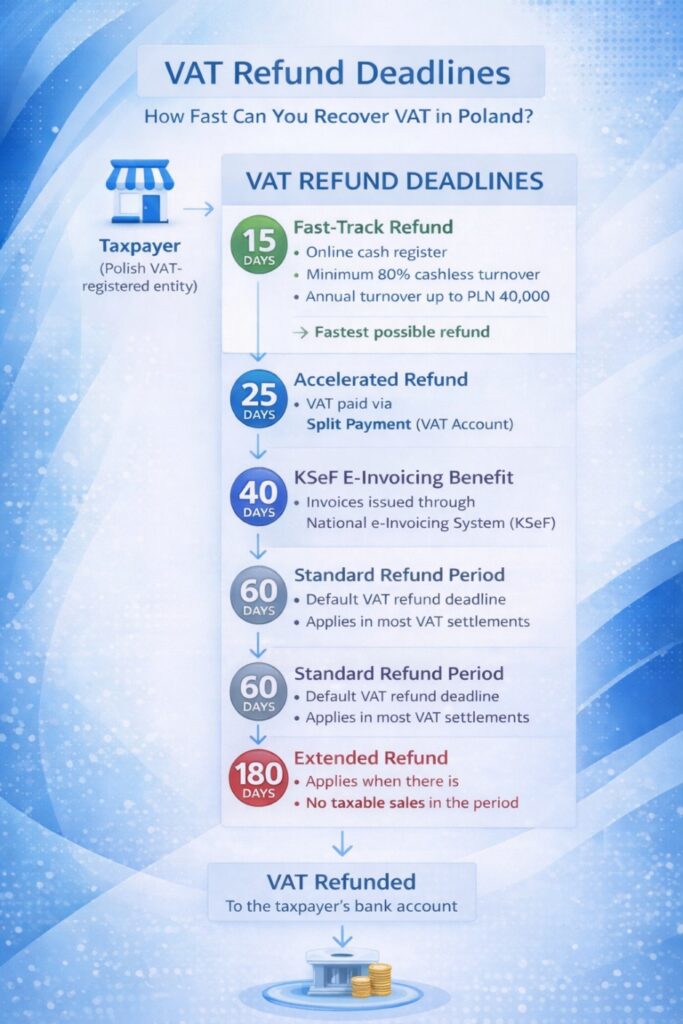
Comparative Table of VAT Refund Deadlines and Conditions
| Refund Term | Deadline | Key Conditions |
| 15 days | 15 calendar days | Online cash registers, ≥80% cashless sales, specified turnover & compliance |
| 25 days | 25 calendar days | Split payment VAT account + statutory conditions under Art. 87(6) |
| 40 days | 40 calendar days | Structured e-invoices via KSeF (from April 2026) |
| 60 days | 60 calendar days | Standard refund timeline (current general rule) |
| Up to 180 days | 180 calendar days | No taxable sales; extended verification |
(*Note: actual deadlines begin from the date of filing the correct JPK_V7 VAT return or — for 15-day track — from the filing due date.)
Practical Aspects
Bank Account in Poland — When is it Required and When Not
Refunds of Polish VAT are normally credited to a bank account. For accelerated refunds (15/25/40 days), the account must meet statutory requirements (e.g., domestic bank or SKOK account included in the VAT payer white list). The appropriate account details must be correctly reported as part of the filing.
Possibility of Extending the Deadline for Audit
The tax office may extend any refund deadline if additional verification or audit procedures are necessary. Official extension notices are typically issued before the initial term expires.
Bank Guarantee / Bill of Exchange — When Required
In cases where the standard 60-day term is extended (e.g., 180-day scenario), taxpayers may be asked to provide security such as a bank guarantee or bill of exchange to support earlier settlement, which may help shorten the refund period.
Impact of KSeF on Refunds from 2026
The introduction of mandatory KSeF-based structured invoicing across all taxpayers will simplify documentation and is expected to make the 40-day refund term more widely applicable, gradually replacing the 60-day standard term.
FAQ
How long does it take to get a VAT refund in Poland?
VAT Refund Deadlines in Poland (as of 2026)
- 60 days (Standard period)
- 40 days (KSeF shortened period)
- 25 days (Accelerated period)
- 15 days (Preferential period)
- 180 days (Extended period)
Do I need a Polish bank account to receive a VAT refund?
If your company is registered as an active VAT taxpayer in Poland and files periodic returns (e.g., JPK_V7), a Polish bank account is mandatory.
For EU-based businesses that are not registered for VAT in Poland the refund can be paid into your bank account in another EU country.
Can a non-EU company get a VAT refund in Poland?
Yes, a non-EU company can apply for a VAT refund in Poland, but the procedure (based on the Thirteenth VAT Directive) is more stringent than for EU companies. Detailed information on this topic can be found here.
What is the deadline to apply for a VAT refund in Poland?
For VAT-registered taxpayers in Poland, the standard refund deadlines are:
- 60 days: The standard period from the date of filing the tax return (JPK_V7).
- 25 days: Accelerated period if the refund is made to a dedicated VAT account (Split Payment) or if specific payment conditions are met.
- 15 days: For “cashless taxpayers” meeting high thresholds of electronic sales.
- 40 days: The new default for users of the mandatory KSeF e-invoicing system (starting 2026).
- 180 days: If no taxable sales were recorded in the period.
Can the Polish tax office extend the VAT refund deadline?
Yes, the Polish tax office (Urząd Skarbowy) can extend the deadline if they decide that the refund requires further verification.
What is the difference between the 25-day and the 40-day VAT refund?
40-Day Refund is the new standard refund period (replacing the previous 60-day term). It is primarily available to taxpayers who issue structured e-invoices through the National e-Invoice System (KSeF). 25-Day Refund is an expedited deadline available to taxpayers who meet stricter conditions
Can I carry forward my VAT surplus instead of claiming a refund?
Yes, you can absolutely carry forward your VAT surplus to the next settlement period instead of claiming a refund. Carrying forward the surplus is the default option in the VAT return. You only receive a refund if you specifically request.
My company made only reverse-charge supplies in Poland — can I still use the 8th Directive refund?
Yes, you can generally still use the 8th Directive refund procedure (VAT-REF) even if you made supplies in Poland, provided those supplies were exclusively subject to the reverse charge mechanism.
How does KSeF affect VAT refund timelines from 2026?
The introduction of the KSeF (National System for e-Invoices) system from 2026 primarily shortens the basic VAT refund deadline by one-third. From February 2026, the basic refund deadline will be shortened from 60 to 40 days for taxpayers using structured e-invoices.