

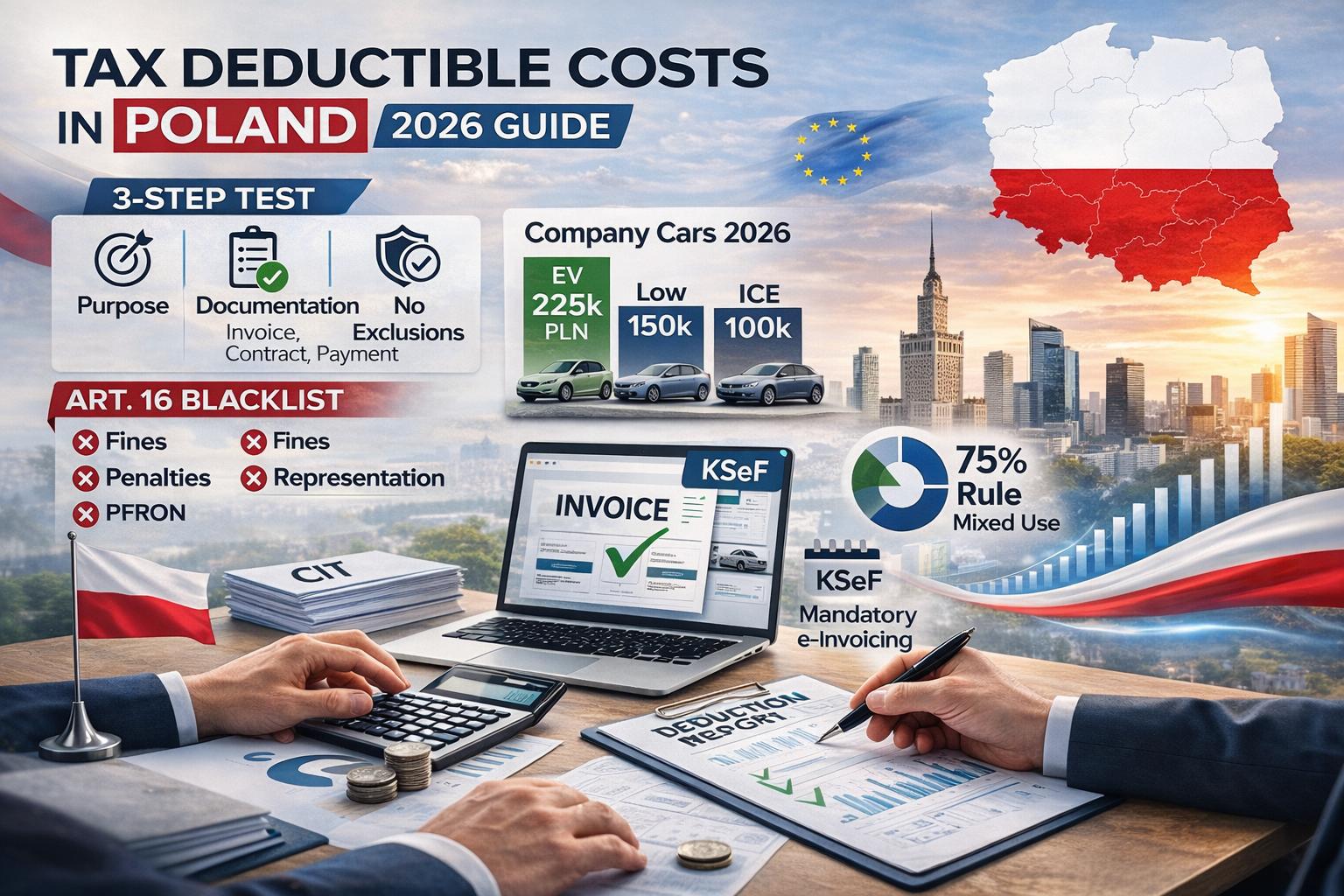
Executive Summary
In Poland, you can recognize a cost as tax-deductible if it is incurred to earn income or secure the source of income, properly documented, and not excluded by law. For companies, this follows Art. 15(1) of the Corporate Income Tax (CIT) Act and the exclusions in Art. 16(1).
What are Tax Deductible Costs (KUP) in Poland?
For CIT taxpayers (e.g., sp. z o.o.), the legal starting point is Art. 15(1) CIT: tax-deductible costs are expenses incurred to earn revenue or to preserve/secure a source of revenue, except for those listed in Art. 16(1) CIT.
https://isap.sejm.gov.pl/isap.nsf/download.xsp/WDU19920210086/U/D19920086Lj.pdf
For PIT (sole traders/individuals) the equivalent rule is Art. 22(1) PIT with exclusions mainly in Art. 23 PIT.
https://isap.sejm.gov.pl/isap.nsf/download.xsp/WDU19910800350/U/D19910350Lj.pdf
The 3-step “deductibility test” (practical)
1) Business purpose test
- Can you show a rational link between the expense and generating revenue (or protecting the business)?
- The link can be indirect (e.g., accounting services), but must be real and defensible.
2) Documentation test
- Do you have an invoice/contract/acceptance protocol, proof of performance, and (often) proof of payment?
- For cross-border or services, add evidence that the service was actually delivered (scope, deliverables, emails, reports).
3) Exclusions (“blacklist”) test
- Even a business-related cost may be disallowed if it falls into Art. 16(1) CIT exclusions.
Direct vs. Indirect Business Expenses
Polish CIT practice distinguishes:
Direct costs (matched to revenue)
Typical examples:
- purchase cost of goods sold,
- subcontractor costs for a specific project,
- production materials for sold products.
Timing rule: generally deducted in the tax year when the related revenue is recognized (matching principle). (Biznes.gov.pl)
Indirect costs (overheads)
Examples:
- rent, utilities, accounting, legal, HR,
- general marketing/ads,
- management costs.
Timing rule: generally deducted when incurred (with spreading if they relate to periods longer than the tax year).
The “Blacklist”: Non-Deductible Expenses (Art. 16 CIT)
Below are high-risk categories where foreign-owned companies most often get adjustments.
1) Representation (vs advertising)
Representation is a classic dispute area. In practice, the tax risk is highest for:
- business lunches/dinners in restaurants,
- alcohol,
- gifts with “prestige” character.
Key principle: advertising/promotional spending aimed at generating sales is easier to defend than “image/prestige” spending. (The line is fact-dependent and case-law driven.)
Expert tip:
Coffee/tea/water for employees in the office may be typically a normal operating cost however there are different tax rulings in this area.
Lunch with a client in a restaurant may be challenged as representation depending on the circumstances and how it’s presented/documented. (If it’s a standard meeting with modest value and clear business agenda, the risk is lower—but not zero.)
2) Penalties, fines, and late-payment interest
Commonly non-deductible:
- fines and penalties imposed by authorities,
- late-payment interest on tax arrears (as a rule),
- many contractual penalties (but some cases are litigated and fact-specific).
3) PFRON contributions (disability fund payments)
Payments to PFRON are generally treated as non-deductible (CIT Act exclusions are commonly cited in practice and guidance).
Company Car Expenses in 2026 (Table)
This section matters because car policies often create silent tax leakage.
2026 passenger car caps (depreciation / leasing type costs)
From 1 January 2026, Poland applies CO₂-based deductibility caps for passenger cars (purchased and typically mirrored in leasing/rental cost limits in practice guidance).
| Passenger car category (2026) | Typical cap for tax-deductible depreciation / similar base | Notes |
| Zero-emission (EV / hydrogen) | PLN 225,000 | Most favorable |
| Low-emission (< 50 g CO₂/km) | PLN 150,000 | Limited number of models qualify |
| ≥ 50 g CO₂/km (most ICE / hybrids) | PLN 100,000 | Less favorable from 2026. |
Operating costs: the “75% rule” (mixed use)
For a passenger car used both business and privately, only 75% of operating expenses (fuel, repairs, service, parking, etc.) is typically deductible for income tax purposes. Full deductibility requires conditions for exclusive business use (including proper records).
Practical CFO checklist (cars):
- define “business only” vs “mixed use” in policy,
- maintain logs/controls if claiming 100%,
- track vehicle CO₂ category for 2026 caps,
- align accounting entries with tax limits early (avoid year-end surprises).
Depreciation (Amortization) of Assets
In Poland, many capex items are not deducted immediately; they are deducted via tax depreciation (amortization). Depreciation write-offs are generally tax-deductible if the asset is used for business and properly recorded.
Typical rates CFOs see in practice (examples)
- Buildings (standard): 2.5% (common baseline; special regimes may apply)
- Passenger cars: 20% (subject to the car caps discussed above)
- Computers/IT: often 30% in practice tables (classification-dependent)
Because rates depend on the asset classification (KŚT) and specific facts, treat the above as indicative and confirm against your fixed-asset register classification and current rules.
One-off depreciation (small taxpayers / new businesses)
Small taxpayers and some new businesses can use one-time depreciation (de minimis aid), commonly referenced as up to EUR 50,000 per year, for eligible asset groups (excluding passenger cars).
Debt Financing & Interest Limitation Rules
Poland applies an “interest limitation” style rule for debt financing costs (often called thin capitalization / EBITDA limitation in business language).
A common rule of thumb in practice guidance: debt financing costs are deductible only up to a threshold tied to PLN 3 million and 30% of tax EBITDA, with detailed mechanics in the CIT Act and interpretations.
CFO warning: group financing structures (intra-group loans, cash pooling, guarantee fees) should be tested early—limitations can create unexpected permanent tax costs.
Mandatory KSeF (2026) and Cost Documentation
What is changing
Poland is rolling out mandatory structured e-invoicing via KSeF with a staged start in 2026:
- 1 Feb 2026: large taxpayers (commonly described as sales > PLN 200m)
- 1 Apr 2026: most other VAT taxpayers
- Government implementation materials and certificates/offline modes are published on official portals. (Gov.pl)
Why it matters for tax-deductible costs
Income tax deductibility rests heavily on reliable evidence of the transaction. In a world where B2B invoices are expected to flow through KSeF, missing or incorrect invoicing (or invoices rejected by the system) can materially increase the risk that:
- the expense is questioned as insufficiently documented, and/or
- VAT settlement is challenged (which often triggers a broader audit).
KSeF guidance indicates that if an invoice cannot be issued in KSeF due to system failure, specific contingency procedures apply; invoices issued “otherwise” in some circumstances may not be treated as valid KSeF invoices. (Krajowy System e-Faktur)
Best practice (2026):
- require KSeF invoice number / verification step in AP workflow,
- ensure purchase invoices contain correct buyer identifiers (NIP, address),
- keep proof of delivery/performance for services (especially cross-border),
- align split payment / “white list” style controls where applicable (risk management approach referenced in market guidance).
FAQ
Is an integration party (team event) tax-deductible?
Often yes if it has a clear HR/business purpose (employee integration, retention), is reasonable in value, and documented (agenda, participant list, invoice). Risk increases with luxury venues/alcohol-heavy format (representation angle).
Can I deduct home office costs in Poland?
Possible, but documentation and business rationale matter (employment/B2B setup, internal policies, allocation keys). For cross-border groups, align HR and payroll treatment with tax position.
Are gifts for clients deductible?
Small promotional items branded for marketing are usually safer than expensive gifts. Gifts that look like prestige-building can be treated as representation and challenged.
Are contractual penalties ever deductible?
Some are disallowed under exclusions; however, court practice shows the outcome can be fact-specific (cause of penalty, relationship to revenue, and statutory wording). Treat as high risk and document thoroughly.
If I don’t have a KSeF invoice, can the tax office deny the cost?
They can challenge costs that are not properly documented. With KSeF becoming mandatory in 2026, invoice compliance will become a central part of “proper documentation” in B2B. Follow KSeF rules and keep supporting evidence.