

Executive Summary
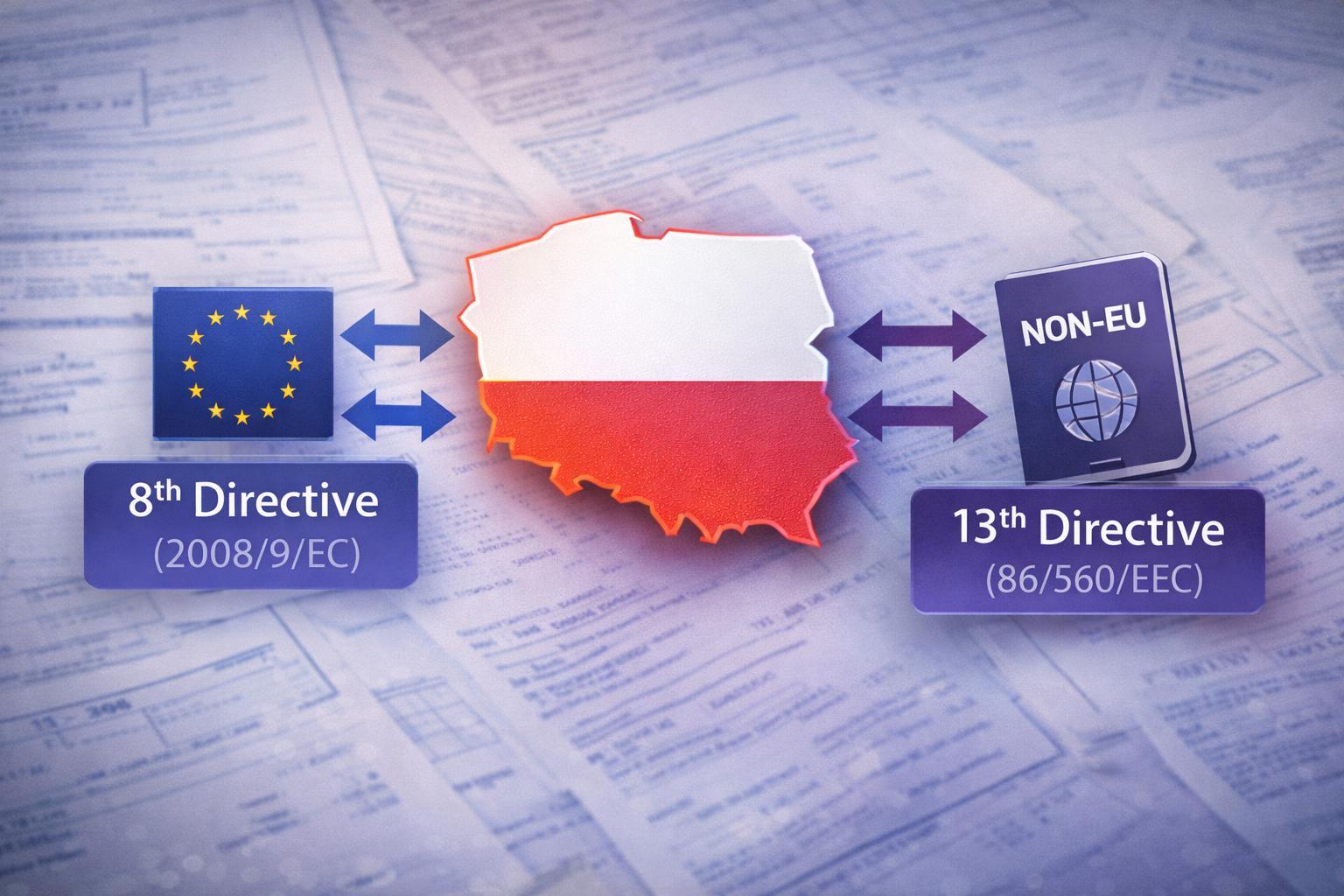
Foreign businesses can reclaim Polish VAT generally if they do not make taxable supplies in Poland. EU companies file an electronic VAT‑REF claim through their home tax portal. Non‑EU entities file under the 13th Directive with the Second Tax Office Warszawa‑Śródmieście and must meet Poland’s reciprocity requirement. Keep original invoices, respect the 30 September deadline, and expect follow‑up queries before refund.
Why VAT refunds matter for cash‑flow
For many exporters, distributors and service providers, Polish input VAT on fuel, tolls or exhibition costs can accumulate into meaningful sums. Structured refund routines improve working capital and reduce price leakage. This guide explains how to recover VAT in Poland efficiently and avoid the common pitfalls that trigger rejections or delays.
VAT refund in Poland for foreign companies (overview)
Two legal paths exist, depending on where you are established:
1) VAT refund in Poland for foreign companies (EU) — VAT‑REF procedure explained
- Who? Businesses established in another EU Member State that are not VAT‑registered in Poland and do not make taxable supplies there.
- How? Submit a VAT‑REF application via your national electronic portal (the claim is forwarded to Poland). Attach invoice data and, where required, scans of invoices for sensitive categories. Poland processes the claim after a formal intake.
- Deadline: 30 September of the year following the refund period (e.g., 2025 expenses → claim by 30 September 2026).
- Refund account: provide an IBAN and swift/BIC; refunds are wired in PLN or, where allowed, in another currency at the office’s discretion.
2) 13th Directive VAT refund for non‑EU entities
- Who? Businesses established outside the EU that are not registered and do not have fixed establishment in Poland.
- Competent office: Head of the Second Tax Office Warszawa‑Śródmieście.
- Reciprocity principle Poland: refunds are granted if the claimant’s country offers comparable refunds to Polish businesses (e.g., Norway, Switzerland, UK currently recognized). Always verify the current list.
- How? Submit a paper/electronic dossier (depending on representation) with original invoices, a certificate of taxable status issued by the home authority, bank details and a power of attorney if represented.
- Deadline: also 30 September for prior‑year costs.
Time limits for VAT refund and claim periods
- Claim period: minimum 3 months, maximum full calendar year. Shorter periods are allowed if the remainder of the year is shorter than three months.
- Monetary thresholds: for short periods, the minimum reclaim value applies (as published for the year); for a full year, a lower threshold applies. Plan submissions to avoid falling below thresholds.
- Processing time: the office aims to decide within the statutory period, which may be extended when tax authority queries are issued. Reply promptly to avoid stoppage.
Key deadlines & amounts (at a glance)
| Item | EU (VAT‑REF) | Non‑EU (13th Directive) | Notes |
| Annual filing deadline | 30 September (following year) | 30 September (following year) | Late filing → rejection risk |
| Claim period | 3 months – 12 months | 3 months – 12 months | Year‑end short periods allowed |
| Competent authority | Filed via home portal → forwarded to Poland | Head of Second Tax Office Warszawa‑Śródmieście | Reciprocity applies for non‑EU |
| Dossier essentials | Invoices (scans where required) | Original invoices + certificate of taxable status | Keep for audit; match bank account name |
Eligible expenses for VAT recovery
- Fuel & road costs: VAT on fuel, toll charges and road taxes can be recovered within Polish limits. For passenger cars, input VAT is typically 50% deductible unless the vehicle is used exclusively for business and properly documented (mileage/usage rules).
- Repairs, parts, tools and sometimes services connected with business trips or operations in Poland.
- Trade fairs and exhibitions: stand rentals, utilities and related services are commonly eligible.
- Telecoms, professional services connected to Polish business activities.
Quick reference table: expense eligibility & limits (Poland)
| Expense category | Eligible via VAT‑REF / 13th? | Polish deductibility / limits | Evidence to keep |
| Fuel for passenger cars | Yes | 50% input VAT (unless 100% business‑use with logs & policy) | VAT invoice with plate no. (if included), mileage log, car policy |
| Fuel for vans/trucks | Yes | Up to 100% if used exclusively for business | VAT invoice, vehicle docs |
| Road tolls & road taxes | Yes | Yes | Toll statements, e‑toll receipts |
| Repairs, parts, maintenance | Yes | Passenger cars: 50% | Invoice, linkage to vehicle |
| Trade fairs/exhibitions | Yes | Up to 100% | Contract, stand order, exhibitor pass |
| Professional & telecom services | Yes | Up to 100% | Contracts, usage records |
| Accommodation (hotels) | Generally No | Generally non‑deductible (narrow package exceptions – only if re‑invoiced) | Booking, explanation if part of onward supply |
| Catering/restaurant | Generally No | Non‑deductible | Invoice; only if re‑invoiced as part of package |
VAT deduction on fuel and car expenses
- Passenger cars used for both business and private purposes → 50% VAT deduction cap on the vehicle and fuel.
- 100% deduction is possible for vehicles used exclusively for business with formal logs and internal policies.
VAT refund on hotel and catering services
- Accommodation and catering are generally non‑deductible in Poland. Narrow exceptions may apply e.g. when such services form part of a single, onward‑supplied package (e.g., certain tourism services) with proper evidence.
Documents required for VAT reimbursement
Prepare a clean, audit‑proof file:
- Original invoices with Polish VAT (retain for inspection); legible scans for the electronic claim where requested.
- Certificate of taxable status from your home tax authority (for 13th Directive claims; often valid 12 months).
- Bank account for reimbursement (IBAN + BIC); match the claimant’s legal name.
- Authorisation / power of attorney for your representative (if any). Consider certified translation to Polish when required.
- Explanation schedules for sensitive items (cars, fuel, accommodation) and any pro‑rata calculation if you only make taxable supplies partly.
How to file step‑by‑step
- Confirm eligibility: no Polish VAT registration and no taxable supplies in Poland during the period.
- Collect invoices and classify by EU codes (fuel, transport, accommodation, etc.).
- Check deductibility under Polish law (50% car rule; accommodation/catering exclusions).
- Prepare the claim:
- EU businesses: submit VAT‑REF in your home portal; keep the UPO/acknowledgment.
- Non‑EU businesses: assemble the 13th Directive dossier, including certificate of status and originals.
- Monitor tax authority queries: respond within deadlines; missing responses may result in rejection or partial refunds.
- Receive refund: funds are transferred to your designated account; keep the full file for the statutory period.
Rejection of VAT refund application – typical reasons & remedies
- Late filing past 30 September.
- Taxable activity in Poland during the period (e.g., local supplies) that disqualifies VAT‑REF/13th Directive route.
- Non‑deductible expenses (accommodation, catering) or insufficient documentation for car/fuel claims.
- No reciprocity for non‑EU claimants.
What to do? You may appeal against rejection within the procedural time limits. Strengthen evidence (contracts, travel agendas, mileage logs), consider representative support, and—if your activity becomes taxable—evaluate registering for Polish VAT and recovering input VAT via the JPK_V7 return instead.
Practical tips to speed up your refund
- Use a monthly document sweep to avoid year‑end backlogs and lost invoices.
- Make VIES checks for counterparties and keep screenshots in your file.
- Keep white‑list (Biała lista) bank checks for Polish suppliers and split payment proofs where applicable—these improve the credibility of your file.